Developer Interview Questions Index is the single page that links every Salesforce developer interview post on this blog, grouped by topic and listed in study order. Bookmark it and work through it from top to bottom.
Last reviewed for the Winter ’27 release (November 2026).
The series covers foundations, data and queries, triggers and testing, asynchronous Apex, user interface, integration, security, DevOps and AI, scenario questions, and final revision.
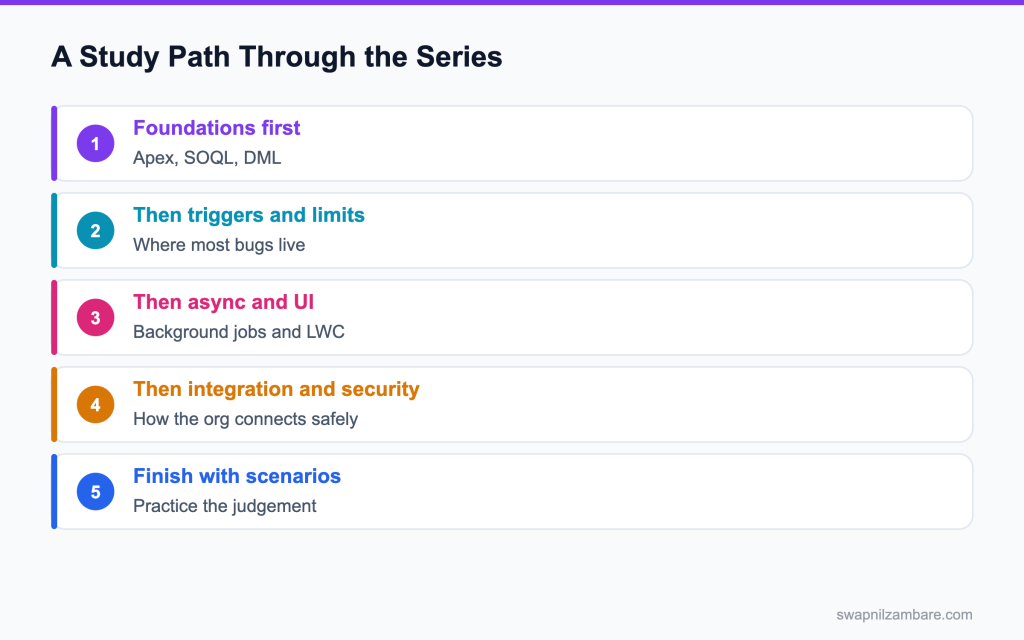
Caption: The order the posts are listed in below. Each step builds on the one before.
How to Use the Developer Interview Questions Index
Use the Developer Interview Questions Index as a checklist. Read one topic post a day, answer its questions aloud, and tick it off. Leave the scenario posts for the final two weeks, when the basics are solid.
If you are short on time, start with the two revision parts, part 1 and part 2, then go back for the topics you found hard.
New to development? The developer interview guide explains how to prepare before you start.
Topic Posts vs Scenario Posts
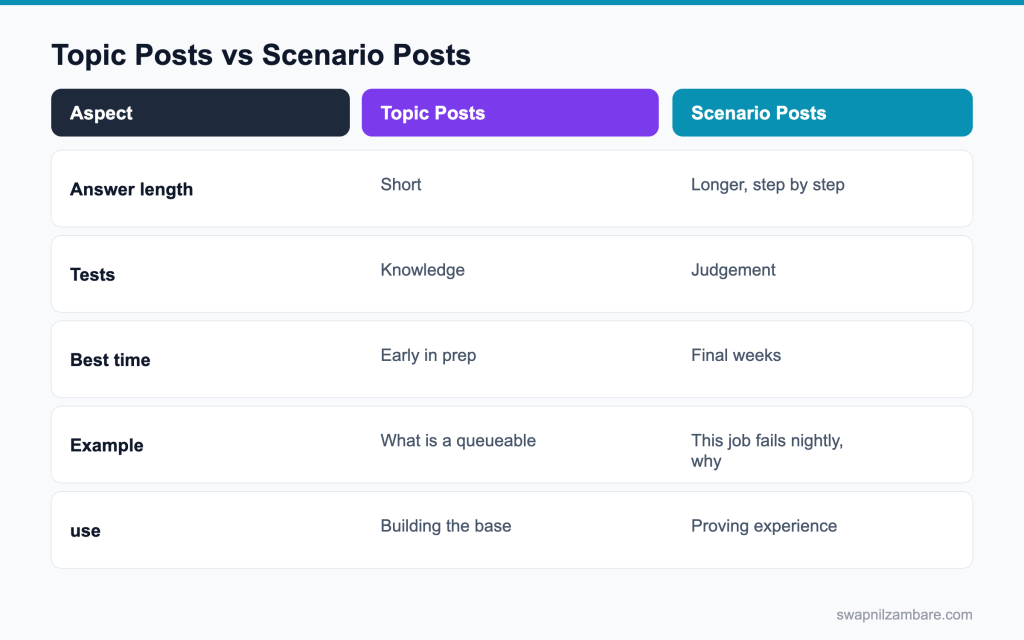
Caption: Topic posts build knowledge. Scenario posts prove you can use it.
The Full Developer Interview Questions Index
Every post below is listed in the order it is best studied.
Developer Interview Questions Index for Foundations and Apex
Start here. These posts cover how the platform works, Apex syntax, collections, classes and the patterns that keep code tidy. This part of the Developer Interview Questions Index is the base for everything after it, and nearly every first round draws from it.
Developer Interview Questions Index for Data and Queries
Next comes data. SOQL, SOSL and DML questions test whether you can read and write records safely and in bulk, and the large data posts show what changes when tables grow to millions of rows.
Developer Interview Questions Index for Triggers, Limits and Testing
Triggers are where most real bugs live, so this section of the Developer Interview Questions Index gets extra weight in interviews. Read the limits and testing posts with it, because the three topics are almost always asked together.
Asynchronous Apex and Events
Background work follows. These posts explain future methods, queueables, batch and scheduled jobs, and the event tools that let systems react without being tightly linked.
User Interface
This section covers Lightning Web Components from the first file to testing with Jest, plus the older Aura and Visualforce frameworks that many orgs still run, and public sites built on LWR.
Integration
Integration posts cover callouts, Apex REST services, the main Salesforce APIs, authentication and the patterns used to connect systems reliably.
Security
Security posts cover sharing keywords, field and object access, user mode, and secure coding. Read these before any senior or integration focused interview.
| # | Post | Questions |
|---|---|---|
| 38 | Apex Security Interview Questions: Sharing, CRUD and FLS | 77 |
| 39 | Salesforce Packaging Interview Questions with CI CD and Security Review | 55 |
DevOps, Flow and AI
These posts cover how code moves between orgs, how Flow and Apex work together, and the newer platform areas such as Agentforce and Data Cloud.
Developer Interview Questions Index for Scenario Questions
Scenario posts are for the final weeks. Each one gives a real problem and a step by step answer, and this part of the Developer Interview Questions Index is where experience shows most clearly.
Revision and Career
Finish with revision. The quick revision parts suit the day before an interview, the certification posts suit exam preparation, and the senior and architect posts suit lead roles.
Developer Interview Questions Index FAQ
Q1: Where should I start if I am new to Salesforce development?
With the foundations section, in order. Apex basics, collections and SOQL come up in every interview and everything else builds on them.
Q2: How long does it take to work through the whole series?
About six to eight weeks at one post a day, with weekends for practice in a free org.
Q3: Do I need to read every post?
For a junior role, focus on foundations, data, triggers and testing. For a mid or senior role, add async, integration, security and the scenario posts.
Q4: Which posts matter most for a first job?
Apex basics, SOQL, DML, triggers, governor limits and test classes. Those are asked in almost every first round.
Q5: Which posts matter most for a senior role?
The scenario posts, the senior developer post and the architect post, because senior rounds test judgement more than recall.
Q6: Should I memorise the answers?
No. Understand them and say them in your own words. Interviewers notice memorised answers quickly.
Q7: How do I practise speaking the answers?
Read a question, close the page, answer aloud, then compare. Recording yourself helps too.
Q8: Do I need a Salesforce org to prepare?
Yes, a free Developer Edition org. Building each feature once makes the answers far easier to give.
Q9: How do the PD1 and PD2 posts fit in?
They follow the certification style. Use them if you are taking the exam, or as extra practice if you are not.
Q10: How often is the series updated?
Posts are reviewed as Salesforce releases change features. Always check the official docs for the latest limits and commands.
Q11: What if I only have one week?
Do the two revision parts, the governor limits post, the trigger post, and two scenario posts in your role’s area.
Q12: Are the scenario answers the only right answers?
No. They show one sound way to think. Interviewers care more about your method than an exact match.
Q13: Is this index useful for admins too?
Some posts help, but admins should use the admin interview series on this blog, which is written for that role.
Q14: What should I do the night before an interview?
Revise the two quick revision parts aloud and get some sleep. Last minute cramming of new topics rarely helps.
Q15: What is the best way to show experience in an interview?
Give a real example for each answer where you can, with what happened and what you learned.
Q16: How are the posts in each section ordered?
From basic to advanced, so each post only assumes what came before it.
Q17: What is the difference between the topic posts and the scenario posts?
Topic posts test what you know with short answers. Scenario posts test what you would do, with longer answers that start from a symptom.
Q18: How many questions should I be able to answer before an interview?
Aim to answer every question in the two revision parts without notes, and most of the questions in your role’s main topics.
Q19: What should I do when I get a question wrong?
Write it down, read the related post again, then build the feature in your org. A question you have built an answer for is hard to forget.
Q20: Should I study Aura and Visualforce?
Know the basics. Many companies still run them, and interviewers often ask how you would move a page to LWC.
Q21: How much Agentforce do I need to know?
For most developer roles, how actions are built in Apex, what grounding means, and how the trust layer protects data. The Agentforce posts cover all three.
Q22: Are the governor limits in these posts current?
They were checked when each post was written. Limits rarely change, but always confirm against the official limits page before an exam.
Q23: Can I use these posts for a certification exam?
Yes, alongside the official exam guide. The PD1 and PD2 practice posts follow the exam style most closely.
Q24: What is the single most useful habit for interview prep?
Answering out loud. Knowing an answer and saying it clearly under pressure are different skills, and only practice builds the second.
Q25: Where do I report a mistake in a post?
Leave a comment on that post. Corrections are made as soon as they are confirmed.
The Developer Interview Questions Index will keep growing as new topics are added, so check back before each round of interviews.
Tips for Using This Index
| Stage | What to do |
|---|---|
| Weeks 1 to 2 | Foundations and data posts, one a day |
| Weeks 3 to 4 | Triggers, testing, async and UI posts |
| Weeks 5 to 6 | Integration, security and DevOps posts |
| Weeks 7 to 8 | Scenario posts and the revision parts |
| Day before | Quick revision parts, aloud |
Come back to this Developer Interview Questions Index whenever you finish a post, and pick the next one in order. The order matters more than speed.
Bookmark the Developer Interview Questions Index rather than individual posts. New posts and updates are added here first.
Where to Read More
Alongside the series, use the Apex developer guide, the Lightning Web Components guide, and Trailhead for hands on practice.
What’s Next?
After the developer series, the blog returns to admin topics, starting with Salesforce Scheduler. If you are just starting, open the first post in the foundations table above.