Aura Interview Questions still appear because most large orgs have Aura components in production. An interviewer asking about it wants to know whether you can maintain them and whether you can plan a sensible migration.
Last reviewed for the Winter ’27 release (November 2026).
This post covers the questions asked, grouped into the bundle and markup, attributes and expressions, events, server side controllers, and scenario questions about migration.
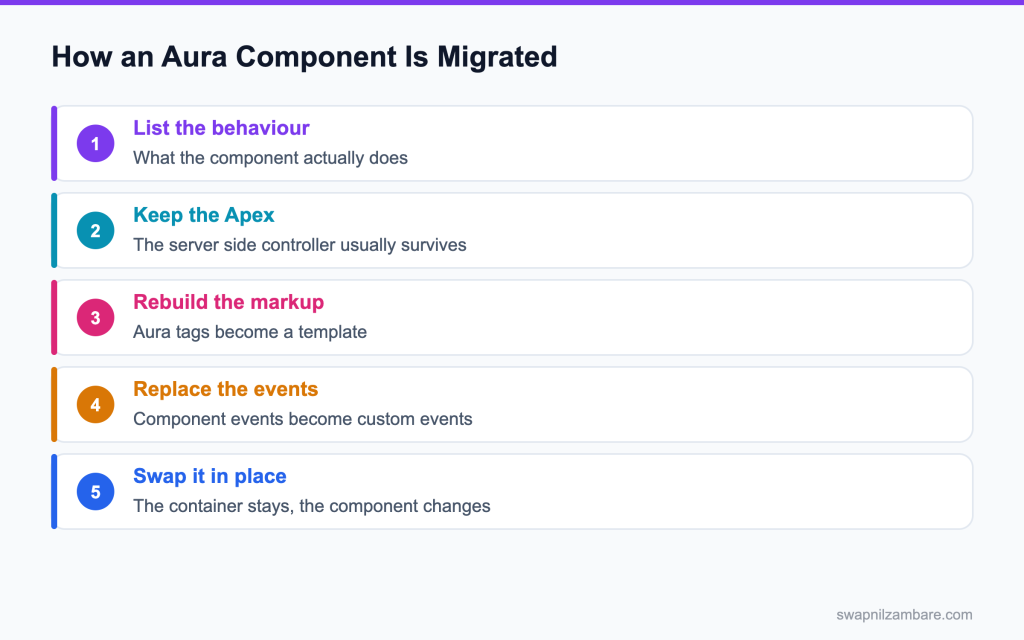
Caption: The Apex usually survives a migration, and the markup and events are what change.
What Aura Interview Questions Cover
Aura Interview Questions test whether you understand a framework built before web components existed. Aura has its own component model, its own event system and its own expression syntax.
Think of it like a house built to an older building code. The modern replacement for its event system is covered in the post on Lightning Message Service. It works, it is maintainable, and you would not build the next one the same way.
A bundle is a folder of files rather than three, and Aura Interview Questions often begin there. That alone explains several Aura Interview Questions, because each file has a specific job.
The Files in an Aura Bundle
| File | What it holds |
|---|---|
| Component or application | The markup, with aura tags |
| Controller | Client side JavaScript handlers |
| Helper | Shared JavaScript functions |
| Renderer | Custom render behaviour, rarely needed |
| Style | CSS for the component |
| Design | What App Builder can configure |
| Documentation | Example markup and description |
| SVG | The icon shown in App Builder |
<aura:component controller="CourseController">
  <aura:attribute name="courseId" type="String" />
  <aura:attribute name="fee" type="Decimal" default="0" />
  <aura:handler name="init" value="{!this}" action="{!c.doInit}" />

  <lightning:card title="Course">
    <p>{!v.fee}</p>
  </lightning:card>
</aura:component>
Three pieces of syntax carry most Aura Interview Questions. The v prefix reads an attribute, the c prefix calls a controller action, and the init handler is how a component runs code on load.
Aura vs Lightning Web Components
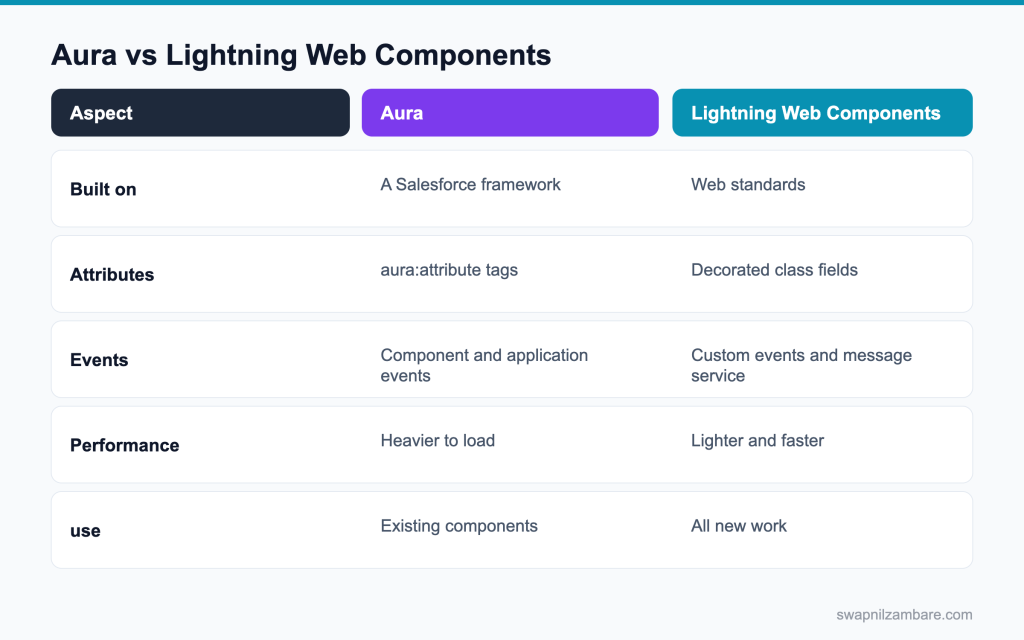
Caption: New work goes to Lightning Web Components, and Aura is maintained where it already exists.
| Concept | Aura | Lightning Web Components |
|---|---|---|
| Public property | aura:attribute with access global | api decorated field |
| Init logic | An init handler | connectedCallback |
| Child to parent | A component event | A custom event |
| Unrelated components | An application event | Lightning Message Service |
| Server call | An action with a callback | An imperative call or a wire |
Aura Interview Questions often walk down that table and ask for the equivalent on each side.
The post on Aura basics covers the framework, and the post on migrating Visualforce covers the same planning approach applied to pages.
Aura Interview Questions on Markup and Attributes
Q1: What is an Aura component?
A reusable UI unit built from a bundle of files, using Salesforce’s older Aura framework.
A bundle has a .cmp markup file, a controller.js, a helper.js and optional style, design and renderer files. Lightning Experience itself was first built on Aura.
Interview tip: list the bundle files from memory. It is a common opening question.
Q2: What is the difference between a component and an application?
An application (.app) is a standalone top level container with its own URL. A component (.cmp) is embedded in pages, apps or other components.
Most real work uses components. Applications are mainly used for Lightning Out or standalone test pages.
Q3: How do you declare an attribute?
With an aura:attribute tag, giving a name and a type.
Example: <aura:attribute name=”courses” type=”Course__c[]” default=”[]”/>
Follow-up you may get: Which types can an attribute have? String, Boolean, Integer, Object, sObjects, lists and Aura.Component[] among others.
Q4: How do you read one in markup?
With the v value provider inside an expression, like {!v.courseName}.
In JavaScript, read it with component.get(‘v.courseName’) and change it with component.set(‘v.courseName’, ‘Apex Basics’).
Interview tip: give the JavaScript get and set too. It shows hands on use.
Q5: How do you call a controller action from markup?
With the c value provider in an event attribute, like onclick=”{!c.handleSave}”.
The controller function receives (component, event, helper), and usually calls a helper method to do the work.
Q6: What does the access attribute do?
It controls whether the component or attribute can be used outside its namespace.
Values are private, public (the default, within the namespace) and global (any namespace).
Q7: What access value makes a component usable elsewhere?
global, which is required for use outside the namespace, like in a managed package’s subscriber org.
Once a global component is released in a managed package, it cannot be removed, so use global carefully.
Follow-up you may get: What is the default access? public, which means within the namespace.
Q8: How does a component run code on load?
An init handler wired to a controller action.
Example: <aura:handler name=”init” value=”{!this}” action=”{!c.doInit}”/> runs doInit when the component loads.
Interview tip: compare init with connectedCallback in LWC. Interviewers love the comparison.
Q9: What is aura:iteration for?
Looping over a list in markup.
Example: <aura:iteration items=”{!v.courses}” var=”c”><p>{!c.Name}</p></aura:iteration>
Q10: What is aura:if for?
Conditional rendering, with an else facet.
Example: <aura:if isTrue=”{!v.isLoading}”><lightning:spinner/><aura:set attribute=”else”>…</aura:set></aura:if>
Follow-up you may get: Does aura:if render hidden markup? No, it creates and destroys the markup.
Q11: What is a facet?
Markup passed into a component through an attribute of type Aura.Component[], similar to a slot in LWC.
body is the default facet: whatever you put between a component’s tags goes into v.body.
Q12: What is aura:set used for?
Setting an attribute value on a nested or extended component, including facets like else.
Example: inside aura:if, <aura:set attribute=”else”> supplies the markup for the else branch.
Q13: What are value providers?
Prefixes that give expressions their data: v for the view’s attributes and c for the controller, plus global ones like $Label, $Locale and $Browser.
Example: {!$Label.c.Course_Full} reads a custom label, and {!v.record.Name} reads an attribute.
Interview tip: name $Label and $Locale as global value providers. Few candidates do.
Q14: What does the design file control?
Which attributes an admin can set in Lightning App Builder, and with what labels and defaults.
Example: <design:attribute name=”title” label=”Card title”/> in the .design file shows a title box in the builder.
Q15: Why does a component need an SVG file?
To show a custom icon for the component in the App Builder palette.
It is optional; without it the component gets a default icon.
Q16: What is the base component library?
The lightning namespace components, like lightning:button in Aura and lightning-button in LWC.
They share the same underlying implementation, so behaviour and styling match in both frameworks.
Q17: Can an Aura component contain an LWC?
Yes, which is what makes a step by step migration possible.
Example: <c:courseCard courseId=”{!v.recordId}”/> in an Aura component renders an LWC called courseCard.
Interview tip: say this is what makes incremental migration possible.
Q18: What is the difference between Aura and LWC in one line?
Aura is Salesforce’s older framework with its own markup and event model, while LWC is built on web standards, which makes it faster, lighter and easier to learn for anyone who knows modern JavaScript.
Q19: How do you use an LWC event in an Aura parent?
Add an on handler with the event name on the LWC tag, like <c:courseList onselected=”{!c.handleSelected}”/>. In the Aura controller, read the data with event.getParam(‘courseId’) for each key in the LWC event’s detail.
Q20: Can an LWC contain an Aura component?
No, which shapes the order of a migration.
So migration goes from the leaves up: replace children first, then their Aura parents.
Aura Interview Questions on Events
Q21: What are the two kinds of Aura event?
Component events and application events.
Component events go up the containment tree to parents. Application events broadcast to everyone listening.
Q22: What does a component event do?
It travels up the containment hierarchy to a parent component that handles it.
It is like a custom event in LWC: the child fires it, and an ancestor with a handler reacts.
Follow-up you may get: How do you stop an event bubbling? Call event.stopPropagation() in a handler.
Q23: What does an application event do?
It broadcasts to every component on the page that registered a handler for it.
The sender does not know who listens, which is flexible but makes the flow hard to trace.
Q24: Which should you prefer?
A component event, because application events are hard to trace and can affect unrelated components.
| Point | Component event | Application event |
|---|---|---|
| Who hears it | Ancestors in the containment tree | Any component with a handler |
| Coupling | Clear parent and child link | Loose, hard to trace |
| Declared with | aura:event type=”COMPONENT” | aura:event type=”APPLICATION” |
| LWC replacement | CustomEvent | Lightning Message Service |
Interview tip: give the LWC replacement for each event type.
Q25: How do you declare an event?
As its own bundle with an aura:event tag and a type.
Example: <aura:event type=”COMPONENT”><aura:attribute name=”courseId” type=”Id”/></aura:event>
Q26: How does a component say it can fire one?
With an aura:registerEvent tag.
Example: <aura:registerEvent name=”courseSelected” type=”c:CourseSelectedEvent”/>
Q27: How does a component handle one?
With an aura:handler tag naming the event and the action to run.
Example: <aura:handler name=”courseSelected” event=”c:CourseSelectedEvent” action=”{!c.handleSelected}”/>
Follow-up you may get: Do application event handlers need a name? No, only the event attribute.
Q28: How do you fire an event in JavaScript?
Get the event by name, set its parameters and call fire().
Example: const evt = component.getEvent(‘courseSelected’); evt.setParams({ courseId: id }); evt.fire(); For application events, use $A.get(‘e.c:EventName’).
Interview tip: mention getEvent for component events and $A.get for application events.
Q29: How do you pass data on an event?
Through parameters set with setParams before firing, read with event.getParam in the handler.
Example: const id = event.getParam(‘courseId’);
Q30: What is the Aura equivalent of a custom event in LWC?
A component event. In LWC the data moves from params to event.detail.
So evt.setParams({ courseId: id }) becomes new CustomEvent(‘selected’, { detail: { courseId: id } }).
Q31: What replaces an application event after migration?
Publish on a message channel from one component and subscribe in the others. During migration, Aura and LWC can share the same channel.
Q32: What is the phase of an Aura event?
Bubble or capture, which controls the order handlers run.
Capture runs from the outermost component down to the source, then bubble runs back up. Most handlers use the default bubble phase.
Follow-up you may get: What is the default phase? Bubble.
Q33: How do you show a toast in Aura?
Get the force:showToast event and fire it: const t = $A.get(‘e.force:showToast’); t.setParams({ title: ‘Saved’, message: ‘Course updated’, type: ‘success’ }); t.fire();
Q34: What is the Aura equivalent of an @api method?
aura:method. The child declares it, the parent finds the child with component.find(‘auraId’) and calls the method, optionally passing arguments.
Q35: Why is that a source of bugs?
Because a handler high in the tree can act before the one you expected.
Prefer the default bubble phase, and keep event flow simple so handler order does not matter.
Aura Interview Questions on Server Side Calls
Q36: How does an Aura component call Apex?
Through a server action created from the Apex method, with a callback.
Example: const action = component.get(‘c.getCourses’); action.setParams({ level: ‘Advanced’ }); action.setCallback(this, (res) => { … }); $A.enqueueAction(action);
Interview tip: write the four lines from memory: get, setParams, setCallback, enqueueAction.
Q37: What annotation does the Apex method need?
@AuraEnabled.
The same annotation is used for LWC, so one Apex method can serve both frameworks.
Q38: Does the method need to be static?
Yes. @AuraEnabled methods called from components must be static.
They also need to be public or global so the component can reach them.
Q39: What does cacheable true do?
It allows the result to be cached on the client, and blocks DML in that method.
In Aura you also call action.setStorable() to use the cache for that call.
Follow-up you may get: What is setStorable for? Marking an action so its response can be cached.
Q40: How do you read the result in the callback?
Check response.getState(), then read the value with response.getReturnValue().
Example: if (res.getState() === ‘SUCCESS’) { component.set(‘v.courses’, res.getReturnValue()); }
Q41: What states can a callback see?
SUCCESS, ERROR and INCOMPLETE are the main ones.
Handle all three, so the user is never left with a spinner after a failure.
Q42: What does incomplete mean?
The client lost its connection to the server, so show an offline or retry message.
It is common on mobile networks, so plan for it rather than treating it as rare.
Interview tip: say how you handle it for users. Interviewers want the UX answer.
Q43: How do you queue the action?
Pass it to $A.enqueueAction(action).
Aura then sends it, often together with other queued actions, in one request.
Q44: Why does that batching exist?
To reduce round trips, by sending several actions together.
It helps on slow networks, but a slow action in a batch can delay the others.
Follow-up you may get: Can you mark an action as low priority? Yes, action.setBackground() sends it separately so it does not slow other actions.
Q45: Does the Apex survive a migration to LWC?
Usually yes, because @AuraEnabled methods work from both Aura and LWC.
Migration mostly changes the client side. Check the method is static and returns types LWC can use.
Q46: What changes on the client side?
The call becomes an imperative promise or a wire, with no callback object.
| Aura | LWC |
|---|---|
| aura:attribute | Class field, or @api for public |
| {!v.name} | {name} |
| aura:if, aura:iteration | lwc:if, for:each |
| component.getEvent().fire() | this.dispatchEvent(new CustomEvent()) |
| Application event | Lightning Message Service |
| action.setCallback | await apexMethod() or @wire |
| force:recordData | getRecord, lightning-record-form |
Interview tip: walk through the mapping table. It covers most migration questions.
Q47: How do you surface an Apex error to the user in Aura?
Read the message from response.getError() in the callback and show a toast.
Example: const errors = res.getError(); const msg = errors && errors[0] && errors[0].message; then fire force:showToast with the message.
Q48: What are storable actions?
Actions marked with action.setStorable() whose responses can be cached on the client and returned quickly on repeat calls. The Apex method should be cacheable, because the cached response may be shown before the server answers.
Q49: How do you call several Apex methods in Aura without nesting callbacks?
Wrap each action in a Promise inside $A.getCallback, then chain them or use Promise.all. In LWC this becomes simple async and await calls.
Q50: Which exception type gives a readable message?
AuraHandledException, for both frameworks.
Throw it in Apex with a plain message: throw new AuraHandledException(‘This course is full.’);
Scenario Based Aura Interview Questions
Q51: Scenario: you must migrate 40 Aura components. Where do you start?
With the simplest leaf components, since an Aura parent can contain an LWC child.
Rebuild a leaf as an LWC, drop it into the existing Aura parent, test it, then move up the tree one level at a time.
Q52: Scenario: an Aura parent contains the component you want to migrate. Is that a problem?
No. Replace the child with an LWC and leave the parent for later.
The Aura parent passes attributes to the LWC’s @api properties and listens to its events with on handlers.
Q53: Scenario: the component you want to migrate is the parent. What then?
Migrate the children first, because an LWC cannot contain an Aura component.
Once every child is an LWC, the parent can be rebuilt as an LWC too.
Interview tip: “leaves first” is the one line migration rule. Say it early.
Q54: Scenario: the component uses an application event. What replaces it?
Lightning Message Service, with a channel both sides use.
Aura components use lightning:messageChannel and LWCs import the same channel, so they can talk during the migration.
Q55: Scenario: the Apex has 400 lines. Do you rewrite it?
No. @AuraEnabled methods work from LWC, so keep them and change only the client.
Use the migration to add tests and clean up the method if needed, but not as a reason to rewrite working server code.
Q56: Scenario: a migrated component is slower than expected. What do you check?
Whether each instance calls Apex separately when LDS or a wire could share one cached read.
Also check for work moved into renderedCallback that runs on every render, which Aura’s lifecycle did differently.
Q57: Scenario: an Aura component works for admins and fails for others. What do you check?
The access attribute, the Apex sharing keyword and field level security on the fields shown.
Also check Apex class access for the user’s profile or permission sets.
Q58: Scenario: a callback sometimes reports incomplete. What do you do?
Handle the INCOMPLETE state explicitly and tell the user the connection dropped.
Offer a retry button instead of leaving a spinner running.
Q59: Scenario: two handlers fire in the wrong order. Why?
The event phase. Check whether a capture handler higher up runs first.
Use the bubble phase unless you have a clear reason, and avoid relying on handler order.
Q60: Scenario: a design file attribute does not appear in App Builder. What is missing?
The attribute is not exposed in the design file, or its access is too narrow.
Add a design:attribute for it, and make sure the aura:attribute has public or global access.
Q61: Scenario: the business wants everything migrated this quarter. What do you advise?
Prioritise components that change often or have bugs, and leave stable ones alone.
Aura is still supported, so migrate where it pays back, and plan the rest over several releases.
Q62: Scenario: an Aura component uses force:recordData. How do you migrate it?
Use getRecord to read and updateRecord or a record form to save in the LWC. Both use Lightning Data Service, so caching and access checks stay the same.
Q63: Scenario: an Aura component is used in a Lightning Out page. Can you migrate it?
Yes. Lightning Out can host LWCs too, through an Aura application that depends on the LWC. Test the host page carefully, because styles and events can behave differently outside Lightning Experience.
Q64: Scenario: an interviewer asks whether Aura is deprecated. What do you say?
It remains supported, new work goes to Lightning Web Components, and migration is driven by need.
It remains supported, new work goes to Lightning web components, and migration is driven by business value, not a deadline.
Common Mistakes Candidates Make
- Not knowing that an LWC cannot contain an Aura component, which Aura Interview Questions use to test migration planning
- Planning to rewrite the Apex during a migration
- Preferring application events because they are easier to wire
- Forgetting the access attribute when a component is used elsewhere
- Ignoring the incomplete callback state
- Proposing a full rewrite with no business reason
More Aura Interview Questions
Q65: What is the helper file for?
It holds reusable functions. Controller functions stay short and call the helper, which keeps logic in one place.
Q66: What is the renderer file?
It lets you change how a component renders. It is rarely needed and is usually a sign that the logic belongs elsewhere.
Q67: What does $A.getCallback do?
It wraps code that runs outside the Aura lifecycle, such as a setTimeout or a promise, so the framework notices changes and re-renders.
Q68: What is force:recordData?
The Aura way to load, create and save a single record through Lightning Data Service without Apex.
Follow-up you may get: What is the LWC equivalent? getRecord with updateRecord, or lightning-record-form.
Q69: How do you make an Aura component a quick action?
Implement the force:lightningQuickAction interface, or force:lightningQuickActionWithoutHeader for a custom header.
Q70: How does an Aura component get the current record id?
Implement force:hasRecordId, and the recordId attribute is set when the component sits on a record page.
Q71: How does a parent call a method on an Aura child?
Declare an aura:method in the child, then find the child with an aura:id and call that method.
Q72: How does an Aura component move to another page?
With the lightning:navigation component and a page reference, the same model LWC uses.
Q73: How does Lightning Web Security affect Aura components?
When it is turned on in Session Settings, it covers Aura components as well as LWCs, replacing Lightning Locker. Most Aura code works unchanged, but code that relied on Locker’s proxies or shared globals should be tested in a sandbox first.
Q74: Should new components ever be built in Aura?
Almost never. A few features still needed Aura in the past, like some utility bar or console APIs, but LWC covers nearly every case today. Check the documentation for the specific feature before choosing Aura.
Q75: Is Aura deprecated?
No. It is still supported, but new work should use LWC, and most teams move Aura components to LWC over time.
Plan migrations by value: components that change often or need features only LWC offers go first.
Best Practices to Mention in an Interview
- Migrate leaf components first and work upward
- Keep the AuraEnabled Apex and change only the client
- Replace component events with custom events, and application events with the message service
- Handle every callback state, including incomplete
- Prefer component events over application events in code you keep
- Prioritise components that change often
- Leave a stable component alone unless it is failing
Official Resources
- Lightning Aura Components Developer Guide
- Lightning Web Components Developer Guide
- Migrate from Aura on Trailhead
Quick Recap
- Aura Interview Questions cover a framework most large orgs still run
- A bundle is many files, each with one job
- The v prefix reads attributes and the c prefix calls controller actions
- Component events travel up, and application events broadcast
- An Aura parent can hold an LWC, but not the other way round
- The Apex survives a migration, and the markup and events change
What Is Next
Coming soon: Apex callout interview questions on REST, SOAP and credentials.