Salesforce Packaging Interview Questions are how an interviewer finds out whether you have shipped anything. Writing code is one skill, and getting it into an org repeatedly without breaking it is another.
Last reviewed for the Winter ’27 release (November 2026).
This post covers the questions asked, grouped into package types, versions, continuous integration, the pipeline itself, the AppExchange security review, and scenario questions.
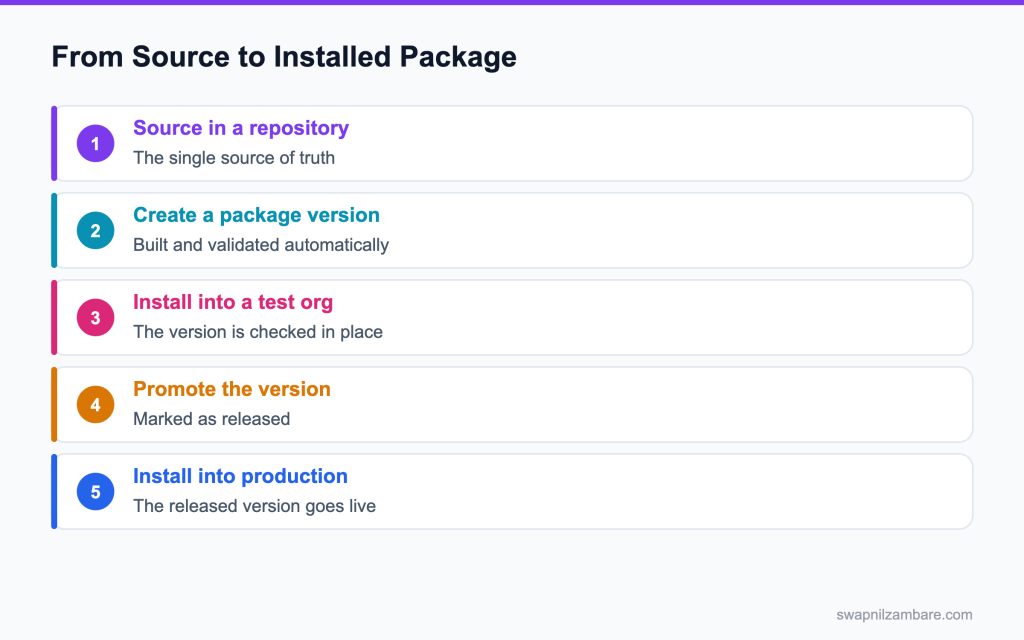
Caption: The path a version takes. Each step is a command, which is why the whole thing can run unattended.
What Salesforce Packaging Interview Questions Cover
Salesforce Packaging Interview Questions sit on one idea. A package version is a fixed artifact, built once and installed anywhere, which is what makes a release repeatable.
Compare that to a change set, which is assembled by hand each time and cannot be rebuilt or reviewed. The difference is the whole reason this tooling exists.
Most Salesforce Packaging Interview Questions test whether you have run a real pipeline. The post on CI CD covers the automation side in detail.
Unlocked vs Managed Package
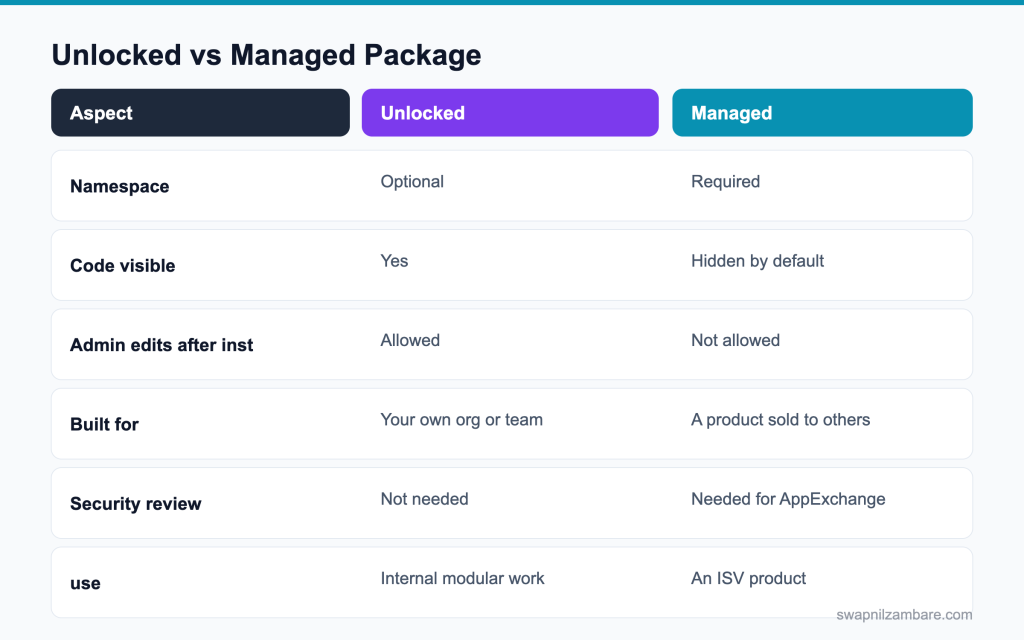
Caption: The choice depends on who installs it and whether they are allowed to change it.
| Term | What it means |
|---|---|
| Package | A named container for metadata, with versions |
| Package version | A fixed build of that package, with a version number and an id |
| Beta version | A build that can be installed into a scratch or sandbox org only |
| Released version | A promoted build that can be installed into production |
| Namespace | A prefix that makes a managed package’s components unique |
| Dependency | Another package a version needs in order to install |
| Package type | Where it fits |
|---|---|
| Unlocked | Internal modular development, where admins may still change things after install |
| Managed | A product distributed to customers, with code hidden and upgrades controlled |
| Managed 1GP | The older managed model, tied to a packaging org |
| Managed 2GP | The current model, built from source with the CLI |
| Unmanaged | A one time copy of metadata, with no upgrade path |
Those tables settle a good share of Salesforce Packaging Interview Questions before the detail starts.
Salesforce Packaging Interview Questions on Package Types
Q1: When do you choose an unlocked package?
For your own org or your company’s work, split into modules that can be versioned and installed independently. Admins can still change components afterwards, which suits an internal team.
Follow-up you may get: Can an unlocked package depend on another unlocked package? Yes, you declare the dependency in sfdx-project.json.
Q2: When do you choose a managed package?
When you distribute a product to other companies and need code hidden, upgrades controlled and a namespace of your own.
Q3: What is the difference between 1GP and 2GP managed packages?
1GP (first-generation) packages are built from a packaging org, and 2GP (second-generation) packages are built from source with the Salesforce CLI.
| Point | 1GP managed | 2GP managed |
|---|---|---|
| Source of truth | The packaging org | Your Git repository |
| How versions are made | Upload from the packaging org | sf package version create from source |
| Namespaces | One per packaging org | Many packages can share one namespace |
| Fits | Older AppExchange products | New products and CI/CD pipelines |
New managed products should start on 2GP, because it fits source control and automated builds.
Q4: What is an unmanaged package?
A snapshot of metadata handed over once. The installer owns the components afterwards and there is no upgrade. Useful for sample code, not for a product.
Q5: Can you convert an unlocked package into a managed one?
No. The namespace and upgrade model are decided at creation, so a change means creating a new package and migrating.
Interview tip: say the decision between unlocked and managed is made at creation. Interviewers check that you plan it up front.
Q6: What is a namespace and when do you need one?
A prefix registered in a namespace org, which makes every component in a managed package unique across all orgs. It is required for a managed package and optional for an unlocked one.
Follow-up you may get: Can you change a managed package’s namespace later? No. It is fixed once linked to the package.
Q7: Should an unlocked package have a namespace?
Usually not, because the prefix then appears in every API name and makes later changes awkward. Use one only when you need the isolation.
Q8: What is sfdx-project.json used for in packaging?
It is the project file that lists your package directories, package names, versions and dependencies. The CLI reads it when you create a version. Example: it says the ‘core’ package lives in force-app/core and depends on the ‘logging’ package version 1.2.
Q9: What is the difference between an org-dependent unlocked package and a normal one?
A normal unlocked package must contain or declare everything it needs. An org-dependent unlocked package can rely on metadata that already exists in the target org, which helps when you split a large old org into packages step by step. The trade-off is weaker checks at build time.
Q10: What is a package ancestor?
The declared previous version a new version upgrades from, which lets the platform check the upgrade is valid. It is set in the project file.
Salesforce Packaging Interview Questions on Versions
Q11: What does a package version number mean?
Four parts, major, minor, patch and build. The build number is assigned automatically, and the first three are yours to manage.
Q12: What is the difference between a beta and a released version?
A beta can only go into a scratch org or a sandbox, so you can test it. Promoting it to released makes it installable in production, and a released version can never be changed.
Follow-up you may get: Where can you install a beta? Only in scratch orgs and sandboxes, never in production.
Q13: Why can a version not be changed?
So that the thing you tested is the thing that installs. If a version could change, a passing test would mean nothing.
Q14: How do you fix a bug in a released version?
You build a new version with the fix and release it, or a patch version if the package supports patches. A released version can never be edited. Example: version 1.4.0 has a bug, so you create 1.4.1 (a patch) or 1.5.0, test it as a beta, then promote it.
Q15: What is a dependency and how is it handled?
Another package your version needs. You declare it in the project file, and the installer must have it present or install it first.
Q16: What happens to data when a package is upgraded?
Records stay. Metadata is replaced by the new version. A field removed from the package is deprecated rather than deleted, which protects data.
Interview tip: mention ‘deprecated, not deleted’ for removed fields. It shows you know packages protect customer data.
Q17: Can you delete a package version?
A beta version, yes, because nobody can install it in production. A released version, no, because customers may already have it installed. You can deprecate an old released version so new customers stop installing it.
Q18: What is a patch version?
A patch version fixes bugs on an existing major.minor line, like 1.4.1 after 1.4.0, without adding new features. It lets customers on 1.4 get a fix without moving to 2.0. Managed 2GP packages support patches when you set them up for it.
Q19: What does promoting a version mean?
Promoting changes a beta version to released, so it can be installed in production. You run sf package version promote after the version passes its tests and has 75% coverage. Once promoted, that version can never change.
Q20: What code coverage does a package version need?
75 percent across the package, checked when the version is created with the coverage flag, and required before a version can be promoted.
Being able to talk through those four commands answers most Salesforce Packaging Interview Questions about the build itself.
Follow-up you may get: Do unlocked packages need 75% coverage too? Yes, to promote a version to released.
# build a version, test it, then promote it
sf package version create -p MyModule -x -w 30 --code-coverage
sf package install -p MyModule@1.2.0-3 -o testorg -w 20
sf apex run test -o testorg --result-format human --wait 20
sf package version promote -p MyModule@1.2.0-3
Salesforce Packaging Interview Questions on CI and CD
Q21: What is continuous integration in a Salesforce context?
Every push runs a build. A scratch org is created, the source is deployed, the tests run, and the result is reported back on the pull request before anyone merges.
Q22: What is continuous delivery here?
After a merge, the pipeline builds a package version and installs it into the next environment without a person running commands.
Q23: What runs the pipeline?
Usually GitHub Actions, GitLab CI, Jenkins or Azure Pipelines. DevOps Center is the platform’s own option for teams who want it inside Salesforce.
Q24: How does a pipeline authenticate to an org?
The JWT bearer flow, with a connected app and a certificate, and the private key held as a repository secret. No password and no browser.
Follow-up you may get: Do you still use a connected app for JWT? New setups can use an External Client App, which Salesforce now recommends for new integrations.
Q25: What is a validation deploy?
A deploy that checks everything and runs tests without committing the change. It is how you find out whether release night will work, during the day.
Q26: Which tests should a pipeline run?
Local tests for a feature branch, so the build stays quick, and the full suite before production. Running everything on every commit gets ignored once it is slow.
Interview tip: give the split: local tests on branches, the full suite before production. It shows you balance speed and safety.
Q27: What is a quick deploy?
Quick deploy releases a validation that already passed within the last 10 days, without running the tests again. It turns a long release window into a few minutes. Example: validate on Thursday afternoon, then quick deploy on Saturday night. If anything changes in the target org in between, the validation expires.
Q28: Where does static analysis fit?
As a pipeline step. Code Analyzer or PMD runs on the changed files and fails the build on the rules your team agreed to treat as errors.
Q29: How do you handle environment differences in a pipeline?
Keep the differences out of the package. Named credentials, custom settings and custom metadata hold the values, and each org gets its own.
Q30: What belongs in .forceignore for a pipeline?
Profiles you do not manage, settings that differ per org, and anything a person configures by hand. Deploys stop failing on components nobody owns.
Q31: What is a release branch model for Salesforce?
Feature branches off a main branch, a pull request with a build, and a tag or release branch for what ships. The same model as any other codebase.
Q32: What is the difference between a sandbox-based pipeline and a scratch-org-based pipeline?
Both test changes before production, but they start from different places.
| Point | Sandbox-based | Scratch-org-based |
|---|---|---|
| Org for testing | Long-lived sandbox | New scratch org per build |
| Data | Real-like data copied from production | Test data you load each time |
| Speed to set up | Ready, but can drift from source | Fresh every time, takes minutes to create |
| Fits | Org-based development | Package-based development |
Q33: Scenario: two developers’ changes conflict in the same Apex class. How does the pipeline help?
Git shows the conflict in the pull request before merge. The developers resolve it together, and the pipeline builds and tests the merged code in a scratch org. That way the conflict is fixed in the repository, not discovered in production.
Q34: How do you roll back a bad release?
Install the previous package version, or deploy the previous tag. There is no undo button, so the previous artifact has to exist and be installable.
Pipeline questions are the half of Salesforce Packaging Interview Questions that separate someone who has watched a build from someone who has fixed one.
| Pipeline step | What it catches |
|---|---|
| Create a scratch org and deploy | Metadata that does not deploy cleanly |
| Run Apex tests with coverage | Broken logic and missing coverage |
| Run static analysis | Security and quality rule breaks |
| Validation deploy to production | Failures that only appear against real config |
| Build and promote a version | A release artifact that can be reinstalled |
Interview tip: say the previous artifact must already exist. Rollback is a plan, not a button.
Salesforce Packaging Interview Questions on the Security Review
Q35: What is the AppExchange security review?
Salesforce’s assessment of a managed package before it can be listed, covering code, configuration and any external service the package talks to.
Follow-up you may get: Is there a fee? Yes, Salesforce charges a fee for the security review of paid listings.
Q36: Which packages need it?
Managed packages listed on AppExchange. An unlocked package used inside your own company does not.
Q37: What does the review look for?
Injection flaws, cross site scripting, missing CRUD and field level security checks, insecure storage of secrets, sharing bypassed without reason, and insecure outbound calls.
Q38: What tool do you run first?
Code Analyzer, which covers the same rule sets the review uses. Fixing its findings before submitting saves a cycle.
Q39: What is the most common reason for a failed review?
Missing field level security and object permission checks on queries and DML. The code works and the data is exposed.
Interview tip: name CRUD and FLS checks as the top failure. It is the answer reviewers and interviewers both expect.
Q40: How do you fix that properly?
Run user mode queries and DML where it suits, use stripInaccessible on data crossing a boundary, and check permissions explicitly where the logic needs to run in system mode.
Q41: How long does a review take?
Weeks rather than days, and longer if it fails. Plan a release around it rather than treating it as a final step.
Q42: What is a false positive in a security review, and how do you handle it?
A false positive is a finding that looks like a problem but is safe in your design. You document why it is safe, with the code reference, and include it in the submission. Example: a without sharing class that only reads a public configuration object.
Q43: Which external services must you declare for the review?
Every external endpoint the package calls, like your own API or a third-party service. The review team scans them too. Undeclared endpoints are a common reason a review is sent back.
Q44: Does a new version need a new review?
Not every version. Significant changes, new external services or a new technology stack trigger another look, so declare changes honestly.
Scenario Salesforce Packaging Interview Questions
Q45: A team releases by change set once a month and release night runs to 2 AM. What do you change first?
Get the metadata into a repository and add a validation deploy on every pull request. The late night is caused by finding failures at the end, and a validation moves them to the morning.
Interview tip: start with the cause, late failures, before the tool. Interviewers want the ‘why’ behind the change.
Q46: Production has a component that a developer edited by hand after the last release. What happens on the next deploy?
The deploy overwrites it, and whoever relied on the manual change finds out the hard way. Fix the process by making the repository the only route into production.
Q47: Your pipeline takes 50 minutes and developers have started ignoring it. What do you do?
Split it. Quick checks and local tests on each push, the full suite on the merge. A build nobody waits for is not protecting anything.
Interview tip: say a slow build that people ignore is worse than a short one. Splitting the pipeline is the senior answer.
Q48: A package version will not install because of a dependency. How do you investigate?
Read the install error for the missing package id, check the dependencies declared in the project file, and install the dependency first. A dependency tree that nobody wrote down is the usual cause.
Q49: Security review came back with 40 findings. How do you work through them?
Group them by rule rather than by file. Most of the list is usually three or four real issues repeated, so one fix pattern clears many findings.
Interview tip: grouping by rule is the line interviewers like. It turns 40 problems into a handful of fixes.
Q50: A customer on version 1.4 wants a fix, but the current release is 2.1. What are the options?
A patch version on the 1.4 line if the package supports patches, or an upgrade to 2.1. Which one depends on what changed between them and what the customer can take.
Q51: How do you package a change that needs a data migration?
Put the migration in a post install script, make it safe to run twice, and log what it did. A migration that cannot be rerun will eventually be rerun.
Follow-up you may get: Which interface runs code after install? InstallHandler, with its onInstall method.
Q52: A manager asks whether unlocked packages are worth the effort for an internal org. What is the honest answer?
They help when the org is large enough to split into modules with clear owners. For a small org with one team, source control and a pipeline give most of the benefit with less ceremony.
Q53: Scenario: a customer’s install fails on one validation rule in their org. What do you do?
- I read the install error to see which record or component failed.
- I check whether the post install script creates data that their rule blocks.
- I make the script handle failures, for example by catching the error and logging it, or by asking the customer to bypass the rule during install.
- I add a similar rule to a test org so it does not happen again.
Q54: Scenario: the business wants daily releases but the security review takes weeks. How do you plan?
I separate the two. Internal orgs get daily releases of unlocked packages through the pipeline. The AppExchange managed package bundles changes into planned releases, submitted for review when something significant changes. Smaller updates that do not need a new review go out between reviews.
Q55: A secret has to reach the package at runtime. Where does it go?
A protected custom setting or a named credential configured after install, never in code and never in a package component. Anything shipped in the package is readable by someone.
Scenario Salesforce Packaging Interview Questions are usually drawn from something that went wrong on the interviewer’s own team, so answer with a process fix rather than a clever trick.
Common Mistakes with Packaging and Pipelines
- Editing components by hand in production while claiming to use source control
- Shipping environment specific values inside the package
- Submitting for security review without running Code Analyzer first
- Building a pipeline so slow that the team works around it
- No way to reinstall the previous version, so there is no rollback
- Storing a certificate or auth token in the repository
Best Practices
| Practice | Why it helps |
|---|---|
| Build a version for every release | You can reinstall exactly what shipped |
| Validate before release night | Failures appear during working hours |
| Keep config out of the package | One artifact installs in every org |
| Run static analysis in the build | Security findings arrive early |
| Use the JWT flow in pipelines | No password and no browser |
| Make post install scripts repeatable | A rerun does not break the data |
Working through Salesforce Packaging Interview Questions is far easier once you have built one version yourself. Create an unlocked package from a small module in a developer org, promote it, and install it into a second org.
Where to Read More
The official guides are the second generation packaging developer guide for packages and versions, the security review requirements for the AppExchange process, and the Code Analyzer documentation for the tool that checks the same rules.
What’s Next?
The next post covers Agentforce for developers, which is where the platform’s newest work sits. The posts on CLI deploy and unlocked packages cover the ground underneath this one.
If you are asked Salesforce Packaging Interview Questions, talk about the artifact. A version that can be rebuilt, reinstalled and rolled back is the point of all of it.


