Salesforce Platform Interview Questions usually open every developer interview, because they show whether you understand how Salesforce works before you write any code. Interviewers ask about multi-tenancy, metadata, the MVC model, org types and when to choose clicks over code. Strong answers here set the tone for the whole interview.
Last reviewed for the Winter ’27 release (November 2026).
This post is Part 1 of our Salesforce developer interview series. It collects the platform questions asked most often, from basic to advanced, with short answers you can say aloud. It builds on what Salesforce development is, multi-tenant architecture and metadata and declarative vs programmatic development.
What are Salesforce Platform Interview Questions?
Salesforce Platform Interview Questions test your understanding of the platform under your code. They cover how many customers share one system, how Salesforce stores your customisations as metadata, and which tools fit which job. So they are less about syntax and more about clear thinking.
Think of a driving test that starts with questions about the car itself. Before you drive, the examiner checks that you know the brakes, the gears and the road rules. Platform questions are that first check for a Salesforce developer.
Why Salesforce Platform Interview Questions Matter
Interviewers use these questions to filter candidates quickly. Here is why Salesforce Platform Interview Questions matter.
- First, they show whether you understand limits and shared resources.
- Also, they reveal if you choose Flow or Apex for the right reasons.
- Next, they test your knowledge of orgs, sandboxes and deployment basics.
- Clear platform answers make later Apex answers more believable.
- Finally, freshers are judged heavily on these basics.
So a few minutes of preparation here pays off in every round.
How to Prepare for Salesforce Platform Interview Questions
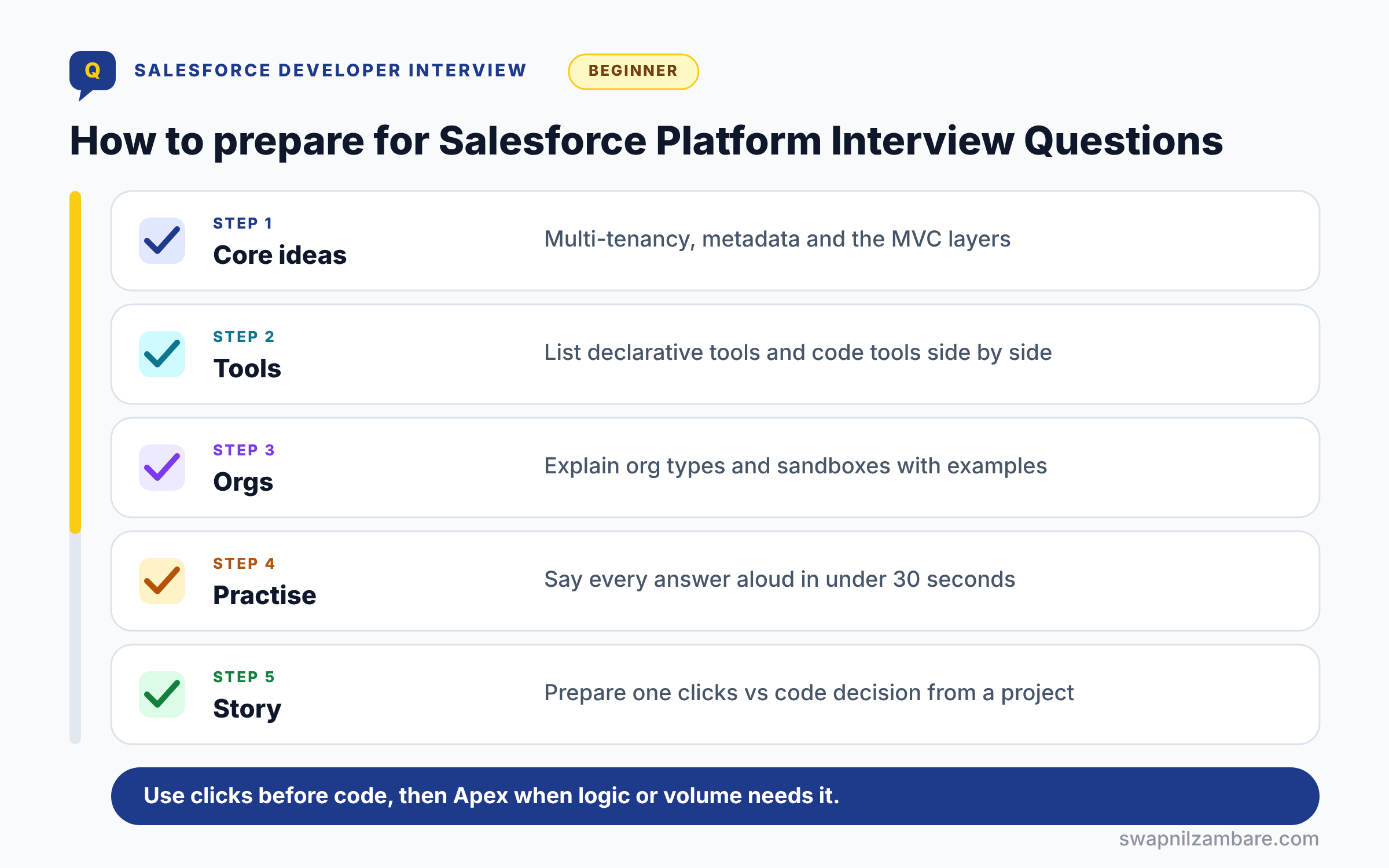
Preparing for Salesforce Platform Interview Questions follows five simple steps. First, learn the core ideas: multi-tenancy, metadata and the MVC layers. Next, list the declarative tools and the code tools side by side. Then practise explaining org types and sandboxes with one real example each. After that, say every answer aloud in under 30 seconds. Finally, prepare one story where you chose clicks over code, or the reverse.
Platform Topics at a Glance
The table below shows the main topics and how often interviewers ask them.
| Topic | How often asked | Key idea to remember |
|---|---|---|
| Multi-tenancy | Very often | Shared resources, so limits exist |
| Metadata | Very often | Customisations are stored as metadata |
| Clicks vs code | Very often | Use declarative tools first |
| Orgs and sandboxes | Often | Build and test away from production |
| MVC on Salesforce | Often | Model, view and controller layers |
| Releases and API versions | Sometimes | Three releases a year |
Declarative vs Programmatic Development
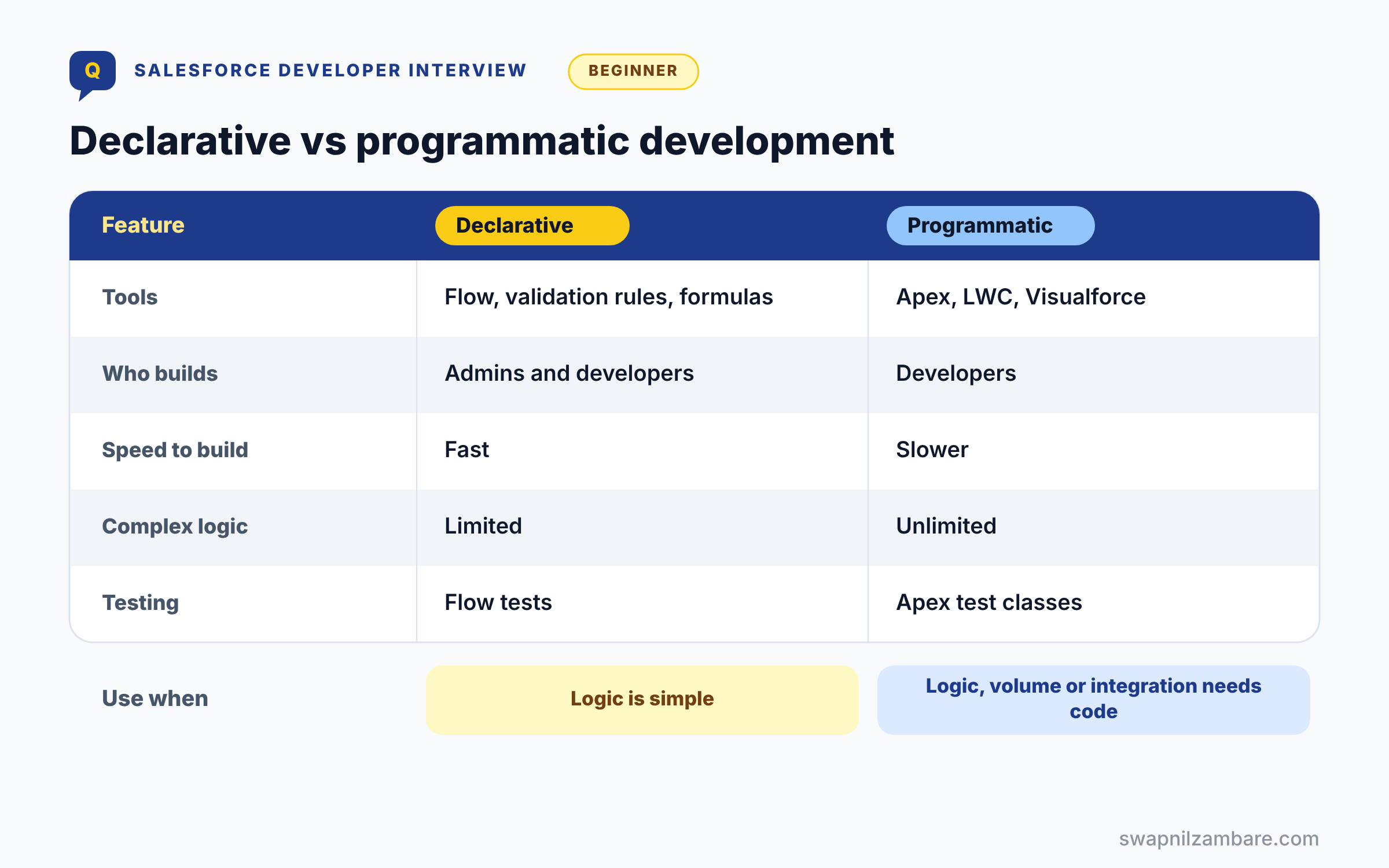
The table below compares the two ways of building on Salesforce.
| Feature | Declarative (clicks) | Programmatic (code) |
|---|---|---|
| Tools | Flow, validation rules, formulas | Apex, LWC, Visualforce |
| Who builds | Admins and developers | Developers |
| Speed to build | Fast | Slower |
| Complex logic | Limited | Unlimited |
| Testing | Flow tests | Apex test classes required |
When to use which is a common question itself. Use declarative tools first, and move to code when logic, volume or integration needs it.
Basic Salesforce Platform Interview Questions
These are the first Salesforce Platform Interview Questions most freshers hear.
Questions on Salesforce Basics
Q1: What is Salesforce?
Salesforce is a cloud-based CRM and app platform. So companies use it to manage customers, sales, service and custom business apps.
Q2: What is the Salesforce Platform?
It is the set of tools for building apps on Salesforce, such as objects, Flow, Apex and LWC. Also, it hosts the database, security and user interface for you.
Follow-up you may get: Who hosts the database and servers? Salesforce does, so you never patch or back up servers.
Q3: What is cloud computing in simple words?
It means using software and servers over the internet instead of on your own machines. So you pay for what you use and skip installing servers.
Q4: What are SaaS, PaaS and IaaS?
SaaS is ready software, PaaS is a platform to build apps, and IaaS is raw infrastructure. Salesforce is mainly SaaS and PaaS.
Interview tip: give Salesforce as the example of both: Sales Cloud is SaaS, and building custom apps on the platform is PaaS.
Q5: What is an org?
An org is one customer’s private Salesforce environment, with its own data, users and settings. For example, production and each sandbox are separate orgs.
Q6: What is CRM?
CRM stands for Customer Relationship Management. It helps a company track customers, deals and support in one place.
Q7: What is AppExchange?
Salesforce’s marketplace for apps, components and consulting partners. Companies install ready made packages, like document generation or e-signature, instead of building them. Apps listed there pass Salesforce’s security review.
Q8: What is the difference between Salesforce Classic and Lightning Experience?
Classic is the older interface, while Lightning Experience is the modern one. Also, new features, such as LWC and Dynamic Forms, only come to Lightning.
Questions on Multi-Tenancy and Metadata
Multi-tenancy is behind many Salesforce Platform Interview Questions, so learn it well.
Q9: What is multi-tenant architecture?
Many customers share the same servers, database and code base, but each sees only its own data. So Salesforce can upgrade everyone at once.
Follow-up you may get: How does Salesforce keep tenants’ data apart? Every record carries an org ID, and every query is filtered by it.
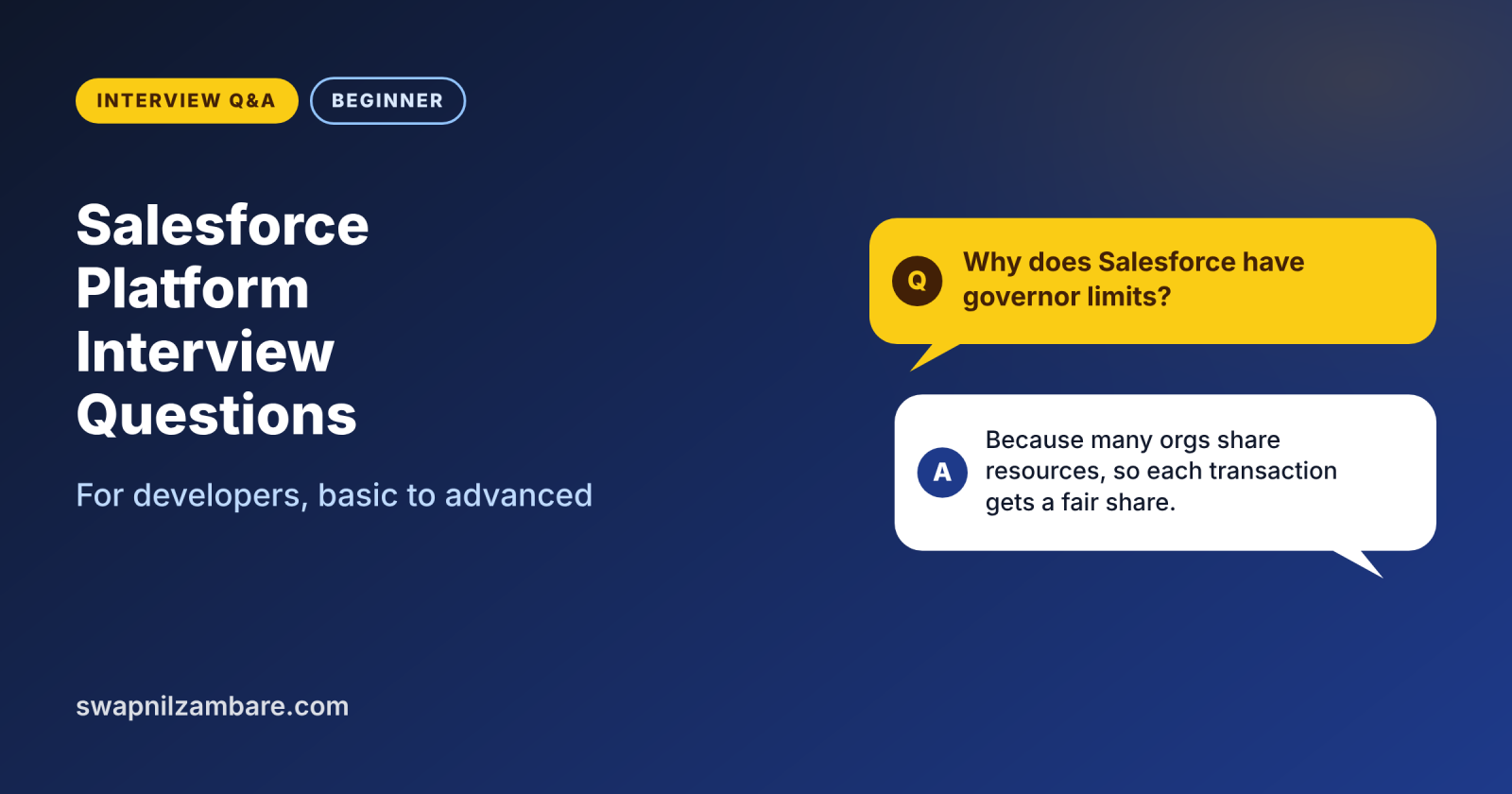
Q10: Why does Salesforce have governor limits?
Because all customers share resources, one org must not slow down others. So limits cap queries, DML, CPU time and more per transaction.
Interview tip: always tie limits back to multi tenancy. The “why” is what the interviewer wants.
Q11: What is metadata in Salesforce?
Metadata is data that describes your setup, such as objects, fields, page layouts and Apex classes. In short, it is your org’s configuration.
Q12: How is metadata different from data?
Data is the records, such as accounts and courses. Metadata is the structure and settings, such as the Course__c object and its fields.
Q13: What is a metadata-driven platform?
The platform builds your app at runtime from stored metadata. As a result, a new field appears without anyone writing database code.
Interview tip: say “no database code needed for a new field”. It is the simplest proof of metadata driven design.
Q14: What is the Tooling API?
An API for developer tools. It reads and changes code and metadata pieces quickly, runs tests, and reads debug logs. IDEs like VS Code and the Developer Console use it behind the scenes.
Q15: What is the Metadata API used for?
It retrieves and deploys metadata between orgs and source control. For example, the Salesforce CLI uses it for deployments.
Questions on Objects and Fields
Q16: What is an object?
An object is like a database table, such as Account or Course__c. Each field is a column, and each record is a row.
Follow-up you may get: How many custom objects can an org have? It depends on the edition; Enterprise allows 200, Unlimited 2,000.
Q17: What is the difference between standard and custom objects?
Standard objects come with Salesforce, such as Account and Contact. However, you create custom objects yourself, and their API names end in __c.
Q18: What are the main relationship types?
Lookup and master-detail are the main ones, plus many-to-many through a junction object. Also, hierarchical relationships exist on User.
Q19: How is lookup different from master-detail?
Master detail is a tight link: the child follows the parent’s sharing and is deleted with it. A lookup is loose, so the child can exist on its own.
| Point | Lookup | Master detail |
|---|---|---|
| Child owner and sharing | Child has its own | Follows the parent |
| Delete the parent | Child stays, field is cleared | Children are deleted |
| Roll up summary fields | No | Yes |
| Required on the child | Optional | Always |
Example: Enrollments under a Course use master detail; a Course’s optional Trainer field is a lookup.
Q20: What is a junction object?
It is a custom object with two master-detail fields. So it creates a many-to-many relationship, such as students and courses.
Interview tip: mention that the first master detail field controls the junction record’s look and sharing.
Q21: What is a schema builder?
A visual tool in Setup that shows objects, fields and relationships as a diagram. You can also create objects and fields from it, which helps when explaining a data model to the team.
Q22: What is an external object?
An object whose records live in another system and are fetched live through Salesforce Connect. Its API name ends in __x, and it uses no Salesforce data storage.
Q23: What is a record type?
It lets one object have different page layouts and picklist values for different processes. For example, Online and Classroom courses.
Intermediate Salesforce Platform Interview Questions
These Salesforce Platform Interview Questions check how you choose tools and environments.
Questions on Clicks vs Code
Clicks vs code comes up in almost every set of Salesforce Platform Interview Questions.
Q24: What is declarative development?
It means building with point-and-click tools, such as Flow, formulas and validation rules. So no code is needed.
Follow-up you may get: Name three declarative tools. Flow, validation rules and formula fields.
Q25: What is programmatic development?
It means writing code, such as Apex, LWC or Visualforce. Developers use it when declarative tools are not enough.
Q26: When should you choose Apex over Flow?
Choose Apex for complex logic, heavy data volumes, complex callouts or strict performance needs. Otherwise, start with Flow.
Interview tip: mention who will maintain it. Ownership is part of the right choice.
Q27: Why does Salesforce recommend “clicks before code”?
Because declarative features are faster to build, easier to maintain and upgraded by Salesforce. Also, admins can change them without developers.
Q28: Which automation tools are retired or not recommended for new work?
Workflow Rules and Process Builder. Salesforce ended support for both on 31 December 2025, so all new automation is built in Flow.
Existing ones still run, but they get no fixes or help from Support. The Migrate to Flow tool converts most of them, and teams should plan to move the rest.
Q29: What is a validation rule?
It is a formula that blocks a save when data is wrong. For example, it can stop a negative course fee.
Q30: What is a formula field?
It is a read-only field that calculates its value from other fields when you view the record. So it is not stored like normal data.
Q31: What is Dynamic Forms?
A Lightning page feature that lets you place fields and sections directly on the page and show them only when conditions are met, like showing a Discount field only for Gold accounts. It reduces the need for many page layouts and record types.
Q32: What is a roll-up summary field?
It counts or sums child records on a master-detail parent. However, it only works with master-detail, not lookup.
Interview tip: add that for lookups you can use a flow or Apex to roll up. It shows you know the workaround.
Questions on Orgs and Environments
Q33: What types of orgs exist?
Common ones are production, sandboxes, Developer Edition orgs, scratch orgs and trial orgs. Each serves a different stage of work.
Q34: What sandbox types are there?
Developer, Developer Pro, Partial Copy and Full. They differ in storage, how much data is copied, and how often you can refresh them.
| Type | Data copied | Refresh interval | Typical use |
|---|---|---|---|
| Developer | Setup only | 1 day | One developer’s work |
| Developer Pro | Setup only, more storage | 1 day | Bigger dev work and testing |
| Partial Copy | Setup plus a sample of data | 5 days | QA with realistic data |
| Full | Setup and all data | 29 days | UAT, performance tests, staging |
Q35: Which sandbox copies all production data?
A Full sandbox copies all data and metadata from production.
It suits performance tests and final UAT, because it matches production most closely. It can be refreshed only every 29 days, so plan refreshes around releases.
Q36: What is a scratch org?
It is a short-lived, source-driven org created from a Dev Hub. Developers use it for quick, isolated feature work.
Follow-up you may get: How long can a scratch org live? Up to 30 days, set when you create it.
Q37: What is a Developer Edition org?
It is a free org for learning and building. Also, it can act as a Dev Hub for packages and scratch orgs.
Q38: How do you refresh a sandbox?
From Setup, Sandboxes, click Refresh when the interval allows. The sandbox gets a fresh copy of production setup and, for Partial and Full, data. Plan it, because anything built only in that sandbox is lost.
Q39: What is the Dev Hub?
It is the org that creates and manages scratch orgs and second-generation packages. You enable it in Setup.
Questions on Users and Security Basics
Q40: What is the difference between a profile and a permission set?
A user has exactly one profile, while permission sets add extra access. So the modern approach keeps profiles minimal and grants access with permission sets.
Follow-up you may get: What is a permission set group? A bundle of permission sets assigned together, often by job role.
Q41: What is OWD?
Organization-Wide Defaults set the baseline record access, such as Private or Public Read Only. Then roles and sharing rules open access up.
Interview tip: name the order: OWD, roles, sharing rules, manual shares. It shows you know how access opens up.
Q42: What is the role hierarchy used for?
It lets managers see records owned by people below them. For example, a Sales Manager sees her team’s courses.
Q43: What is field-level security?
It controls which fields a user can see or edit. So it protects sensitive data, such as salary or fees.
Q44: What are permission set groups?
A way to bundle several permission sets and assign them together, usually by job role, like Sales Rep or Support Agent. You can mute single permissions in a group without editing the sets inside it.
Q45: Can sharing rules restrict access?
No. Sharing rules only open access beyond the org wide defaults.
Salesforce’s sharing model starts from the most restrictive setting and opens up from there. To restrict access, set a tighter OWD, then use roles and sharing rules to open it for the right people. Restriction rules are a separate feature that can limit what users see on some objects.
Advanced Salesforce Platform Interview Questions
These Salesforce Platform Interview Questions come up for experienced roles.
Questions on Architecture and MVC
Senior Salesforce Platform Interview Questions often start with architecture.
Q46: How does MVC map to Salesforce?
The model is objects and data, the view is pages and components, and the controller is Apex or LWC JavaScript. So each layer has its own job.
Q47: What is the Lightning Component Framework?
It is the framework for building UI with Aura and Lightning Web Components. Also, LWC is the recommended model today.
Q48: Why is LWC preferred over Aura?
Because LWC uses web standards, so it is faster, lighter and easier to learn. Aura now mainly serves older components.
Follow-up you may get: Can LWC and Aura work together? Yes, an Aura component can contain LWCs, but not the other way round.
Q49: What is the order of execution?
It is the fixed sequence Salesforce follows when a record is saved, such as validation, triggers, flows and commit. Knowing it prevents surprises.
Q50: What is a transaction in Salesforce?
It is one unit of work that either fully saves or fully rolls back. Also, governor limits are counted per transaction.
Interview tip: mention that one failure rolls everything back, unless you use partial success methods.
Q51: How does Salesforce handle releases?
It ships three major releases a year: Spring, Summer and Winter. Sandboxes often get previews before production.
Q52: What is the difference between synchronous and asynchronous processing?
Synchronous code runs while the user waits and must finish within tighter limits. Asynchronous code, like queueable or batch jobs, runs later in the background with higher limits. Use async for callouts after a save and for large data work.
Q53: What is the Lightning App Builder?
A drag and drop tool for building record, app and home pages. Admins and developers place standard and custom components, including LWCs, and set visibility rules without code.
Q54: What is an API version?
Each release adds a new API version. Winter ’27 is version 68.0.
Code and metadata keep the behaviour of the version they were saved with, so a later release does not break them. Update old classes to newer versions over time to get new features.
Questions on Integration and Data
Q55: What APIs does Salesforce offer?
Main ones are REST, SOAP, Bulk, Metadata, Tooling, Pub/Sub and GraphQL. Each fits a different integration need.
Q56: When do you use Bulk API?
When you load or extract large data volumes, such as many thousands of records. So it runs asynchronously in the background.
Q57: What is an external ID?
It is a field that stores a key from another system. Also, it is indexed and lets integrations upsert without duplicates.
Interview tip: link external IDs to upsert. That is the real reason integrations use them.
Q58: What is Salesforce Connect?
It shows data from outside systems as external objects without copying it. So data stays in the source system.
Q59: What are platform events?
They are messages for event-driven integration. Publishers send events, and any number of subscribers react.
Follow-up you may get: How is CDC different? Change Data Capture publishes record changes automatically, with no code to publish.
Q60: What is the difference between REST and SOAP APIs?
REST is lightweight, uses JSON and simple URLs, and suits web and mobile apps. SOAP uses XML and a strict contract (WSDL), and is still used by older enterprise systems. Most new integrations use REST.
Q61: What is Lightning Data Service?
It is the client-side layer that loads and saves single records for components with a shared cache. As a result, no Apex is needed for simple cases.
Questions on Deployment Basics
Q62: How do you move changes between orgs?
Use change sets, the Salesforce CLI, DevOps Center or packages. Also, most teams now use Git with the CLI.
Q63: What code coverage does production need?
Apex needs at least 75% overall coverage, and every trigger needs some coverage. Tests must pass too.
Follow-up you may get: Do tests run in production during a deploy? Yes, by default local tests run for deployments with Apex.
Q64: Can you write Apex directly in production?
No. You develop in a sandbox or scratch org and deploy to production with tests.
Production blocks creating or editing Apex classes and triggers in Setup. That protects users from untested code and keeps the 75 percent coverage rule in force.
Q65: What is a change set?
A set of metadata moved between connected orgs, built by hand in Setup. An admin creates an outbound change set in the sandbox, uploads it, and production deploys it. It is simple but has no version control.
Q66: What is Salesforce DX?
It is a source-driven way of working with the Salesforce CLI, scratch orgs and Git. So the repository becomes the source of truth.
Scenario-Based Salesforce Platform Interview Questions
Scenario questions check how you apply platform knowledge to real requests.
Questions on Real Decisions
Use these Salesforce Platform Interview Questions to practise thinking aloud.
Q67: A manager wants a field auto-filled when a course is created. Flow or Apex?
Start with a before-save record-triggered flow, because it is fast and admins can maintain it. Use Apex only if the logic grows complex.
Q68: A user cannot see a record. How do you check?
First check object and field permissions, then OWD, role, sharing rules and manual shares. Also, use the Sharing button to see who has access.
Interview tip: walk through the checks in order out loud. Interviewers grade the method, not just the answer.
Q69: Your org hits SOQL limits in a trigger. What does that tell you?
Usually a query is running inside a loop. Bulkify the code with one query outside the loop.
A trigger gets up to 200 records, so one query per record passes the 100 query limit fast. Collect the IDs in a set, query once into a map, and read from the map inside the loop.
Q70: Testers need production-like data. Which sandbox do you pick?
Choose a Partial Copy for a sample of data, or a Full sandbox for all data. The choice depends on test needs and licences.
Q71: A business process needs data from an ERP without storing it. What do you suggest?
Use Salesforce Connect with external objects, so users see live ERP data inside Salesforce.
Q72: How would you explain governor limits to a business user?
Say that Salesforce is shared by many companies, so each request gets a fair share of resources. As a result, code must be efficient.
Interview tip: avoid jargon here. A simple analogy, like a shared apartment’s water supply, works well.
Q73: A team keeps getting “Too many SOQL queries” in production but not in testing. Why?
Tests probably use only one or two records. Production loads send 200 records at a time, so a query inside a loop runs 200 times. Add bulk tests with 200 records to catch it before release.
Q74: A stakeholder asks for a feature Salesforce already offers. What do you do?
Show the standard feature first, explain what it covers and what it does not, and build only the gap. Standard features are upgraded by Salesforce for free, while custom code needs maintenance.
Q75: A team wants to deploy daily without mistakes. What do you recommend?
Use Git, the Salesforce CLI and a CI pipeline that validates with tests. Also, DevOps Center helps admins join the same process.
A Real Salesforce Platform Interview Questions Answer
Interviewers often ask you to show a tiny piece of code that proves a platform idea. Here is a strong answer to “Show me why governor limits matter.”
// Bad: one query per course, so 200 records use 200 queries
for (Course__c c : Trigger.new) {
    Account a = [SELECT Id, Name FROM Account WHERE Id = :c.Account__c];
}

// Good: collect Ids, then one query for the whole batch
Set<Id> accountIds = new Set<Id>();
for (Course__c c : Trigger.new) { accountIds.add(c.Account__c); }
Map<Id, Account> accounts = new Map<Id, Account>(
    [SELECT Id, Name FROM Account WHERE Id IN :accountIds]);
Explain that triggers can receive 200 records at once. So the first loop fails at 101 queries, while the second uses only one.
Here is the debug line you would point to.
Number of SOQL queries: 1 out of 100Common Mistakes with Salesforce Platform Interview Questions
- Giving textbook definitions with no example.
- Saying Apex is always better than Flow.
- Mixing up profiles, roles and permission sets.
- Forgetting that sharing rules can only open access.
- Not knowing which sandbox copies which data.
Best Practices for Answering Salesforce Platform Interview Questions
- Answer in two parts: a short definition, then a real example.
- Use your own project names and numbers where you can.
- Mention limits and security when you talk about design.
- Keep each answer under 30 seconds unless asked for more.
- Revise this list the night before the interview.
Official Resources
Quick Recap
- Salesforce Platform Interview Questions test your understanding of the platform.
- Multi-tenancy explains why governor limits exist.
- Metadata stores your org’s configuration.
- Use clicks before code, then Apex when needed.
- Know org types, sandboxes and basic security.
What’s Next?
Next in the series, practise the core language with our Apex basics interview questions.