Salesforce Deployment Interview Questions check how safely you move data and changes, connect other systems and use new AI features. This is Part 8 of our 25-part series, with questions on data loads, data quality, sandboxes, releases, integrations, Agentforce and Data 360.
In Part 7, we covered reports and page design. These topics often decide experienced interviews, because mistakes here affect the whole company. For real situations, also see our deployment scenario questions.
How to Use These Salesforce Deployment Interview Questions
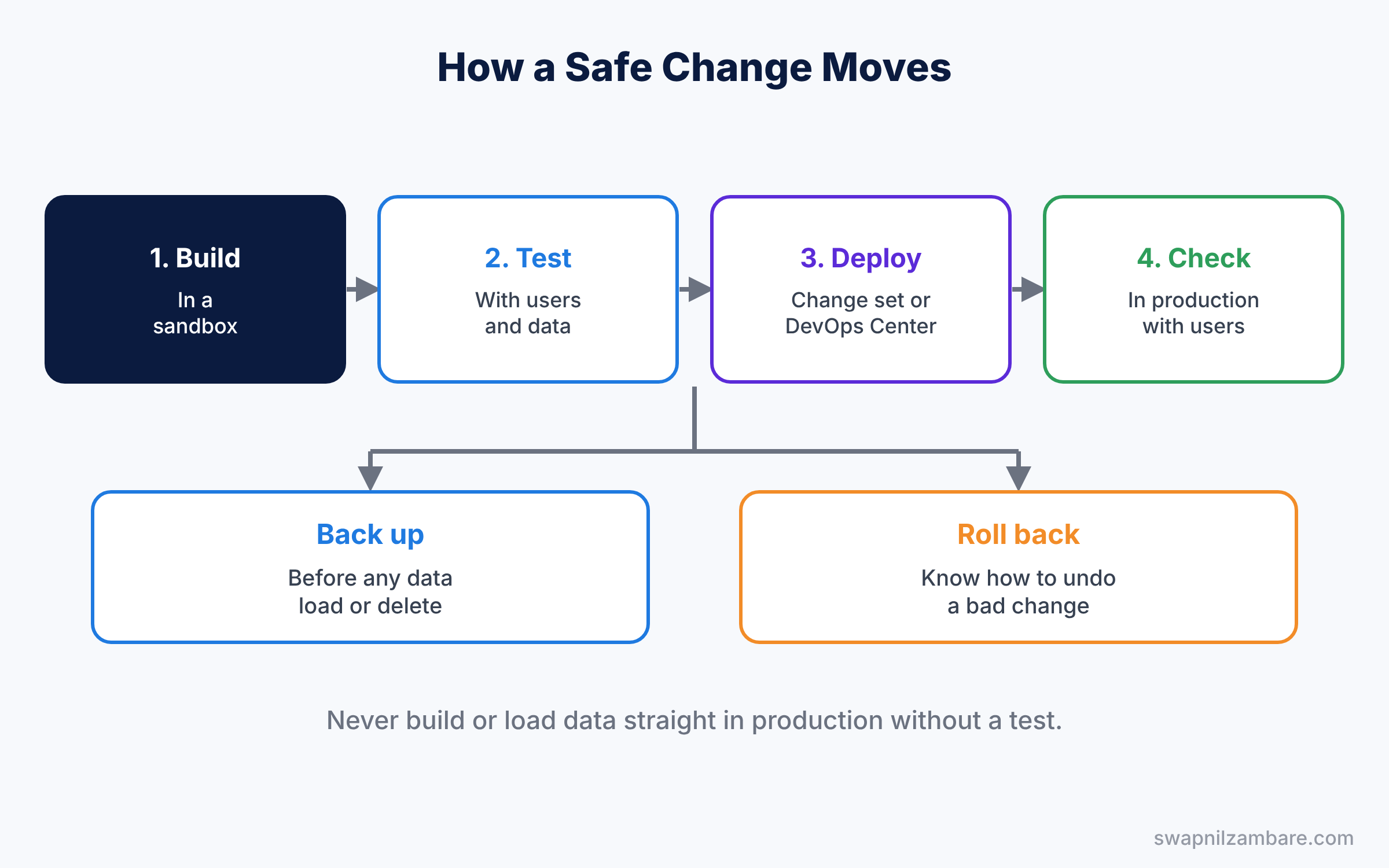
First, learn the safe path for every change: build in a sandbox, test, deploy, then check in production. Next, learn the data tools and their limits. Then cover integrations and AI at a high level. Our sandboxes guide is a good place to start.
Salesforce Deployment Interview Questions on Data Import Tools
Study with Data Loader and Import Wizard.
- What is the Data Import Wizard?
- What is Data Loader?
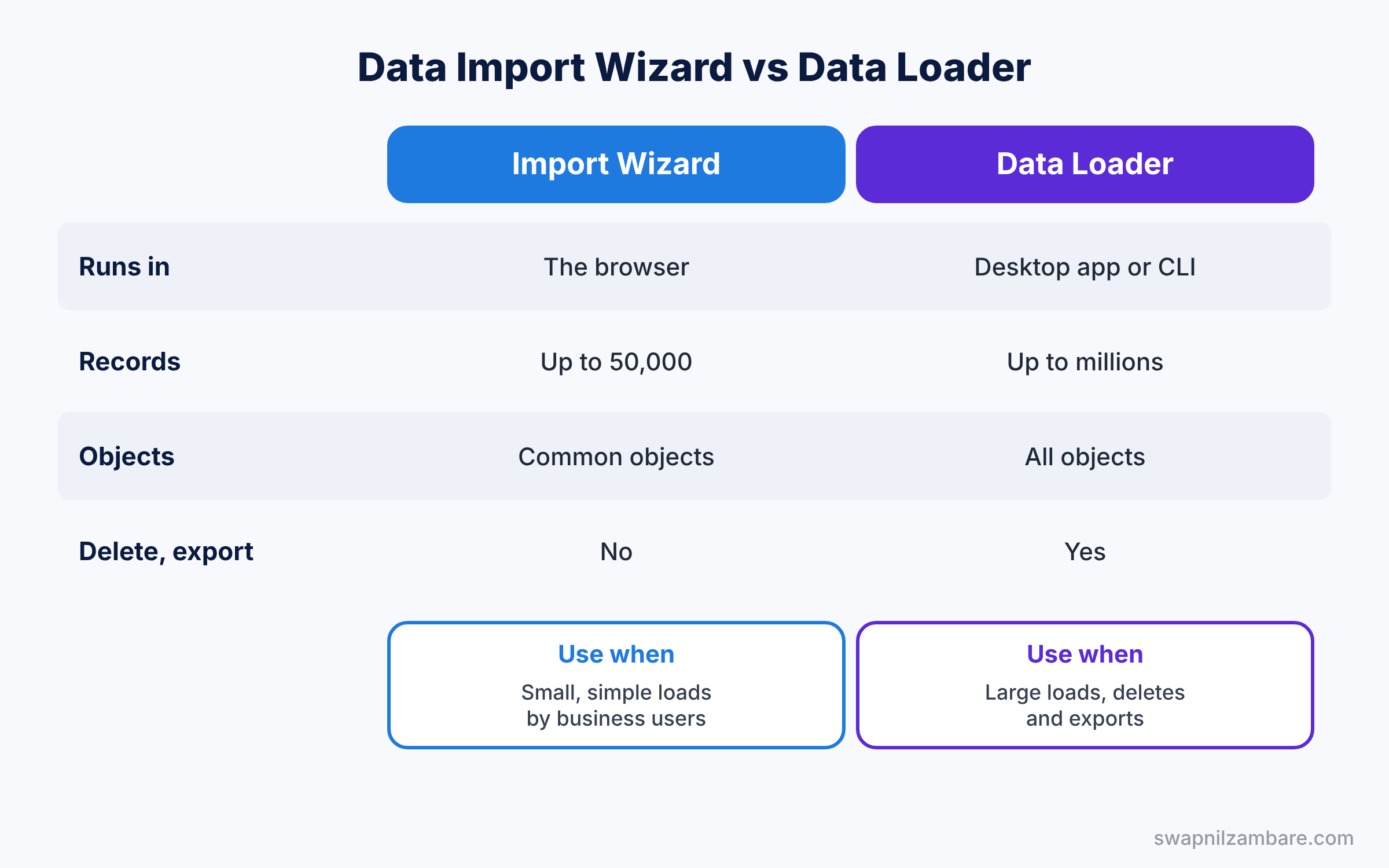
- Explain the difference between them.
- How many records can each tool handle?
- Which objects does the Data Import Wizard support?
- What is insert, update, upsert and delete in Data Loader?
- What is the Bulk API option?
- Explain the difference between Export and Export All.
- How do you check and fix errors after a load?
- What is a hard delete?
- What is a mapping file in Data Loader?
- Define batch size in Data Loader.
- What is the command-line Data Loader?
- What is dataloader.io, at a high level?
- How do you load data into a picklist field safely?
- Scenario: you must update one field on 80,000 records. Which tool and steps?
- Scenario: a load fails for 300 rows with “required field missing”. What do you do?
Data Migration Questions
Study with Data Migration.
- In what order do you load related objects?
- Why do you need external IDs in a migration?
- How do you keep created dates from the old system?
- How do you keep the original record owners?
- Should automation run during a big load?
- How do you test a migration?
- What is a data cleansing step before migration?
- What is a cutover plan?
- How do you check record counts after a migration?
- What is a migration rollback plan?
- What is a pilot load?
- Scenario: you must load 200,000 contacts linked to accounts. Describe your plan.
- Scenario: after a load, many contacts have no account. What went wrong?
Salesforce Deployment Interview Questions on Data Quality and Storage
Study with Duplicate Rules and Data Management.
- What are duplicate rules and matching rules?
- How do you merge duplicates?
- What is the Recycle Bin, and how long does it keep records?
- What is Data Export Service?
- How do you mass delete records?
- How do you mass transfer records?
- What is data skew?
- How do you free up data storage?
- What is duplicate management reporting?
- What is a matching rule equation?
- Define a weekly export file.
- What are data storage and file storage?
- What is archiving?
- Scenario: users keep creating duplicate accounts. What do you do?
- Scenario: a user deleted 300 records by mistake 20 days ago. Can you get them back?
Sandboxes Questions
Study with Sandboxes and Change Sets.
- What is a sandbox?
- What sandbox types exist?
- How often can you refresh each type?
- What does each type copy?
- What is a sandbox template?
- Briefly, what happens to user emails in a refreshed sandbox?
- What is a preview sandbox?
- Why mask data in sandboxes?
- What is a sandbox clone?
- What is post-copy automation, at a high level?
- How do you give a tester sandbox access?
- What is a scratch org, at a high level?
- Scenario: a refreshed Full sandbox sent emails to real customers. How do you prevent this?
- Scenario: testers need 500 realistic records in a Developer sandbox. How do you get them?
Salesforce Deployment Interview Questions on Change Sets and DevOps Center
Study with DevOps Center.
- What is a change set?
- What is an outbound and an inbound change set?
- Define a deployment connection.
- What cannot be deployed with change sets?
- Can you deploy deletions with a change set?
- What is DevOps Center?
- What is a work item?
- Define a pipeline stage.
- Why does DevOps Center use source control?
- What is a deployment validation?
- What is a quick deploy?
- Define a deployment status page.
- What is a destructive change, at a high level?
- What tests run during a deployment?
- Define an unmanaged package used for in deployment.
- What is the Metadata API, at a high level?
- What is Salesforce CLI, at a high level?
- Scenario: you must deploy ten new fields and a flow to production. What is your process?
- Scenario: a deployment fails on a missing field. How do you fix it?
Releases and AppExchange Questions
Study with Release Updates and AppExchange.
- What are release updates?
- How do you test a new release before it reaches production?
- What is the difference between managed and unmanaged packages?
- How do you check if an AppExchange app is safe?
- Can you edit the code of a managed package?
- How do you uninstall a package?
- What is a release note?
- What is the Release Updates page?
- Define a package version.
- What is a security review for an AppExchange app?
- What is a package license?
- Scenario: an installed app stops working after a release. What do you check?
- Scenario: a release update will change login behavior next month. How do you prepare users?
Salesforce Deployment Interview Questions on Integrations and APIs
Study with External Client Apps and Salesforce Connect.
- What is an API, in simple words?
- What are API limits, and where do you check API usage?
- Define an integration user.
- What is Salesforce Connect?
- What is an external object?
- Briefly, what are platform events, at a high level?
- What is the difference between pushing and pulling data?
- What is REST API vs SOAP API, at a high level?
- Briefly, what is a named credential, at a high level?
- What is change data capture, at a high level?
- What is MuleSoft, at a high level?
- Define an outbound message.
- What is an integration pattern?
- What is a webhook, at a high level?
- How do you monitor failed integrations?
- Scenario: an integration hits its daily API limit. What do you check?
- Scenario: the ERP system must show order data in Salesforce without copying it. What do you use?
Agentforce and AI Questions
Study with Agentforce for Admins.
- What is Agentforce?
- What are topics, instructions and actions in an agent?
- Define Agent Builder.
- What is the Einstein Trust Layer?
- How do you test an agent before you activate it?
- How do agents respect user permissions?
- What is a prompt template?
- What is Einstein Copilot, and what is it called now?
- Define grounding in AI.
- What is an agent action that calls a flow?
- What data does an agent use?
- How do you monitor agent conversations?
- What is an agent topic classification?
- What is an agent guardrail?
- Briefly, what is Agentforce testing center, at a high level?
- Scenario: leadership wants an AI agent to answer order questions on the website. What do you check first?
- Scenario: an agent gives wrong answers about fees. How do you fix it?
Salesforce Deployment Interview Questions on Data 360 and Global Features
Study with Data 360 and Translation and Multi-Currency.
- What is Data 360 used for?
- What was Data 360 called before?
- Define identity resolution.
- What is Translation Workbench?
- What is multi-currency?
- Can you turn off multi-currency?
- What is advanced currency management?
- What is a data stream in Data 360?
- Define a segment.
- What is a calculated insight?
- What is a dated exchange rate?
- Define a translation file export.
- What is a data model object in Data 360?
- What is activation in Data 360?
- Scenario: the company opens an office in Germany. What do you change for language and currency?
- Scenario: marketing wants one customer profile from web, app and CRM data. What do you suggest?
Salesforce Deployment Interview Questions FAQ
Are deployment questions only for experienced roles?
Mostly. Freshers should still know sandboxes, change sets and the basic data tools.
How much AI should I know as an admin?
Know what Agentforce does, how admins set topics and actions, and how the Trust Layer protects data.
Official Resources
Quick Recap
- These Salesforce Deployment Interview Questions cover data loads, data quality, sandboxes, deployments, integrations and AI.
- Always build in a sandbox, test, then deploy.
- Know the limits of each data tool.
- Each section ends with two scenario questions.
- Part 9 collects the most asked questions from every topic.
What’s Next?
Continue with the next part. Read Most Asked Admin Interview Questions for Salesforce (Part 9).