Data Model Scenario Questions test how you design objects, fields and relationships for real business needs, and how you fix a data model that has gone wrong. This is Post 2 of our scenario series.
Each scenario matches a topic from our Data Model Interview Questions list. Draw the objects on paper before you answer, because interviewers like to see clear thinking.
How to Use These Data Model Scenario Questions
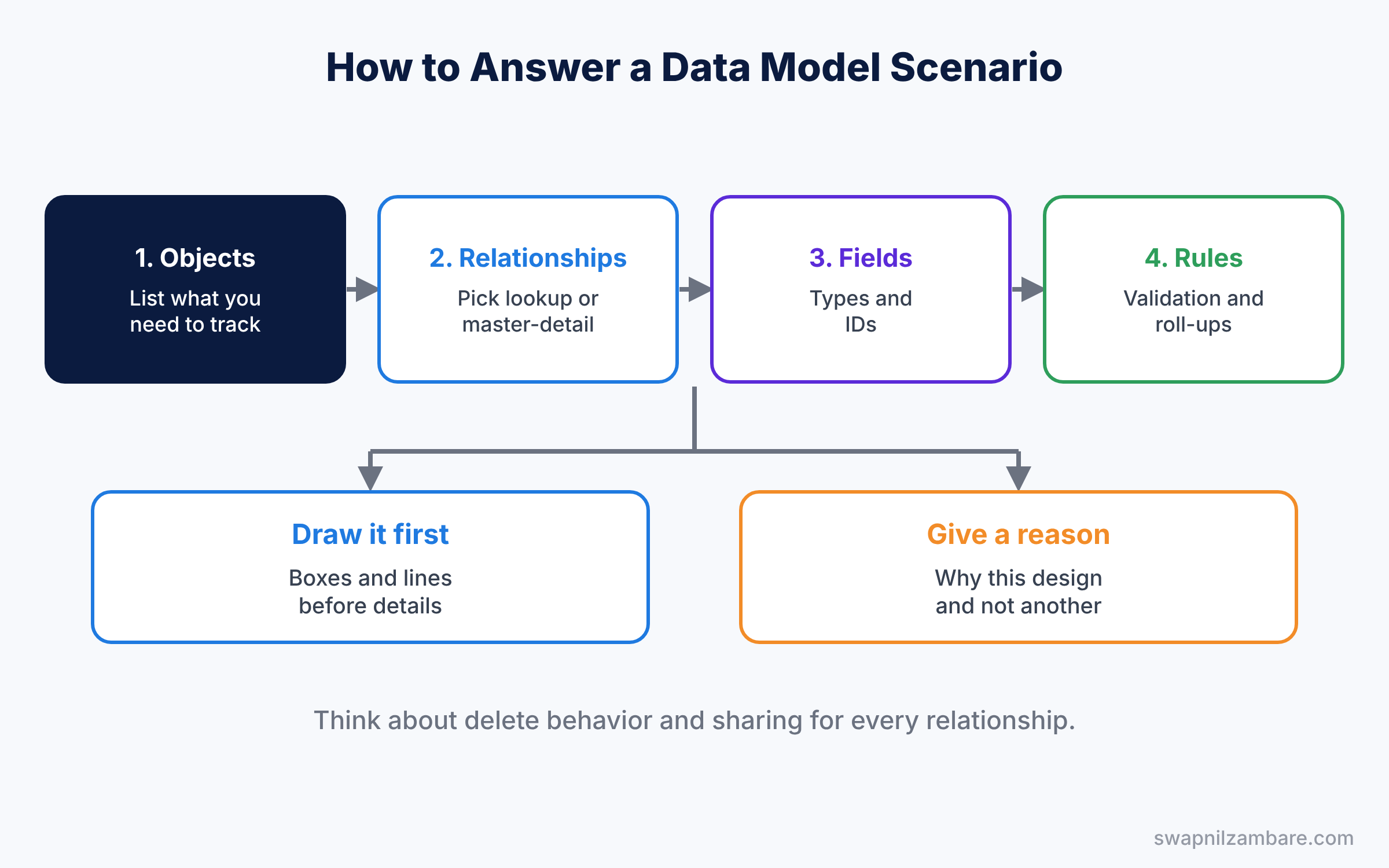
Answer every scenario in four short steps. First, repeat the problem in your own words. Next, say what you would check. Then name the exact feature or setting you would use, and say why. Finally, explain how you would test the fix with a real user.
Data Model Scenario Questions on Designing Objects
Study with Standard vs Custom Objects.
- The school wants to track students, courses and enrollments. Which objects do you create, and how do they relate?
- A team wants a custom object for customers instead of using Account. What do you advise?
- Users want to rename Account to School everywhere. How do you do it, and what does it affect?
- A new process needs 300 fields on one object. What do you suggest instead?
- Two departments track the same thing in two different custom objects. How do you merge them?
- Sales wants to track competitor details on each deal. Do you use fields or a related object, and why?
- A team wants to track equipment loans to students. Which objects and fields do you create?
- Sales wants to track school visits with photos and notes. What do you build?
- An object needs a unique code for every record, like COURSE-0001. Which field type do you use?
- Leadership wants to track who approved each discount. Where do you store it?
- Users store the same information in three different fields. How do you fix it?
A good answer starts with standard objects where they fit, then adds custom objects only for new things. Draw the objects before you answer.
Choosing Relationships Scenarios
Study with Master-Detail vs Lookup.
- Course records must disappear when their program is deleted. Which relationship do you use?
- A child record must stay even if the parent is deleted. Which relationship do you use?
- Users must not delete a parent that still has child records. Which lookup option do you choose?
- Students join many courses and courses have many students. How do you model it?
- You need to change a lookup to master-detail, but some children have no parent. What do you do?
- An object already has two master-detail relationships and needs a third parent. What are your options?
- Each employee must link to their manager, who is also an employee. Which relationship do you use?
- A related list shows records from the wrong parent after a data load. What do you check?
- An object needs a link to both Account and Contact. How do you design it?
- A detail record must move to a different master. Is it allowed, and how?
- Users must pick only active courses in a lookup. What do you add?
- Deleting an account also deleted important custom records. Why, and how do you prevent it next time?
- A child object must inherit sharing from its parent. Which relationship do you use?
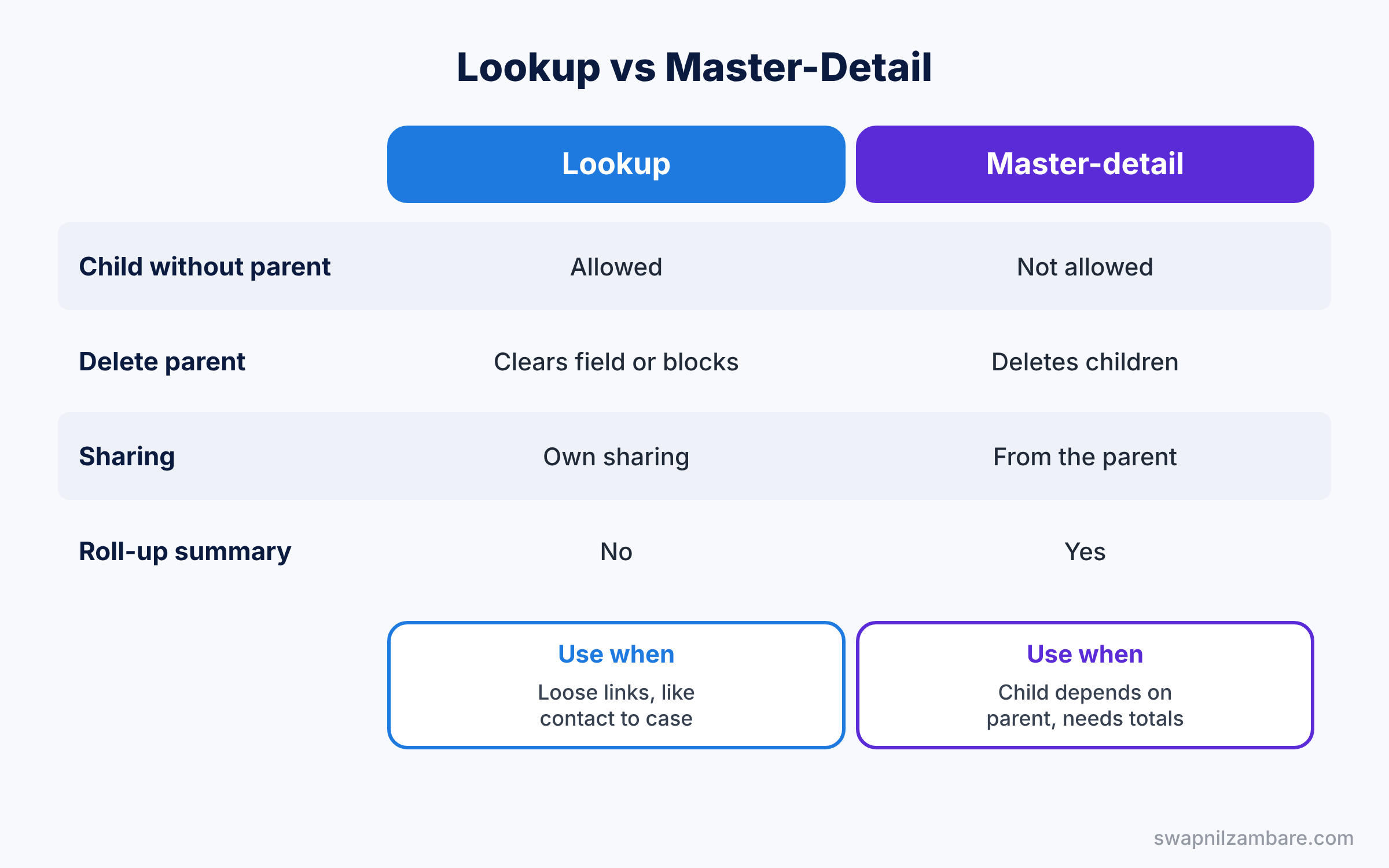
Explain delete behavior, sharing and roll-ups for the relationship you pick. These three points show you understand the choice.
Data Model Scenario Questions on Totals and Roll-Ups
Study with Roll-Up Summary Fields.
- Each course must show the total of paid enrollments. What do you build?
- Each account must show the number of its contacts. Contact uses a lookup to Account. What are your options?
- A roll-up must count only enrollments from this year. How do you build it?
- A roll-up summary shows the wrong total after a data load. What do you check?
- Managers want the latest enrollment date on each course. Which roll-up function do you use?
- A roll-up must sum only paid invoices, not drafts. How do you build it?
- A roll-up summary field cannot be created on an object. What could be the reason?
- An account must show the total value of its open opportunities. What do you build?
- Finance needs a count of contacts per account in a report, not a field. How do you show it?
Say whether a standard roll-up summary works. If the relationship is a lookup, explain the Flow option and its trade-offs.
Fields and Formulas Scenarios
Study with Formula Fields.
- A field has the wrong data type in production and holds 10,000 values. How do you change it safely?
- Show “Senior” when a course lasts more than 12 weeks, else “Standard”. How do you build it?
- A formula shows an error when a field is blank. How do you fix it?
- Users type phone numbers in many formats. Which field type and rule do you use?
- Two systems use different IDs for the same customer. How do you store both?
- A spreadsheet matches records by 15 character IDs and gets wrong results. What do you change?
- A formula must show the number of days until a course starts. How do you build it?
- A formula field is too long and hits the character limit. What do you do?
- A field must be required only for one record type. How do you do it?
- Users want a traffic-light icon based on course status. How do you build it?
- A text field must accept only numbers. How do you enforce it?
A strong answer protects existing data. So mention a backup or a test in a sandbox before any field change.
Data Model Scenario Questions on Picklists and Record Types
Study with Record Types.
- Schools and single students need different fields and stages on Account. How do you design it?
- Picklist values must differ by country. What are your options?
- An old picklist value must be replaced on 5,000 records. How do you do it?
- Five objects use the same list of cities. How do you keep the values in one place?
- A city field must show only cities from the chosen state. What do you build?
- A dependent picklist shows no values for one controlling value. What do you check?
- A new picklist value must appear only for the School record type. How do you add it?
- Users choose the wrong record type when creating accounts. How do you help them?
- A record type must be retired but has old records. What do you do?
Explain how record types, page layouts and picklist values work together. Then say how users pick the right record type.
Validation and Data Rules Scenarios
Study with Validation Rules.
- The Fee must be more than zero, but only for paid courses. How do you build the rule?
- Users must enter a valid PAN number. How do you check the format?
- A validation rule blocks a data load of old records. How do you load them?
- A flow sets a value that a validation rule rejects. How do you fix it?
- Discount rates must be the same in every sandbox and production. Where do you store them?
- A validation rule blocks users who are only changing the owner. How do you fix it?
- A validation rule must run only when the Stage is Closed Won. How do you write it?
- Two validation rules show conflicting errors. How do you clean them up?
- A rule must check that the End Date is after the Start Date. How do you write it?
- Leadership wants a field that only the system can update. How do you build it?
Write the rule logic in plain words first, then the formula idea. Also say how you would test it with a few records.
Data Model Scenario Questions FAQ
Should I draw a diagram in the interview?
Yes, if there is a whiteboard or screen. A simple box-and-line drawing makes your answer clear.
What do interviewers look for?
Clear object choices, the right relationship type, and a reason for each choice.
Official Resources
Quick Recap
- These Data Model Scenario Questions cover objects, relationships, roll-ups, fields, picklists and rules.
- Draw the objects first, then pick relationships.
- Give a reason for every design choice.
- Think about delete behavior and sharing.
- Next, practise Flow scenarios.
What’s Next?
Continue with the next set of scenarios. Read Flow Scenario Interview Questions for Salesforce Admins.