The Platform Developer Certification, officially the Salesforce Certified Platform Developer exam and still widely called PD1, proves you can build custom logic and UI on the Salesforce Platform. It covers Apex, SOQL, triggers, testing, LWC and deployment, which are exactly the topics of this developer series. Many companies list it as a must for developer roles.
In this post, you will learn the exam format, the section weights, a six-week study plan and how to read tricky questions. It builds on the admin certification guide, Apex governor limits and Apex test class basics.
What is the Platform Developer Certification?
The Platform Developer Certification is Salesforce’s core developer credential. It tests whether you can choose between declarative tools and code, write bulk-safe Apex, build Lightning components and test and deploy them. There is no prerequisite, so you can take it before any other exam.
Think of a driving test. You need to know the rules of the road (platform limits), handle the car in traffic (Apex and LWC), and park safely (testing and deployment). Passing shows others you can drive on your own.
Why the Platform Developer Certification Matters
A certificate does not replace experience, but it opens doors. Here is why the Platform Developer Certification matters for developers like Asha at Bright Path Tutors.
- First, many job posts filter candidates by this credential.
- Also, studying fills gaps, such as order of execution and test data.
- Next, partners and consultancies need certified staff for their tier.
- It gives a clear target for structured learning.
- Finally, it prepares you for Platform Developer II.
So the Platform Developer Certification is a strong, practical milestone for any Salesforce developer.
How the Platform Developer Certification Works
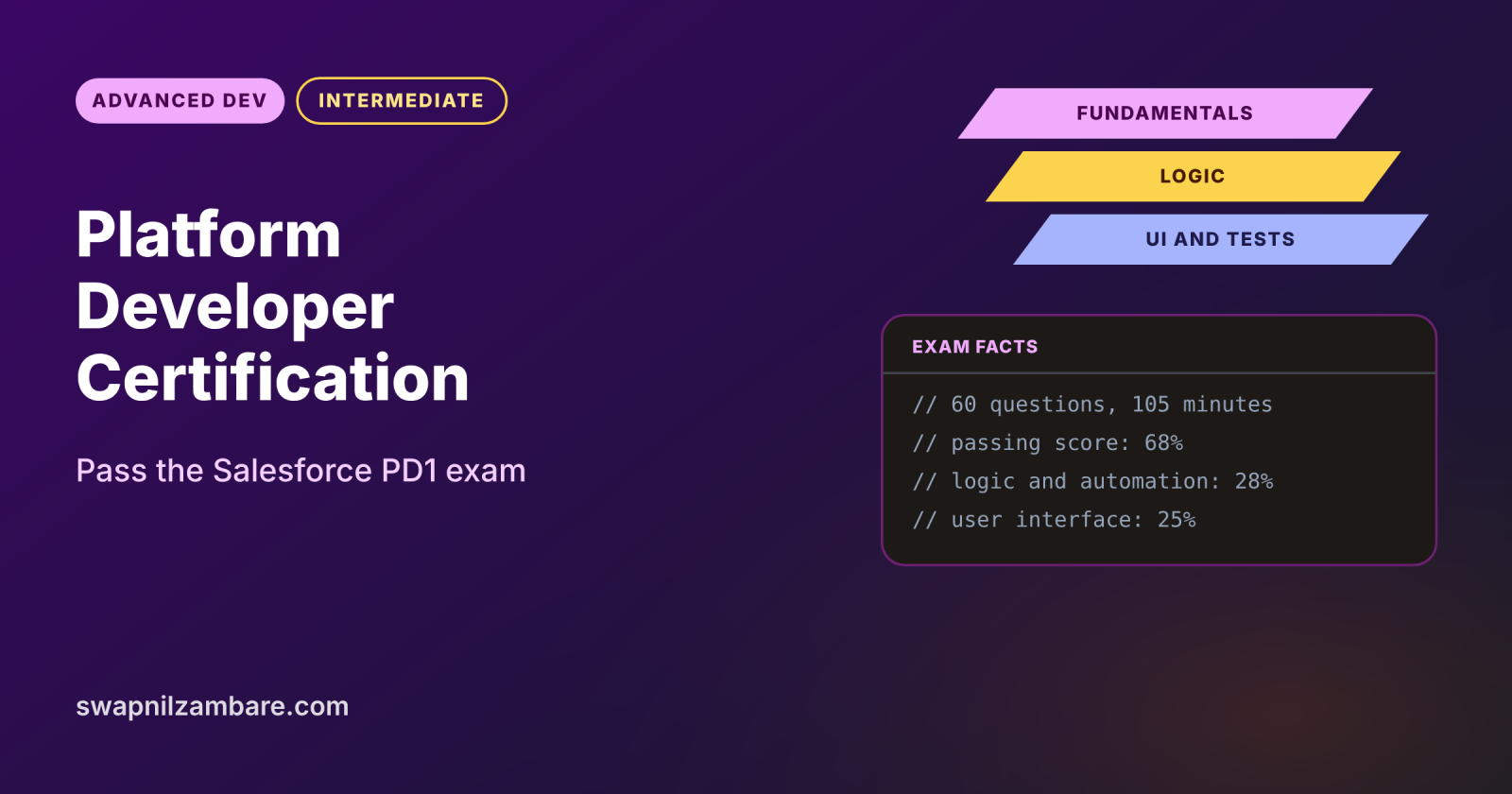
Taking the Platform Developer Certification exam follows a few steps. First, you create a Trailhead account and register through the Salesforce certification site. Next, you choose an online proctored exam or a testing centre. Then you answer 60 scored multiple-choice questions, plus up to five unscored ones, in 105 minutes. After that, you see a pass or fail result with section scores. Finally, you complete a yearly maintenance module on Trailhead to keep the credential.
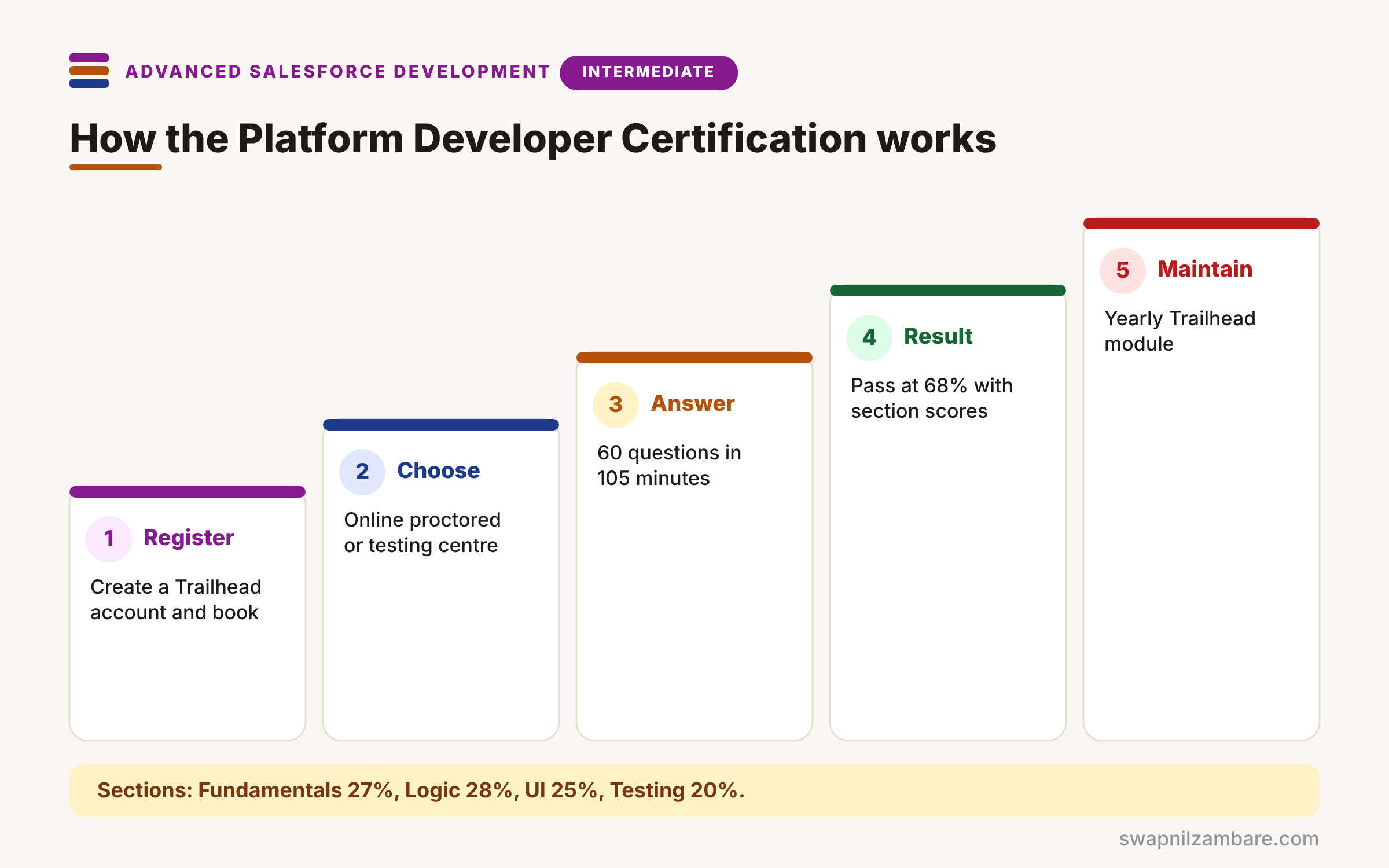
Developer Fundamentals (27%)
This covers multi-tenancy, the data model, declarative vs programmatic choices and governor limits. So you need to know when Flow beats Apex.
Process Automation and Logic (28%)
This is the largest section, with Apex, SOQL, SOSL, DML, triggers and exceptions. Expect many “what is the output” code questions.
User Interface (25%)
This covers LWC, Aura basics and Visualforce basics, plus how components get data. So practise wire, imperative Apex and events.
Testing, Debugging and Deployment (20%)
This covers test classes, coverage, debug logs and deployment tools. Know Test.startTest, @TestSetup and the 75% rule.
Exam Facts at a Glance
The table below lists the key exam facts from the official exam guide.
| Item | Value |
|---|---|
| Questions | 60 scored, plus up to 5 unscored |
| Time | 105 minutes |
| Passing score | 68% |
| Fee | US$200, retake US$100, plus taxes |
| Prerequisite | None |
| Maintenance | Yearly Trailhead module |
Platform Developer vs Platform App Builder
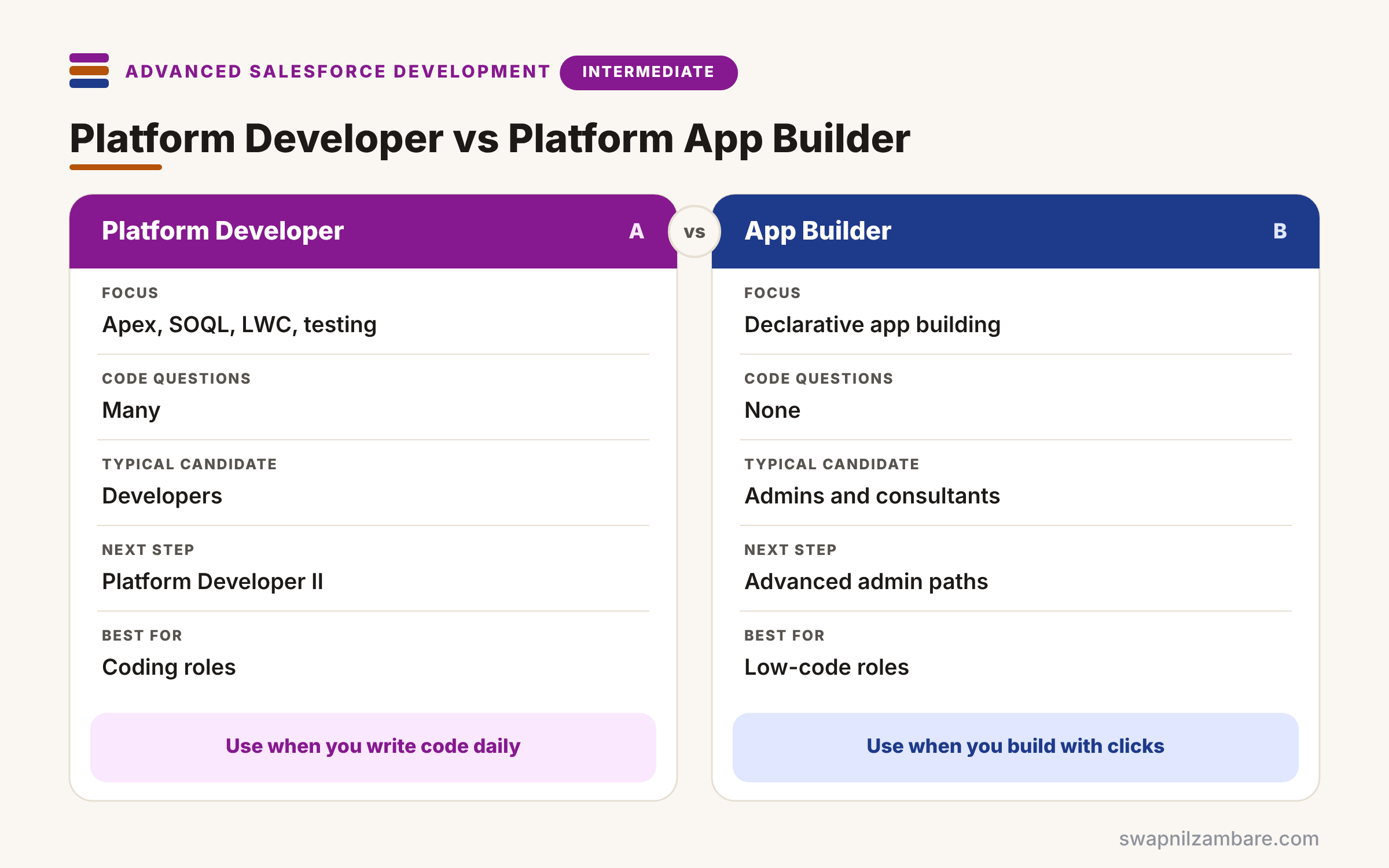
The table below compares this exam with the Platform App Builder exam.
| Feature | Platform Developer | Platform App Builder |
|---|---|---|
| Focus | Apex, SOQL, LWC, testing | Declarative app building |
| Code questions | Many | None |
| Typical candidate | Developers | Admins and consultants |
| Next step | Platform Developer II | Advanced admin or architect paths |
| Best for | Coding roles | Low-code roles |
When to use which depends on your role. Take Platform Developer if you write code daily. Take App Builder first if you mostly build with clicks.
A Real Platform Developer Certification Study Plan
Let’s build a six-week Platform Developer Certification plan that fits around a full-time job. Each week links to posts from this series.
Step 1: The Six-Week Plan
The table below maps each week to topics and practice.
| Week | Topics | Practice |
|---|---|---|
| 1 | Data model, limits, declarative vs code | Governor limits quiz |
| 2 | Apex basics, collections, classes | Write five small classes |
| 3 | SOQL, DML, triggers, order of execution | Build a bulk-safe trigger |
| 4 | LWC, Apex from LWC, events | Build a course list component |
| 5 | Tests, debugging, deployment | Reach 90% coverage on a class |
| 6 | Full mock exams and weak areas | Two timed practice tests |
Step 2: Practise Reading Code Questions
// What is printed? (typical exam style)
List<Integer> nums = new List<Integer>{ 3, 1, 2 };
Set<Integer> uniq = new Set<Integer>(nums);
uniq.add(1);
nums.sort();
System.debug(uniq.size() + ' ' + nums[0]);
Read every line slowly and track the values. The set ignores the duplicate 1, and sort changes the list to 1, 2, 3.
Here is the output.
3 1Step 3: A Trigger Question to Practise
// Which change makes this trigger bulk-safe?
trigger SetCourseOwner on Course__c (before insert) {
    for (Course__c c : Trigger.new) {
        User u = [SELECT Id FROM User WHERE Alias = 'amehta' LIMIT 1];
        c.OwnerId = u.Id;
    }
}
The query runs once per record, so 200 records would use 200 queries and fail. The right answer moves the query above the loop.
Platform Developer Certification Exam-Day Tips
Flag hard questions and come back later, because every question has the same weight. Also, watch for words like “most efficient” or “fewest lines”, which change the best answer. Finally, read each answer option fully before choosing.
Common Mistakes with the Platform Developer Certification
- Memorising dumps instead of understanding concepts.
- Skipping LWC because you work mostly in Apex.
- Ignoring declarative questions, which still appear often.
- Not practising with a timer.
- Booking the exam before finishing any mock tests.
Best Practices for the Platform Developer Certification
- Study from the official exam guide and Trailhead trailmix.
- Write real code in a Developer Edition org every day.
- Learn governor limits and order of execution well.
- Take at least two timed mock exams.
- Review every wrong answer until you can explain it.
Practice Task
Write a trigger and test class that pass with 200 records, then explain each line to a friend. Hint: use @TestSetup and Test.startTest() around the DML.
Most Asked Interview Questions on the Platform Developer Certification
Interviewers often ask questions straight from the exam topics. Here are the 21 questions asked most about the Platform Developer Certification.
Basic Questions on the Platform Developer Certification
Q1: What is the official name of PD1 now?
It is the Salesforce Certified Platform Developer exam.
Q2: How many questions are on the exam?
There are 60 scored questions, plus up to five unscored ones.
Q3: How long is the exam?
You get 105 minutes.
Q4: What is the passing score?
It is 68%, so you need about 41 correct answers.
Q5: Is there a prerequisite?
No, so you can take it as your first certification.
Q6: Which section has the highest weight?
Process Automation and Logic, at 28%.
Q7: How do you keep the certification active?
Complete the yearly maintenance module on Trailhead.
Code and Scenario Questions on the Platform Developer Certification
Q8: How many SOQL queries can one synchronous transaction run?
100, so queries in loops quickly fail.
Q9: What code coverage does production deployment need?
At least 75% overall, and every trigger needs some coverage.
Q10: When should you use Flow instead of Apex?
When the logic is simple and admins can maintain it.
Q11: What does Test.startTest() do?
It gives the code under test a fresh set of limits and runs async work at stopTest.
Q12: How does an LWC call Apex?
Through @wire for cacheable reads or an imperative call that returns a promise.
Q13: What is the difference between before and after triggers?
Before triggers change fields on the same records, while after triggers work with Ids and related records.
Q14: How do you handle partial DML failures?
Use Database methods with allOrNone set to false and check each SaveResult.
Advanced Questions on the Platform Developer Certification
Q15: Why does the exam focus on bulkification?
Because Salesforce runs triggers in batches of up to 200 records.
Q16: What is the order of execution used for?
It explains when validation, triggers, flows and rollups run during a save.
Q17: How do you secure Apex in exam answers?
Use with sharing, user mode queries and stripInaccessible where needed.
Q18: How should you prepare for UI questions?
Build small LWCs that use wire, events and Lightning Data Service.
Q19: Do Visualforce and Aura still appear?
Yes, at a basic level, so learn how they relate to LWC.
Q20: How do you answer “most efficient” questions?
Pick the option with fewest queries, no loops around DML and declarative tools where enough.
Q21: What comes after this certification?
Platform Developer II, which goes deeper into performance and integration.
Official Resources
- Salesforce Certified Platform Developer Exam Guide (Salesforce Help)
- Salesforce Certified Platform Developer (Trailhead)
Quick Recap
- The Platform Developer Certification is the core developer exam.
- 60 questions, 105 minutes and a 68% passing score.
- Logic and automation is the biggest section at 28%.
- Practise code reading and bulk-safe triggers.
- Keep it active with a yearly Trailhead module.
What’s Next?
Once you pass, aim higher. Next, read our guide to the Platform Developer II certification.