Platform Developer II, or PD2, is Salesforce’s advanced developer certification for people who design and build complex, high-performing solutions. It goes beyond writing working code and asks whether your code is fast, secure, testable and well integrated. Most candidates take it after a year or two of real project work.
In this post, you will learn the exam format, the five sections, the topics that trip people up and a focused study plan. It builds on the Platform Developer certification guide, Large Data Volumes and Apex Enterprise Patterns.
What is Platform Developer II?
Platform Developer II is the Salesforce Certified Platform Developer II credential. It tests advanced Apex, integration, performance, security, LWC and testing skills, mostly through scenario questions. You must already hold the Salesforce Certified Platform Developer certification to take it.
Think of moving from a driving licence to an advanced driving course. You already know the rules, so now the test checks how you handle bad weather, heavy loads and long trips safely. PD2 is that advanced course for Salesforce code.
Why Platform Developer II Matters
PD2 is less common, so it stands out. Here is why Platform Developer II matters for senior developers at Bright Path Tutors and beyond.
- First, it signals you can design solutions, not just write code.
- Also, senior and lead roles often prefer or require it.
- Next, studying covers performance and integration gaps.
- Consultancies value it for complex client projects.
- Finally, it is a step towards architect credentials.
So PD2 is a strong signal of senior-level skill.
How Platform Developer II Works
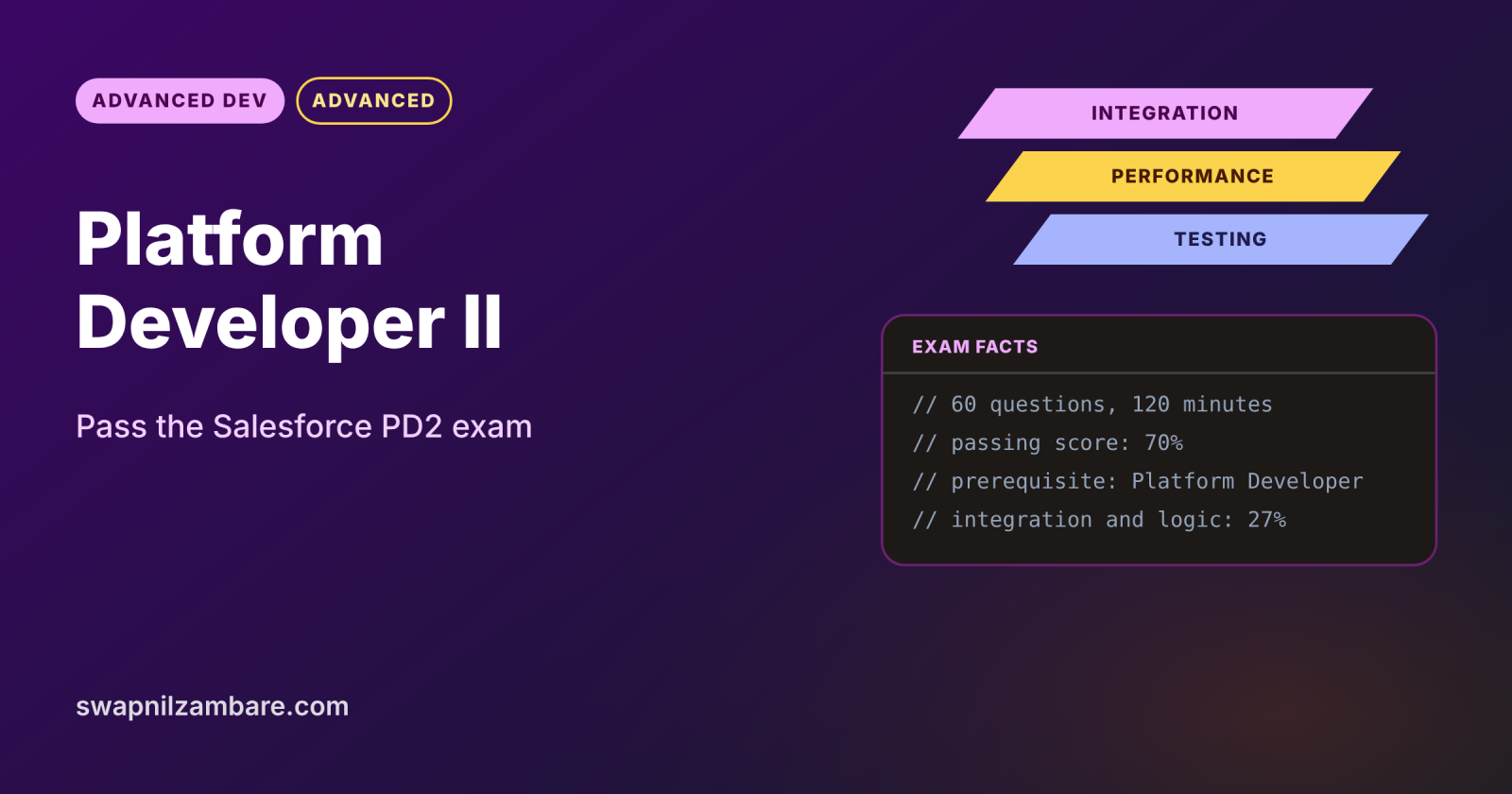
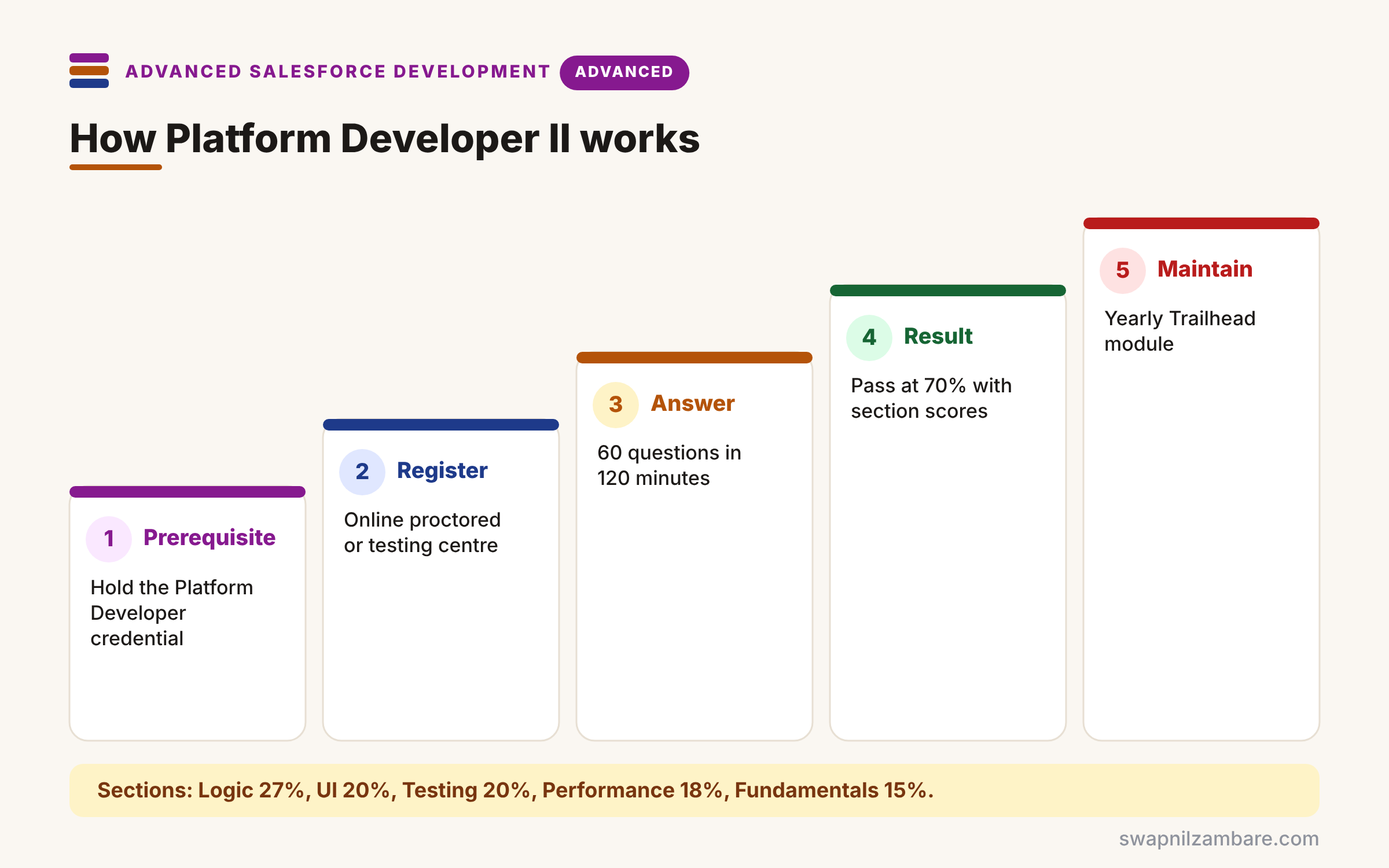
The Platform Developer II exam follows a familiar process. First, you confirm you hold the Platform Developer certification. Next, you register for an online proctored exam or a testing centre. Then you answer 60 scored questions, plus up to five unscored ones, in 120 minutes. After that, you need 70% to pass and see section feedback. Finally, you keep the credential active with yearly Trailhead maintenance.
Advanced Developer Fundamentals (15%)
This covers advanced data modelling, localisation, multi-currency and Apex features. So know custom metadata, sharing and Schema methods.
Process Automation, Logic and Integration (27%)
This is the largest section, with async Apex, callouts, platform events and REST services. Expect “which approach is best” scenarios.
User Interface (20%)
This covers advanced LWC, such as communication, performance and Lightning Data Service. Also expect questions on securing UI data.
Testing, Debugging and Deployment (20%)
This covers mocks, test data strategies, debugging tools and deployment choices. So practise HttpCalloutMock and async testing.
Performance (18%)
This covers selective queries, large data volumes, caching and efficient LWC. It is where many experienced developers lose marks.
Exam Facts at a Glance
The table below lists the key exam facts from the official exam guide.
| Item | Value |
|---|---|
| Questions | 60 scored, plus up to 5 unscored |
| Time | 120 minutes |
| Passing score | 70% |
| Fee | US$200, retake US$100, plus taxes |
| Prerequisite | Salesforce Certified Platform Developer |
| Maintenance | Yearly Trailhead module |
Platform Developer vs Platform Developer II
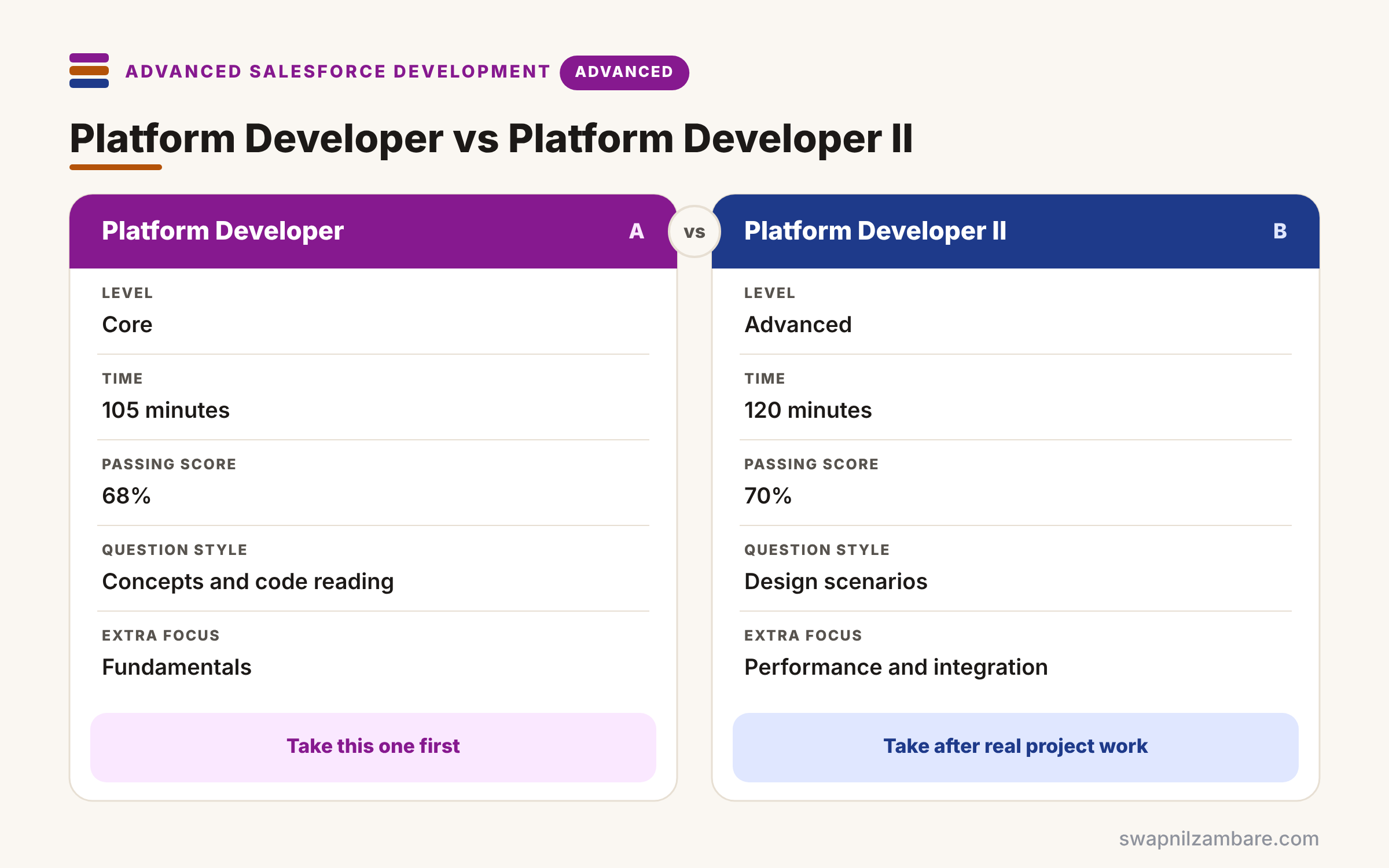
The table below compares the two developer exams.
| Feature | Platform Developer | Platform Developer II |
|---|---|---|
| Level | Core | Advanced |
| Time | 105 minutes | 120 minutes |
| Passing score | 68% | 70% |
| Question style | Concepts and code reading | Design scenarios |
| Extra focus | Fundamentals | Performance and integration |
When to use which is a question of timing. Take Platform Developer first. Move to Platform Developer II after real project work with async Apex, integrations and performance tuning.
A Real Platform Developer II Study Plan
Let’s build an eight-week Platform Developer II plan. It uses posts from Levels 7 to 10 of this series.
Step 1: The Eight-Week Plan
The table below maps each week to topics and practice.
| Week | Topics | Practice |
|---|---|---|
| 1 | Advanced Apex, Schema, sharing | Dynamic SOQL with security |
| 2 | Async Apex and platform events | Queueable chain with finalizer |
| 3 | Callouts, REST services, JSON | Callout with mock and retries |
| 4 | Advanced LWC and LDS | Component with LMS and cache |
| 5 | Testing strategies and mocks | Mock a selector and callout |
| 6 | Performance and large data | Fix a non-selective query |
| 7 | Patterns and architecture | Service and selector layers |
| 8 | Mock exams and weak areas | Two timed practice tests |
Step 2: Practise a Scenario Question
// Scenario: this runs on 50,000 Attendance__c rows nightly and fails.
// Which is the BEST fix?
public class AttendanceJob implements Queueable {
    public void execute(QueueableContext ctx) {
        List<Attendance__c> rows = [SELECT Id, Status__c FROM Attendance__c
                                    WHERE Status__c = 'Late'];
        for (Attendance__c a : rows) { a.Flagged__c = true; }
        update rows;
    }
}
The job can exceed the 10,000 DML rows limit and heap limits in one transaction. So the best answer converts it to Batch Apex with a selective QueryLocator.
Step 3: A Testing Question to Practise
// Which line makes this callout test pass?
@IsTest
static void syncsStudent() {
    // missing line here
    Test.startTest();
    LearnHubService.createStudent('Ravi', 'ravi@school.example');
    Test.stopTest();
}
Here is the expected answer.
Test.setMock(HttpCalloutMock.class, new LearnHubMock());Tests cannot make real callouts, so a mock must be registered before the call.
Platform Developer II Exam-Day Tips
Scenario questions often have two answers that work. So pick the one that scales best, uses fewest limits and is easiest to maintain. Also, read the last line of each question first, so you know what it asks.
Common Mistakes with Platform Developer II
- Studying only Apex and skipping LWC performance.
- Ignoring Large Data Volumes and selective queries.
- Weak knowledge of async limits and testing async code.
- Choosing answers that work but do not scale.
- Rushing scenario questions without reading every option.
Best Practices for Platform Developer II
- Follow the five sections of the official exam guide.
- Build a small end-to-end app with async, callouts and LWC.
- Practise mocks for selectors, callouts and events.
- Learn limits for sync and async contexts.
- Take timed practice tests and review every mistake.
Practice Task
Refactor the AttendanceJob above into Batch Apex with a test that covers 250 records. Hint: use Database.QueryLocator in start and assert results after Test.stopTest().
Most Asked Interview Questions on Platform Developer II
PD2 topics are the core of senior developer interviews. Here are the 21 questions asked most about Platform Developer II.
Basic Questions on Platform Developer II
Q1: What is the prerequisite for PD2?
You must hold the Salesforce Certified Platform Developer certification.
Q2: How many questions are on the exam?
There are 60 scored questions, plus up to five unscored ones.
Q3: How long is the exam?
You get 120 minutes.
Q4: What is the passing score?
It is 70%, so you need 42 correct answers.
Q5: Which section has the highest weight?
Process Automation, Logic and Integration, at 27%.
Q6: What does the Performance section cover?
Selective queries, large data, caching and efficient UI code.
Q7: How is PD2 different from PD1?
PD2 asks design scenarios, so you choose the best approach, not just a working one.
Code and Scenario Questions on Platform Developer II
Q8: How do you process 5 million records nightly?
Use Batch Apex with a selective QueryLocator, so each chunk gets fresh limits.
Q9: How do you call out after a trigger saves data?
Enqueue a Queueable that implements Database.AllowsCallouts.
Q10: How do you test a platform event subscriber trigger?
Publish in the test, then call Test.getEventBus().deliver() or Test.stopTest().
Q11: How do you avoid duplicate Apex queries across LWCs?
Use cacheable methods, Lightning Data Service or Platform Cache.
Q12: How do you secure a dynamic SOQL query?
Use bind variables, user mode and allow-listed field names.
Q13: How do you make a REST service safe to retry?
Use an external ID with upsert, so repeated calls do not duplicate data.
Q14: How do you mock a selector in tests?
Inject an interface, then pass a fake implementation in the test.
Advanced Questions on Platform Developer II
Q15: When do you choose platform events over Queueable?
When several subscribers must react, or when publishers and subscribers should be decoupled.
Q16: How do you find a slow query?
Use the Query Plan tool and debug logs, then add selective, indexed filters.
Q17: What is the 10,000 DML rows limit?
It is the maximum number of rows one transaction can process with DML.
Q18: How do you reduce LWC render cost?
Use lwc:if, stable keys, pagination and lean getters.
Q19: How do you design for multi-currency?
Use currency fields, convertCurrency in SOQL where needed and avoid hard-coded rates.
Q20: Why do architecture patterns appear on the exam?
Because separation of concerns makes code testable, scalable and easier to change.
Q21: What is the best way to prepare?
Build real features with async, integration and performance needs, then practise timed exams.
Official Resources
- Salesforce Certified Platform Developer II Exam Guide (Salesforce Help)
- Prepare for Your Platform Developer II Credential (Trailhead Trailmix)
Quick Recap
- Platform Developer II is the advanced developer exam.
- 60 questions, 120 minutes and a 70% passing score.
- Five sections, with integration and logic the largest.
- Performance is where many candidates lose marks.
- Choose answers that scale, not just ones that work.
What’s Next?
Certifications open doors, and interviews decide the job. Next, read our final guide to Salesforce developer interview questions.