Data Management Scenario Questions test how safely you load, clean, protect and recover data, the tasks where one mistake can affect thousands of records. This is Post 4 of our scenario series.
Each scenario matches a topic from our Salesforce Deployment Interview Questions list. In every answer, mention a backup and a small test load first.
How to Use These Data Management Scenario Questions
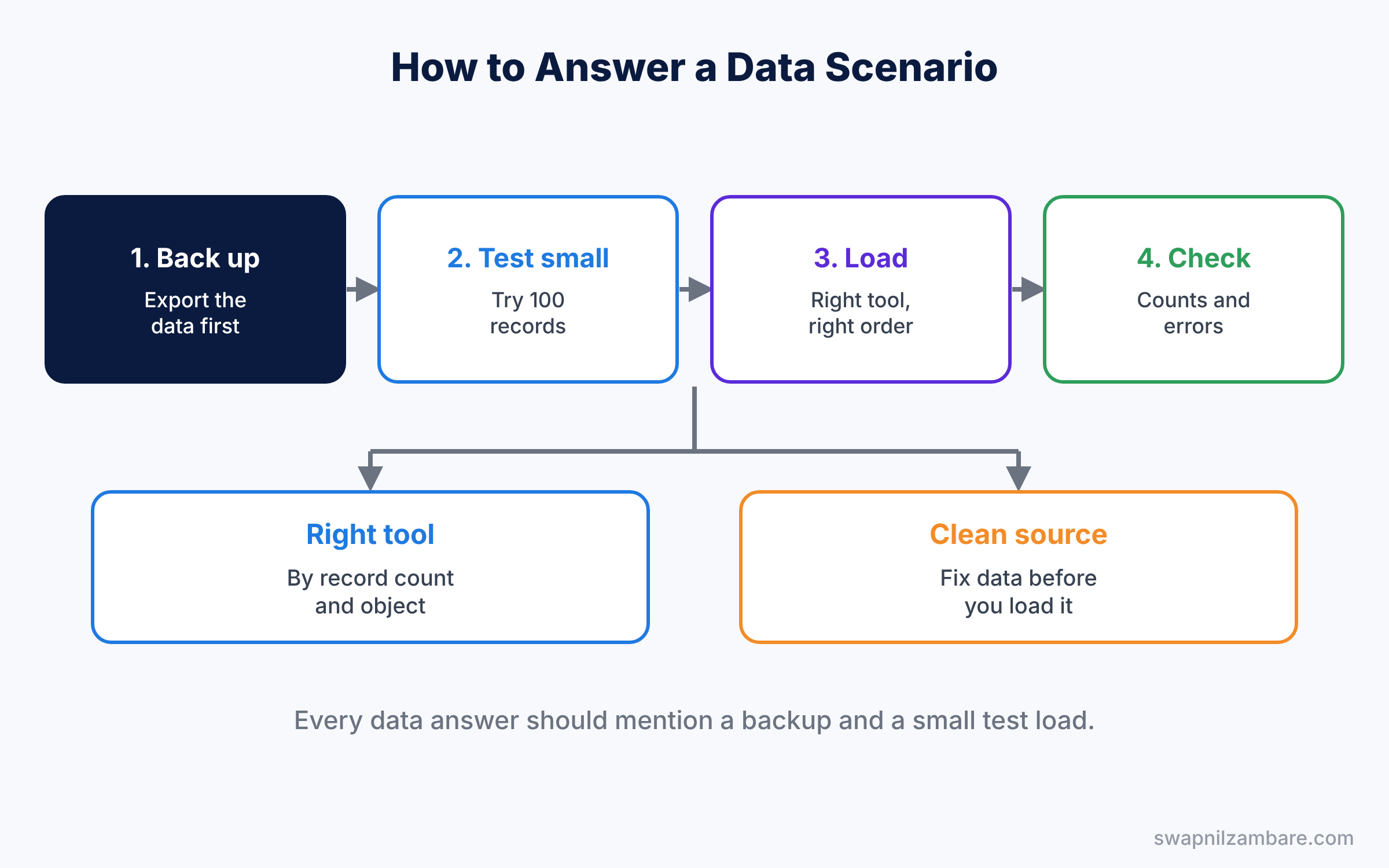
Answer every scenario in four short steps. First, repeat the problem in your own words. Next, say what you would check. Then name the exact feature or setting you would use, and say why. Finally, explain how you would test the fix with a real user.
Data Management Scenario Questions on Loading Data
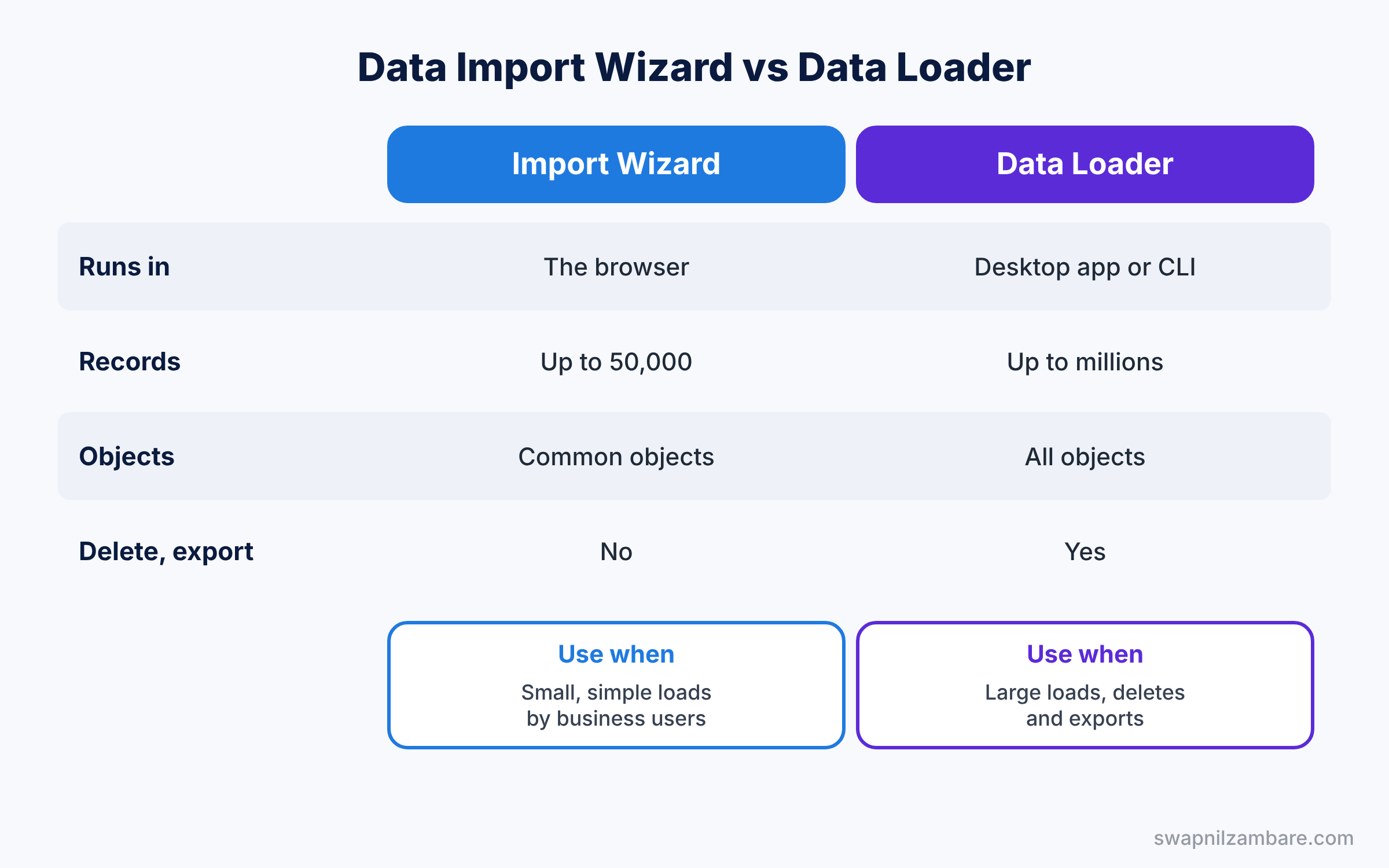
Study with Data Loader and Import Wizard.
- You must load 200,000 contacts linked to accounts. Describe your plan.
- You must update one field on 80,000 records. Which tool and steps do you use?
- Marketing gives you 3,000 leads in a spreadsheet. Which tool do you use, and why?
- A load fails for 300 rows with “required field missing”. What do you do?
- After a load, many contacts have no account. What went wrong?
- A load must not trigger welcome emails to customers. How do you prevent it?
- A file has dates in DD/MM/YYYY format, but loads fail. What do you check?
- A load must update records and create new ones at the same time. Which operation do you use?
- A picklist load fails because of unknown values. What do you do?
- A load runs very slowly. What settings do you change?
A good data answer always includes a backup, a small test file and the right tool for the record count.
Migrating Data Scenarios
Study with Data Migration.
- You move from an old CRM to Salesforce. In what order do you load the data?
- The business wants to keep original created dates from the old system. How do you do it?
- Old records must keep their original owners, but some owners have left. What do you do?
- A migration must finish over one weekend. How do you plan the cutover?
- After migration, record counts do not match the old system. How do you check?
- The old system has contacts without companies. How do you load them?
- The old system has 15 years of activity history. Do you migrate all of it?
- Users want old attachments moved to Salesforce. What do you check first?
- A migration must run again after fixing errors. How do you avoid duplicates?
Explain the load order: parents first, then children, using external IDs. Then say how you would check record counts after the load.
Data Management Scenario Questions on Duplicates and Data Quality
Study with Duplicate Rules.
- Users keep creating duplicate accounts. What do you do?
- A load created 5,000 duplicate contacts. How do you clean up?
- Duplicate rules block a valid record a user needs to save. What are your options?
- Leads arrive with names in all capitals. How do you clean them going forward?
- Sales says reports are wrong because many fields are empty. How do you improve data quality?
- Two accounts are duplicates, and each has its own opportunities. What happens when you merge them?
- A matching rule finds too many false duplicates. How do you tune it?
- Email addresses are stored in different letter cases. How do you keep them consistent?
- Leadership wants a monthly data quality score. What do you build?
A strong answer fixes both the old duplicates and the cause. So mention matching rules, duplicate rules and a cleanup report.
Deleting and Recovering Data Scenarios
Study with Data Management.
- A user deleted 300 records by mistake 20 days ago. Can you get them back?
- A user deleted an account an hour ago. How do you restore it with its contacts?
- You must delete 1 million old task records. How do you plan it?
- Leadership asks for a full data backup every week. What do you set up?
- A user mass transferred the wrong records yesterday. How do you fix it?
- A user deleted a custom object record that had child records. How do you restore both?
- Records were hard deleted by mistake. What can you do?
- A user deleted a field with important data. Can you get it back?
- You must remove all data for a customer who asked to be forgotten. How do you plan it?
Know the Recycle Bin limit of 15 days and what is lost after that. Then mention backups as the long-term answer.
Data Management Scenario Questions on Storage and Archiving
Study with Data Management.
- Data storage is at 95%. What are your options?
- File storage is full because users attach large files. What do you do?
- Old closed cases from ten years ago slow down reports. What do you suggest?
- One account has 50,000 child contacts and saves are slow. What is the problem, and how do you fix it?
- Old email messages take most of your storage. What can you do?
- Leadership wants to keep closed cases for seven years but storage is limited. What do you suggest?
- Your org is close to the file storage limit. How do you find the biggest files?
Explain what uses storage and how to measure it before you delete anything. Then suggest archiving for old records.
Sandbox Data Scenarios
Study with Data Mask.
- Testers need 500 realistic records in a Developer sandbox. How do you get them?
- A refreshed Full sandbox has real customer emails. What do you do before testers start?
- A Partial Copy sandbox needs only this year records. How do you set it up?
- Developers need test data that matches production field values. How do you provide it?
- A sandbox has no data after refresh because it is a Developer sandbox. What are your options?
- Testers need users in every role in the sandbox. How do you set them up quickly?
- A sandbox integration points to the production system. What do you change after refresh?
A good answer keeps real customer data out of test orgs. So mention Data Mask and Seed or sample data.
Data Management Scenario Questions FAQ
What should every data answer include?
A backup, a small test load, the right tool and a check of results after the load.
Is it OK to say “I would ask a developer”?
Yes, for very large or complex jobs. Explain what you would prepare first.
Official Resources
Quick Recap
- These Data Management Scenario Questions cover loads, migration, duplicates, recovery, storage and sandbox data.
- Always back up first and test with a small file.
- Pick the tool by record count and object.
- Check results after every load.
- Next, practise reports and performance scenarios.
What’s Next?
Continue with the next set of scenarios. Read Performance Scenario Interview Questions: Reports and Speed.