Business Analysis for Admins means understanding the real business need before you click anything in Setup. A manager may ask for “a new field”, while the real problem is a missing follow-up step. So good admins ask questions first and build second.
This post builds on the admin career roadmap and Flow Builder. We will analyse a request from the Bright Path Tutors fee team.
What is Business Analysis for Admins?
Business Analysis for Admins is the set of skills an admin uses to turn business needs into Salesforce solutions. It includes discovery, process mapping, writing user stories, prioritising and confirming the solution with users.
Think of a tailor. A poor tailor sews whatever the customer points at. A good tailor measures, asks about the occasion and then suggests a design. Business analysis is the measuring part.
Why Business Analysis for Admins Matters
Many Salesforce projects fail because the wrong thing was built. Users ask for a feature based on their old habits. However, the real need may be simpler or different.
So Business Analysis for Admins saves rework. Also, it builds trust, because users feel heard and see solutions that fit their day.
How Business Analysis for Admins Works
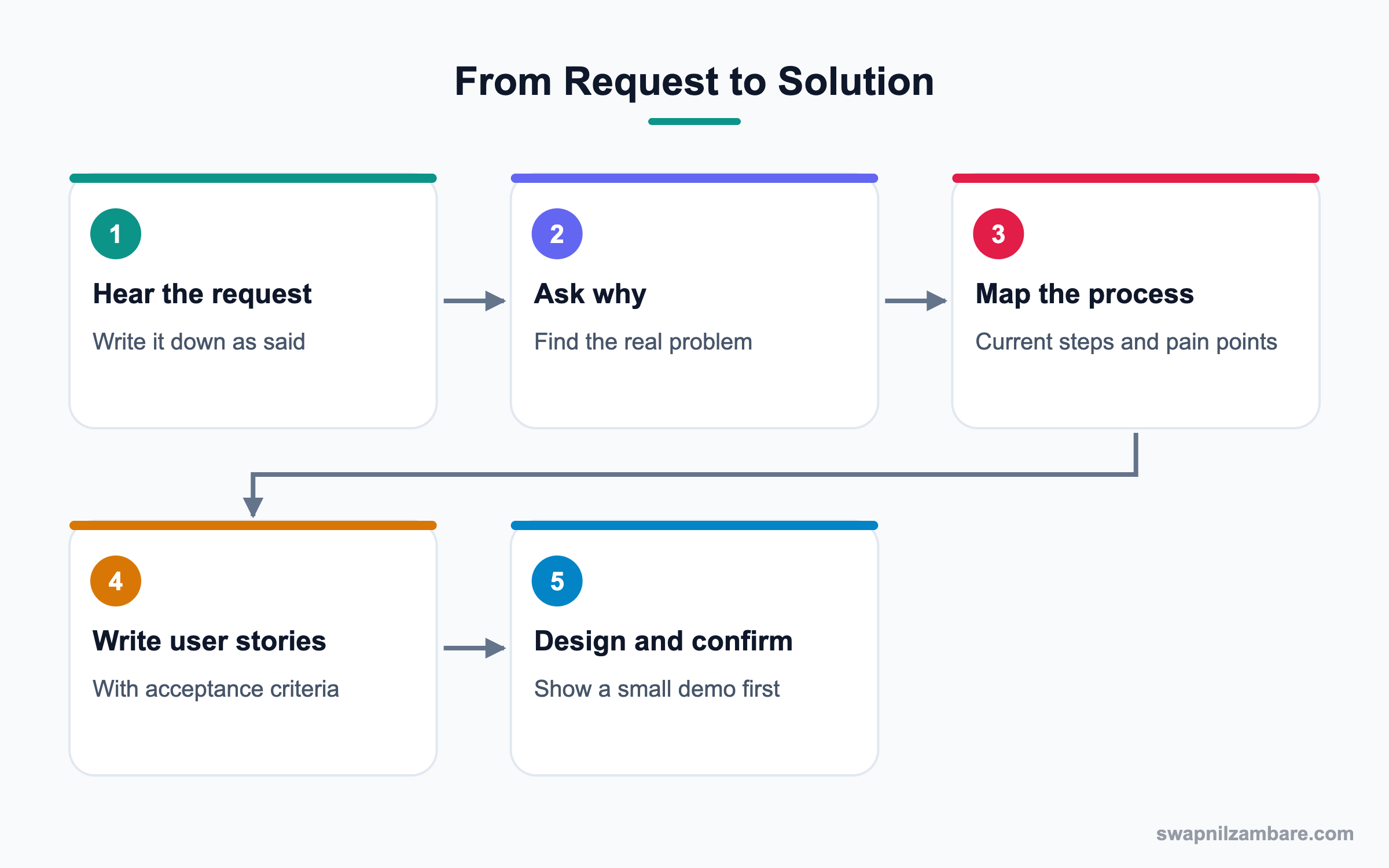
Business Analysis for Admins starts with a request and ends with a confirmed design. In between, you ask why, map the current process and write clear user stories.
Discovery Questions
Ask open questions like “What happens today?”, “What goes wrong?” and “How will you know it works?”. Then listen more than you talk.
The Five Whys
Ask why several times to reach the root cause. For example, “Why do you need a field?” leads to “Because we forget follow-ups”.
Process Mapping
Draw the current process as boxes and arrows, called the as-is map. Then draw the improved to-be map with Salesforce steps.
User Stories
A user story says who needs something, what they need and why. For example, “As a fee officer, I want a reminder before the due date, so that fewer fees are late.”
Acceptance Criteria
These are the tests that prove a story is done. They are often written as Given, When, Then.
Prioritisation
Not every request can be built now. Use a simple method like MoSCoW, which sorts items into Must, Should, Could and Won’t.
Business Analysis for Admins Toolkit
This table lists common tools and when to use them.
| Tool | Use it to | Example |
|---|---|---|
| Discovery meeting | Understand the need | 30 minutes with the fee team |
| Five whys | Find the root cause | Late fees, not missing field |
| As-is process map | Show today’s steps | Fee follow-up on paper |
| To-be process map | Show the new steps | Automated reminders |
| User story | Describe the need | As a fee officer… |
| MoSCoW | Prioritise | Must have reminders |
Requirement vs User Story
Admins meet both formats. This table compares them.
| Feature | Requirement | User story |
|---|---|---|
| Format | The system shall… | As a role, I want…, so that… |
| Focus | System behaviour | User value |
| Testing | Separate test cases | Acceptance criteria |
| Size | Can be large | Small |
| Common in | Formal projects | Agile teams |
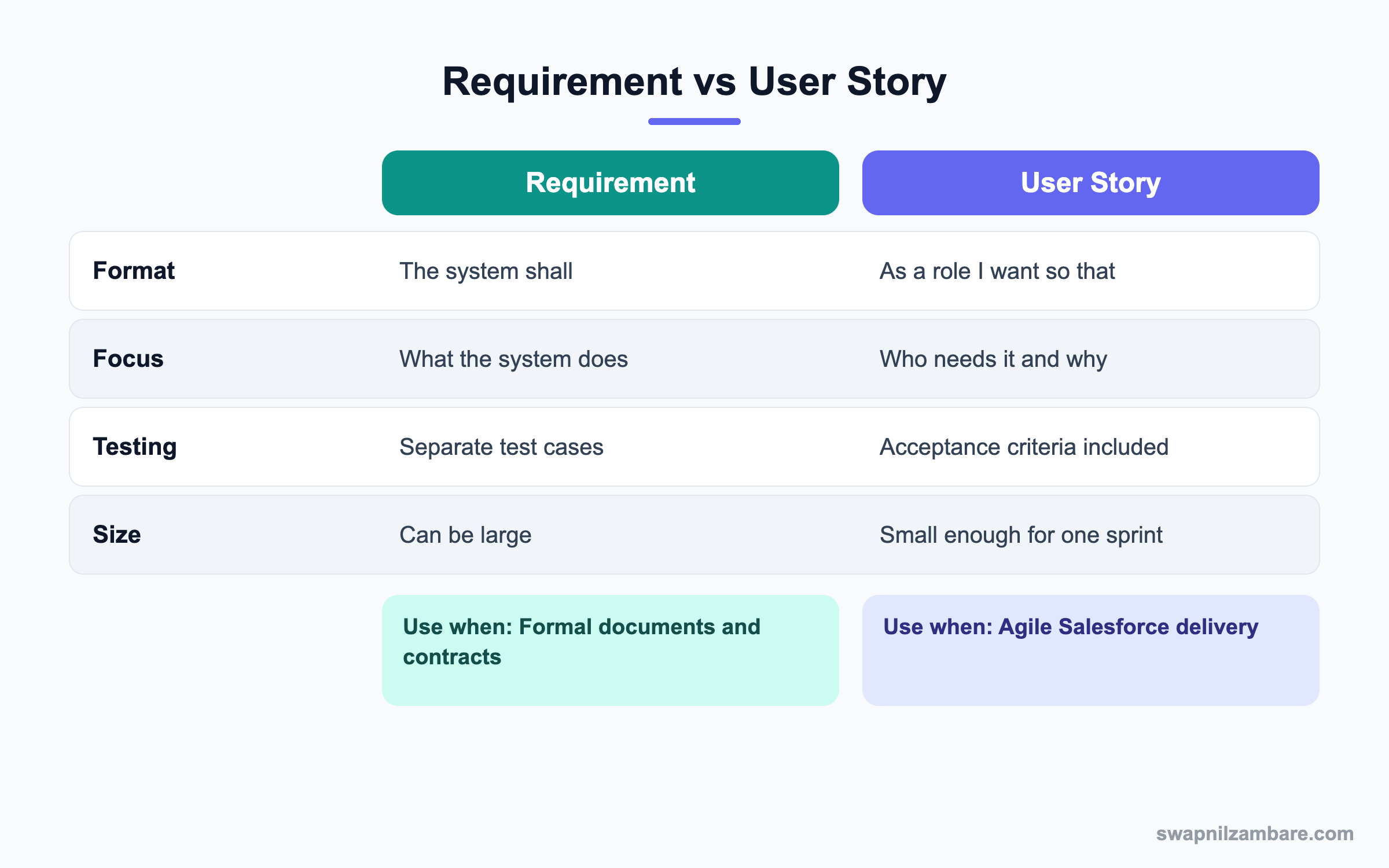
In short, user stories keep the user and the reason in view. That is why most Salesforce teams prefer them.
A Real Business Analysis for Admins Example
The fee manager at Bright Path Tutors asks for “a checkbox called Reminder Sent on Enrolment”. Let’s analyse it properly.
Step 1: Ask Why
- Why a checkbox? To know if the parent was reminded.
- Why does that matter? Because many fees are paid late.
- Why are they late? Because officers forget to send reminders.
- So the real need is reliable reminders, not just a checkbox.
Step 2: Map the Process
| As-is step | Pain point |
|---|---|
| Officer checks a spreadsheet weekly | Easy to forget |
| Officer emails parents by hand | Slow, mixed wording |
| Officer marks the sheet | No record in Salesforce |
Step 3: Write the User Story
“As a fee officer, I want parents to get an automatic reminder three days before the due date, so that fewer fees are paid late.”
These are the acceptance criteria.
Given an enrolment with Fee Status = Due
And Due Date is 3 days from today
When the scheduled flow runs at 8 AM
Then the parent receives the Fee Reminder email
And Reminder Sent Date is set to today
Step 4: Confirm the Design
Show the fee manager a quick demo in a sandbox. Then agree on the email wording and the time of day. Finally, build the scheduled flow and test it with real-looking data.
Common Mistakes in Business Analysis for Admins
- Building exactly what was asked without asking why.
- Talking to the manager but never to the people who do the work.
- Writing stories without acceptance criteria.
- Treating every request as urgent.
- Skipping the demo, so users see the solution too late.
Best Practices for Business Analysis for Admins
- Ask open questions and repeat back what you heard.
- Map the as-is process before designing the to-be one.
- Keep user stories small and testable.
- Show small demos early and often.
- Keep a visible backlog with priorities agreed by the business.
Practice Task
Pick a request from your own work or imagine one. Ask the five whys, then write one user story with three acceptance criteria. Hint: the “so that” part must state a business benefit.
Most Asked Business Analysis for Admins Interview Questions
These Business Analysis for Admins questions test how you think, not just what you click.
Basic Business Analysis for Admins Interview Questions
Q1: What is business analysis for a Salesforce admin?
Business Analysis for Admins is understanding business needs and turning them into the right Salesforce solution. It includes discovery, mapping, stories and testing.
Q2: What is a user story?
A short description of a need in the form “As a role, I want something, so that benefit”.
Q3: What are acceptance criteria?
They are the conditions that prove a story is done. They make testing clear for everyone.
Q4: What is an as-is process map?
It shows how work happens today, including problems. It helps find what to fix.
Q5: What is a to-be process map?
It shows how the process will work after the change, including Salesforce steps.
Q6: What is MoSCoW?
A prioritisation method that sorts items into Must have, Should have, Could have and Won’t have now.
Q7: Why ask why so many times?
Because the first request often hides the real problem, which is a core lesson of Business Analysis for Admins. Asking why reveals it.
Intermediate Business Analysis for Admins Interview Questions
Q8: How do you run a discovery meeting?
Set a clear goal, invite the people who do the work, ask open questions and summarise at the end.
Q9: How do you handle conflicting requests?
Bring both sides together, show the impact of each option and let the business owner decide.
Q10: What is the difference between functional and non-functional requirements?
Functional ones say what the system does. Non-functional ones cover qualities like speed, security and usability.
Q11: How do you write good acceptance criteria?
Make them specific and testable, often with Given, When, Then. Avoid vague words like fast or easy.
Q12: When would you say no to a request?
When it adds little value, breaks standards or has a better existing solution. Then explain the reason and offer an alternative.
Q13: How do you confirm you understood a requirement?
Repeat it back, show a sketch or demo and get written agreement on the story.
Q14: What tools can you use to map processes?
Whiteboards, Lucidchart, Miro or even sticky notes. The tool matters less than involving users.
Advanced Business Analysis for Admins Interview Questions
Q15: Scenario: a manager wants ten new fields. What do you do?
Ask what decisions the fields support. Often reports, existing fields or automation meet the need with fewer fields.
Q16: How do you measure if a solution worked?
Agree on a success metric up front, like fewer late fees. Then compare before and after.
Q17: How do you manage scope creep?
Keep a backlog, agree on what is in each release and move new ideas to later releases.
Q18: Scenario: users reject a solution after launch. What went wrong and what now?
Usually users were not involved early. Now gather feedback, fix the top issues and involve them in the next change.
Q19: How does business analysis help with Agentforce projects?
It defines the jobs the agent should do, the data it needs and how success is measured. So AI work stays focused.
Q20: What is a stakeholder map?
A list of people affected by a change, with their interest and influence. It shows who to involve and how.
Q21: How do you document decisions?
Keep a short decision log with date, decision, reason and owner. Link it to the user stories.
Q22: Scenario: two departments define a field differently. How do you resolve it?
Hold a short meeting, agree one definition and record it in the data dictionary. Then update help text.
Q23: Why demo early instead of building everything first?
Because early feedback is cheap. So you fix the design before you build the full solution.
Q24: How do you estimate effort for a story?
Break it into tasks, compare with past work and add time for testing. Then share a range, not a single promise.
Q25: What is the Salesforce Business Analyst certification?
It is a Salesforce credential that tests discovery, requirements, user stories and process mapping skills. It suits admins who want to grow.
Q26: Do small orgs need Business Analysis for Admins?
Yes. Even in a small org, one wrong build wastes days. So a short chat and one user story still help.
Q27: How long should a discovery meeting be?
Usually 30 to 60 minutes is enough for one topic. Then follow up with short questions instead of long meetings.
Q28: How do you talk to users who are not technical?
Use their words, not Salesforce terms. For example, say “reminder email” instead of “scheduled flow action”.
Q29: What is the role of a data dictionary in Business Analysis for Admins?
It records what each field means and who owns it. So teams share one definition and reports stay correct.
Q30: How do you prioritise when everything is a Must?
Ask what happens if an item waits one month. Then the items with real business loss stay as Must.
Official Resources
Quick Recap
- Business Analysis for Admins means understanding needs before building.
- Ask why to find the real problem behind a request.
- Map the as-is and to-be processes.
- Write small user stories with clear acceptance criteria.
- Demo early and agree on success metrics.
What’s Next?
Next, we help people use what we build with Salesforce User Adoption and Change Management.