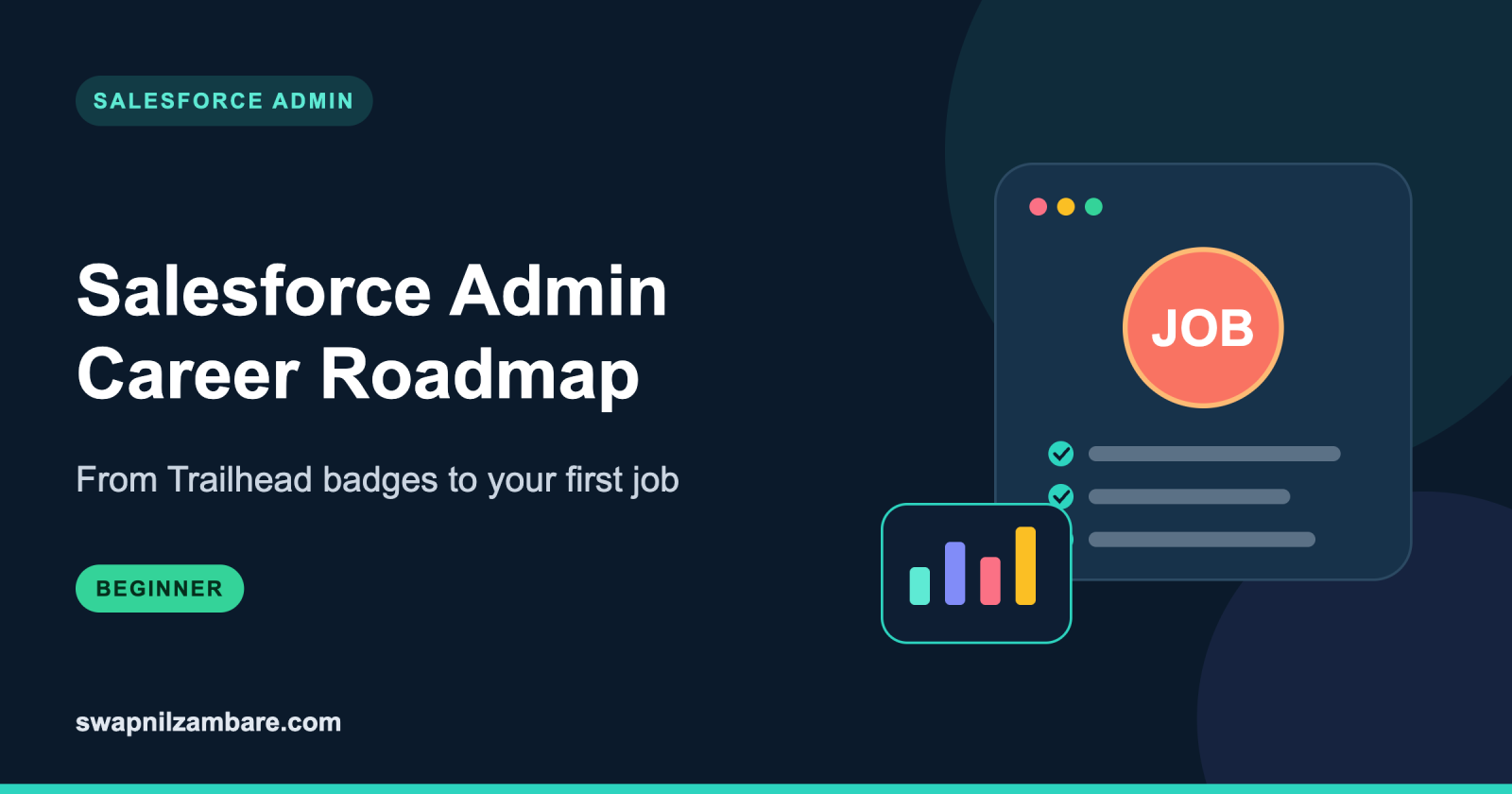
A Salesforce Admin Career is one of the most common ways into the Salesforce world. You do not need to write code to start, but you do need clear skills and proof that you can use them. This roadmap shows the steps in order, so you know what to do this month and next.
This post builds on Salesforce Admin vs Developer and the admin certification guide. It also links back to the posts in this series that teach each skill.
What is a Salesforce Admin Career?
A Salesforce Admin Career means working as the person who sets up and runs Salesforce for a company. Admins manage users, security, data, reports and automation. They also talk to business teams and turn requests into working features.
Think of an admin as the manager of a busy apartment building. They hand out keys, fix rules, keep records tidy and help residents with problems. Most of the job is people and process, with Salesforce as the tool.
Why a Salesforce Admin Career Is Worth Planning
Thousands of companies use Salesforce, so admins are needed in many industries. Also, the role grows into business analyst, consultant, architect or developer later. So it is a strong first step.
However, many beginners collect badges without a plan. Then they struggle in interviews because they cannot show real work. A planned Salesforce Admin Career path fixes this.
How the Salesforce Admin Career Path Works
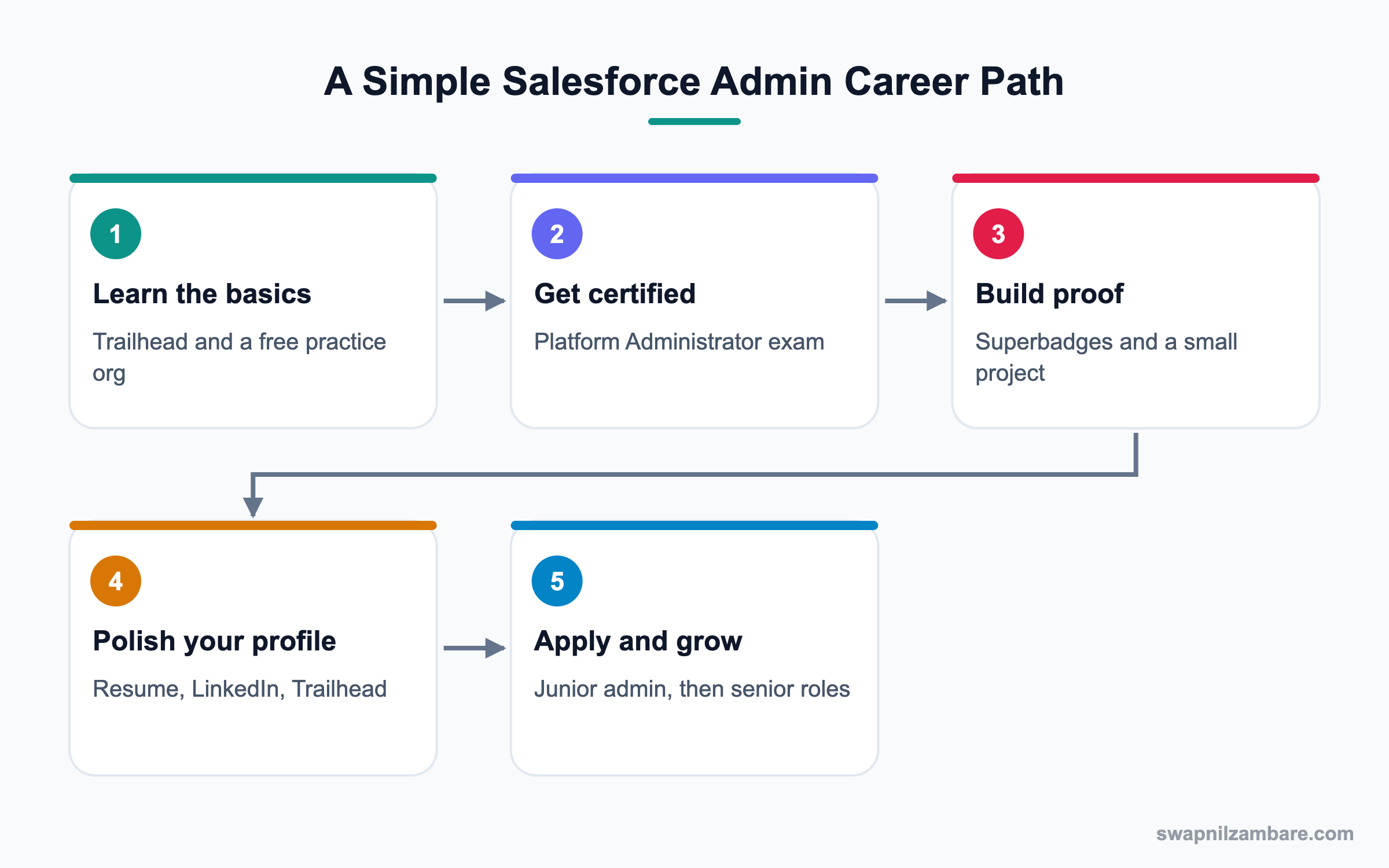
The Salesforce Admin Career path has five stages. You learn, you certify, you build proof, you polish your profile and then you apply. Each stage feeds the next one.
Stage 1: Learn the Basics
Start with Trailhead and a free Developer Edition org. Follow this blog’s admin series in order, from objects and fields to flows and security. Spend about one hour a day, and always try each lesson in your org.
Stage 2: Get Certified
The first exam is the Salesforce Certified Platform Administrator. It tests users, security, data, automation and reports. Use Trailhead practice, this blog’s interview posts and a timed mock test.
Stage 3: Build Proof
Complete a few admin superbadges, because they test hands-on skill. Then build one small project end to end, like our Bright Path Tutors app. Record a short video or write a blog post about it.
Stage 4: Polish Your Profile
Update your resume, LinkedIn and public Trailhead profile. Show your project, certifications and badges clearly.
Stage 5: Apply and Grow
Apply for junior admin, support analyst and admin trainee roles. After a year, aim for the Platform Administrator II or Platform App Builder certification.
Skills Every Salesforce Admin Career Needs
This table lists the core skills and where this blog covers them.
| Skill area | What to know | Where to start | |
|---|---|---|---|
| Data model | Objects, fields, relationships | [[Data model post | Data Model Explained]] |
| Security | Profiles, permission sets, sharing | [[Sharing post | Sharing Rules, Roles and OWD]] |
| Automation | Flows, approvals, validation rules | Flow Builder posts | |
| Reports | Reports, dashboards, report types | Reports and Dashboards post | |
| Data | Import, export, duplicates | Data Loader post | |
| Soft skills | Listening, writing, training | Practise with real users |
Fresher vs Career Switcher
Freshers and people changing careers follow the same steps. However, they lean on different strengths. This table compares them.
| Point | Fresher | Career Switcher |
|---|---|---|
| Strength | Time to practise | Business and domain knowledge |
| Gap | No work history | New to Salesforce |
| Best proof | Projects and superbadges | Projects tied to old domain |
| First role | Junior admin, support | Admin in a known industry |
| Story in interview | Learning speed | Business problems solved |
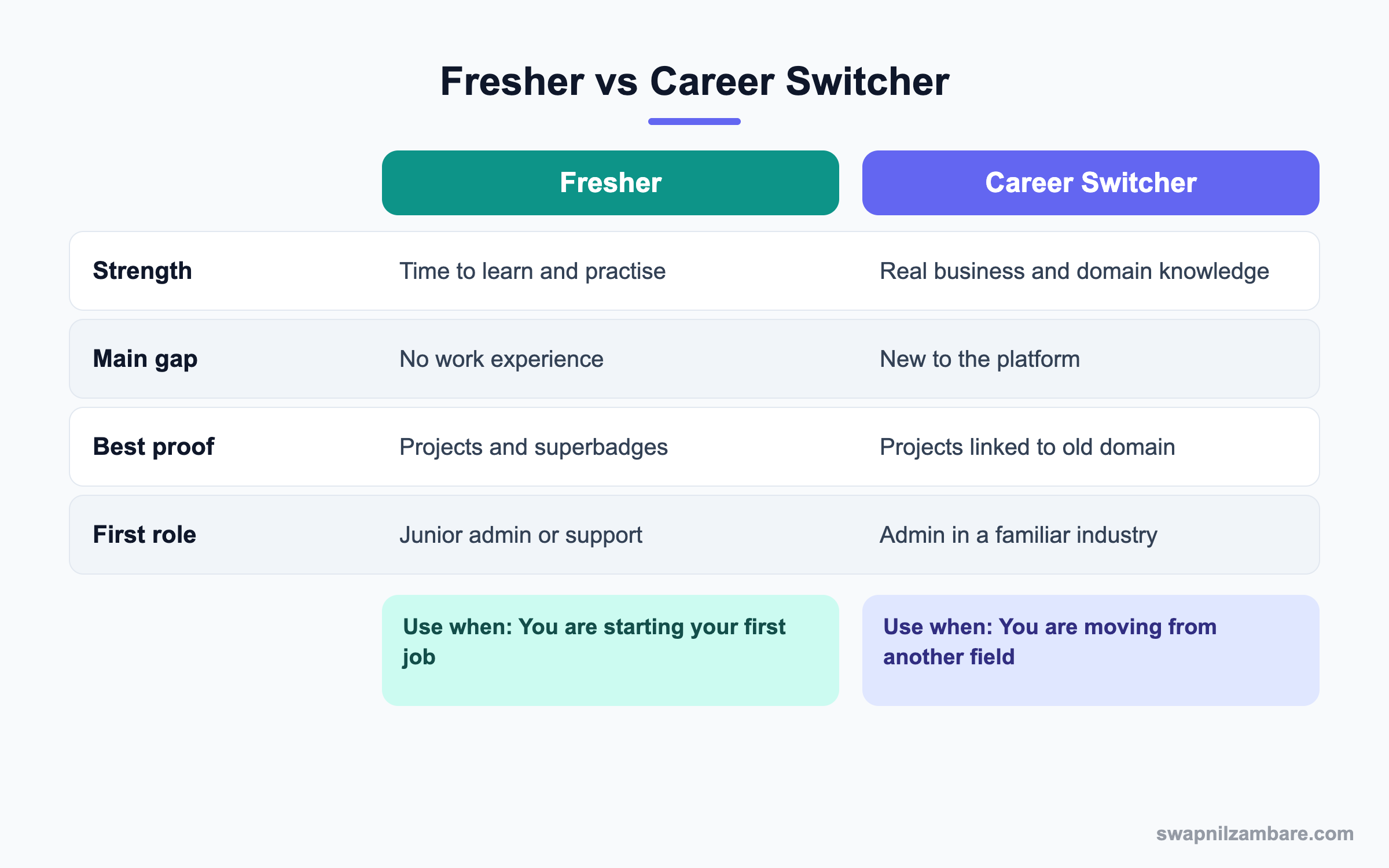
In short, freshers should show strong hands-on projects. Career switchers should show how Salesforce solves problems from their old field.
A Real Salesforce Admin Career Example
Asha Mehta is a commerce graduate who wants her first admin job. Here is her 90-day plan.
Days 1 to 30: Learn
- Create a Developer Edition org.
- Complete the Admin Beginner trail on Trailhead.
- Follow this blog’s first 20 admin posts and build each example.
Days 31 to 60: Certify
- Take two practice tests and note weak topics.
- Re-read those topics and rebuild them in the org.
- Book and pass the Platform Administrator exam.
Days 61 to 90: Prove and Apply
- Finish two admin superbadges.
- Build the Bright Path Tutors app with objects, flows, reports and a dashboard.
- Write a one-page project summary with screenshots.
- Update her resume and apply to ten roles a week.
This is how Asha wrote her project on her resume.
| Resume section | What she wrote |
|---|---|
| Project title | Bright Path Tutors CRM |
| Objects | Course, Enrolment, Student, with lookups |
| Automation | Record-triggered flow for welcome emails |
| Security | Roles, sharing rules, permission sets |
| Reporting | Enrolments by course dashboard |
| Result | Cut manual follow-up steps in the demo by half |
Common Mistakes in a Salesforce Admin Career Plan
- Collecting hundreds of badges with no real project.
- Memorising exam dumps, which fail in real interviews.
- Writing “Salesforce” on a resume with no details of what you built.
- Ignoring soft skills like explaining a solution simply.
- Waiting for the perfect job instead of starting in a support role.
Best Practices for a Salesforce Admin Career
- Build every lesson in your own practice org.
- Keep one project you can demo in five minutes.
- Join Trailblazer Community groups and local user groups.
- Write short posts or notes about what you learn, because it proves understanding.
- Renew your certifications on time through Trailhead maintenance modules.
Practice Task
Write a one-page project summary for your practice org. Include the business problem, objects, automation, security and one report. Then ask a friend to read it and explain it back to you. Hint: if they cannot, simplify the words.
Most Asked Salesforce Admin Career Interview Questions
So these Salesforce Admin Career questions come from HR and manager rounds. They test your story, not just your clicks.
Basic Salesforce Admin Career Interview Questions
Q1: Tell me about yourself.
Keep it to one minute. Share your background, why you chose Salesforce, your certification and one project you built.
Q2: Why do you want to be a Salesforce admin?
Say what you enjoy, such as solving business problems and helping users. Then link it to something you built or fixed.
Q3: Which certifications do you have?
Name each one and the month you passed it. If you are preparing, say which exam and when you plan to take it.
Q4: What is your Trailhead rank?
Share your rank and badge count, but focus on superbadges and projects. They show real skill.
Q5: Describe a project you built.
Explain the problem, the objects, the automation and the result. Use simple words and a clear order.
Q6: How do you keep learning?
Mention Trailhead, release notes, community groups and blogs. Also say how you try new features in your practice org.
Q7: What are a Salesforce admin’s daily tasks?
Managing users, fixing access issues, building reports, updating flows and handling small change requests. Admins also train users.
Intermediate Salesforce Admin Career Interview Questions
Q8: How do you handle a request from a business user?
First understand the real need with a few questions. Then propose the simplest solution, build it in a sandbox and test with the user.
Q9: How do you prioritise many requests?
Look at business impact and urgency, and agree priorities with the manager. Then keep a simple backlog that everyone can see.
Q10: Tell me about a time you made a mistake.
Pick a real, small example. Explain what happened, how you fixed it and what you changed to avoid it again.
Q11: How do you explain a technical change to a non-technical user?
Use plain words, a short demo and a one-page guide. Focus on what changes for them, not on the setup.
Q12: What would you do in your first 30 days as an admin?
Learn the business, review the org’s users, security and automation, and list quick wins. Then fix a few small issues to build trust.
Q13: How do you test your changes?
Build in a sandbox, test as different users with Log in as, and get user sign-off. Then deploy with a change set or DevOps Center.
Q14: Why should we hire a fresher for this role?
Share your learning speed, your project and your certification. Also show that you can explain your work clearly.
Advanced Salesforce Admin Career Interview Questions
Q15: Where do you see yourself in three years?
Give a realistic path, such as senior admin, then business analyst or consultant. Link it to skills you are already building.
Q16: Tell me about a time you disagreed with a stakeholder.
Show that you listened, explained options with facts and agreed on a solution. Avoid blaming anyone.
Q17: How do you handle a production issue under pressure?
Stay calm, find the impact and inform the right people. Then fix it safely, and write a short note on the cause later.
Q18: How would you measure your success as an admin?
Use adoption, data quality, fewer support tickets and on-time delivery of requests. Numbers help, even small ones.
Q19: What salary do you expect?
Research the market for your city and level first. Then give a range and stay open to discussion.
Q20: Do you have any questions for us?
Always ask one or two, such as how the team plans releases or which Salesforce clouds they use. It shows real interest.
Q21: Is a Salesforce Admin Career good for non-IT graduates?
Yes. Many admins come from commerce, arts or operations. Because the role is about business processes, that background often helps.
Q22: How long does it take to start a Salesforce Admin Career?
Many beginners get job-ready in three to six months of steady practice. However, it depends on daily effort and real projects.
Q23: Should you learn coding for a Salesforce Admin Career?
It is not needed at the start. Still, basic SOQL and formula skills help, and later you can learn Apex if you want to grow.
Q24: What is the difference between an admin and a consultant?
An admin usually runs one company’s org every day. A consultant designs solutions for many clients, so they need more requirement and design skills.
Q25: How do you show a Salesforce Admin Career project without a job?
Build it in a free org, then share screenshots, a short video or a blog post. Also explain the business problem it solves.
Q26: Which certification should you take after Platform Administrator?
Platform App Builder is a common next step, since it deepens building skills. Then Platform Administrator II helps for senior roles.
Official Resources
- Trailhead: Admin Beginner Trail
- Trailhead: Platform Administrator Certification
- Trailblazer Community
Quick Recap
- A Salesforce Admin Career starts with basics in a free practice org.
- The Platform Administrator certification is the first big step.
- Projects and superbadges prove skill better than badge counts.
- Your resume should describe what you built and the result.
- Keep learning through release notes, community groups and new certifications.
What’s Next?
Next, we level up formulas with Advanced Formula Functions.