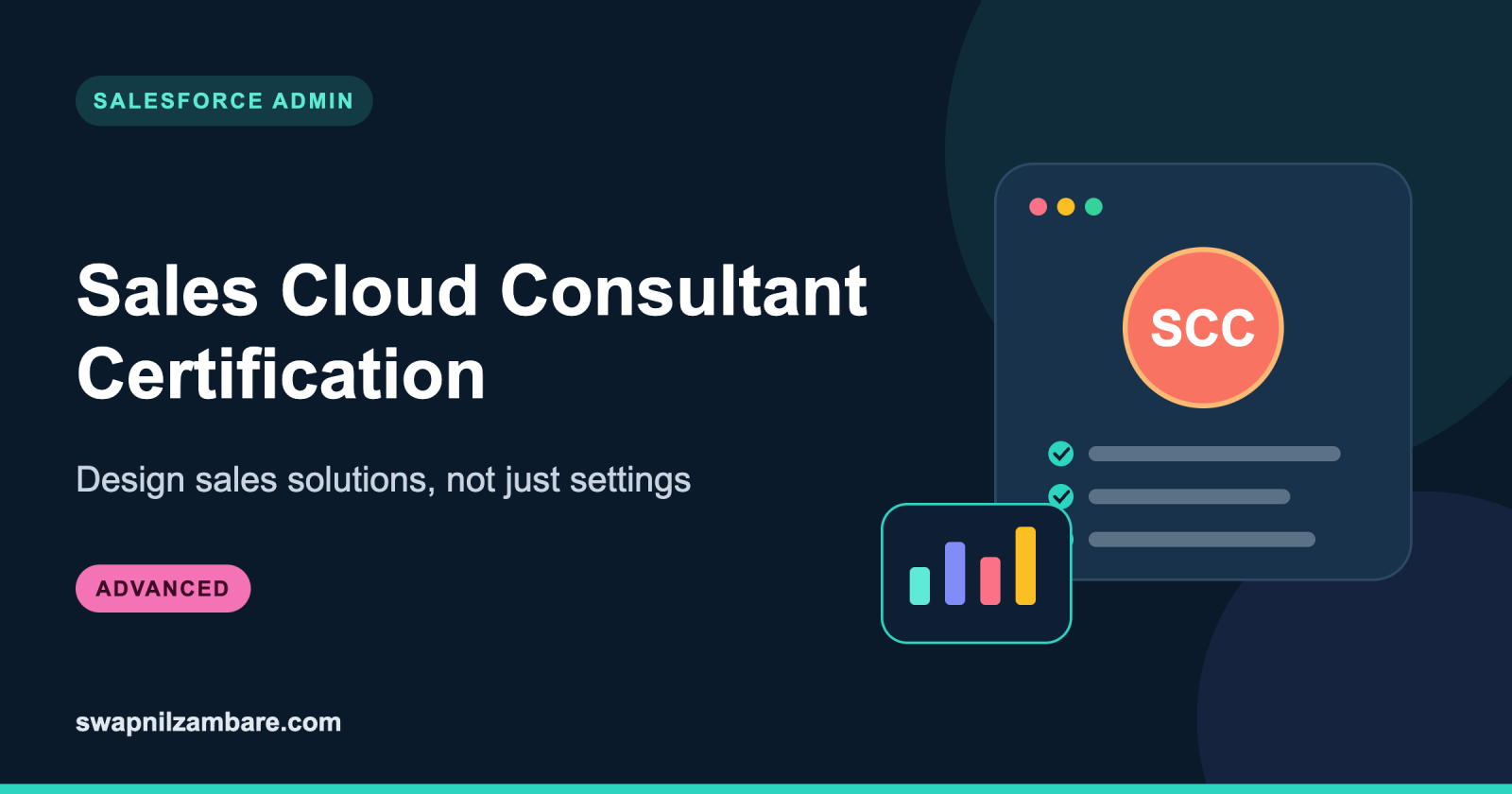
The Sales Cloud Consultant Certification tests whether you can design a sales solution for a client, not just configure a feature. Questions describe a business and ask what you would recommend. So the exam rewards people who understand sales processes as well as Salesforce.
This post builds on Opportunities and sales process, Collaborative Forecasting and Enterprise Territory Management. We will plan four weeks of study around real scenarios.
What is the Sales Cloud Consultant Certification?
The Sales Cloud Consultant Certification is for people who implement Sales Cloud for customers. It assumes you already hold the Administrator credential and know the platform. The exam covers discovery, sales process design, lead and opportunity management, products and quotes, forecasting, territories, reporting, data management and integrations. Exam format and weights can change, so read the current exam guide.
Think of a doctor who knows every medicine but must also diagnose. The Administrator exam tests the medicine cabinet. This exam tests the diagnosis and the treatment plan.
Why the Sales Cloud Consultant Certification Matters
Consulting roles pay for judgement, not clicks. A client may ask for territories when the real problem is poor lead routing.
So the Sales Cloud Consultant Certification proves you can find the real need and design for it. Also, it is a common requirement for consultant and senior admin roles.
How the Sales Cloud Consultant Certification Exam Is Structured
Most questions are long scenarios with a client situation and a business goal. Options often look similar, and the best answer balances the requirement, effort and scale. The main areas include implementation strategies, sales practices, lead and opportunity management, account and contact management, products and quotes, forecasting, sales productivity, reporting and data management.
Implementation Strategies
This covers discovery, phasing, stakeholder alignment and choosing a rollout approach.
Sales Practices
This covers how sales teams actually work, from prospecting to closing and renewals.
Lead and Opportunity Management
This covers web-to-lead, assignment, conversion, sales processes, stages and path.
Account, Contact and Products
This covers hierarchies, contact roles, price books, quotes and when CPQ fits better.
Forecasting and Territories
This covers forecast categories, collaborative forecasting, quotas and territory models.
Reporting and Data
This covers report types, dashboards, data migration, duplicates and data quality.
Sales Cloud Consultant Certification Topic Areas
Use this table to plan study time, then confirm weights in the official exam guide.
| Area | What it tests | Practice idea |
|---|---|---|
| Implementation strategy | Discovery and phasing | Write a phase plan for a client |
| Lead management | Routing and conversion | Design assignment rules |
| Opportunity management | Process and stages | Map stages to forecast categories |
| Products and quotes | Price books and quoting | Build a quote with two price books |
| Forecasting | Categories and quotas | Explain commit versus best case |
| Reporting and data | Reports and migration | Plan a data load order |
Administrator vs Sales Cloud Consultant
This table shows how the question style changes.
| Feature | Administrator | Sales Cloud Consultant |
|---|---|---|
| Question | How does it work? | What should the client do? |
| Scope | One setting | Whole process |
| Answer | Correct configuration | Best recommendation |
| Weight | Platform knowledge | Business judgement |
| Risk | Wrong setting | Wrong design |
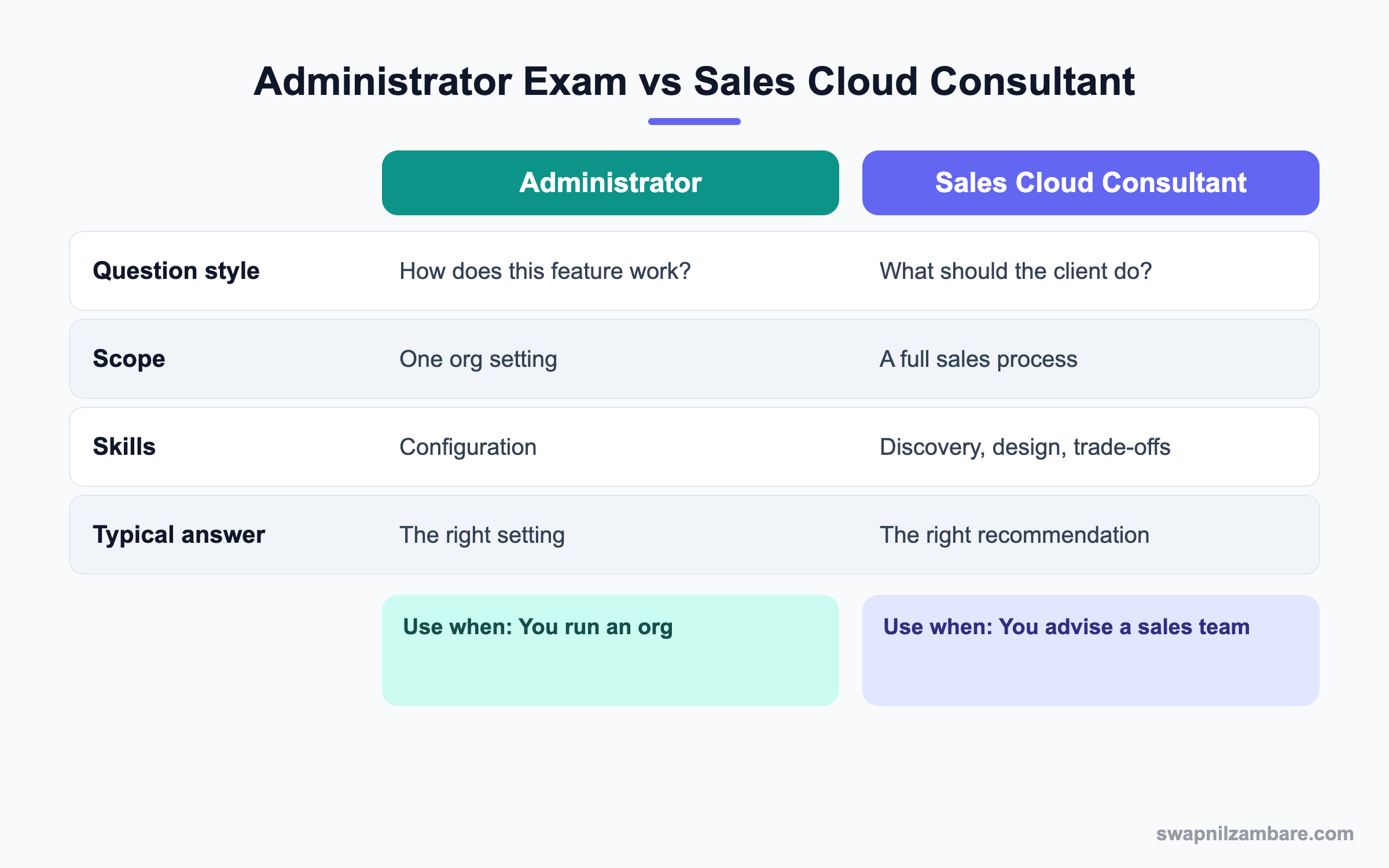
In short, the consultant exam asks you to choose, justify and sequence. So read every scenario for the business goal first.
A Real Four-Week Study Plan
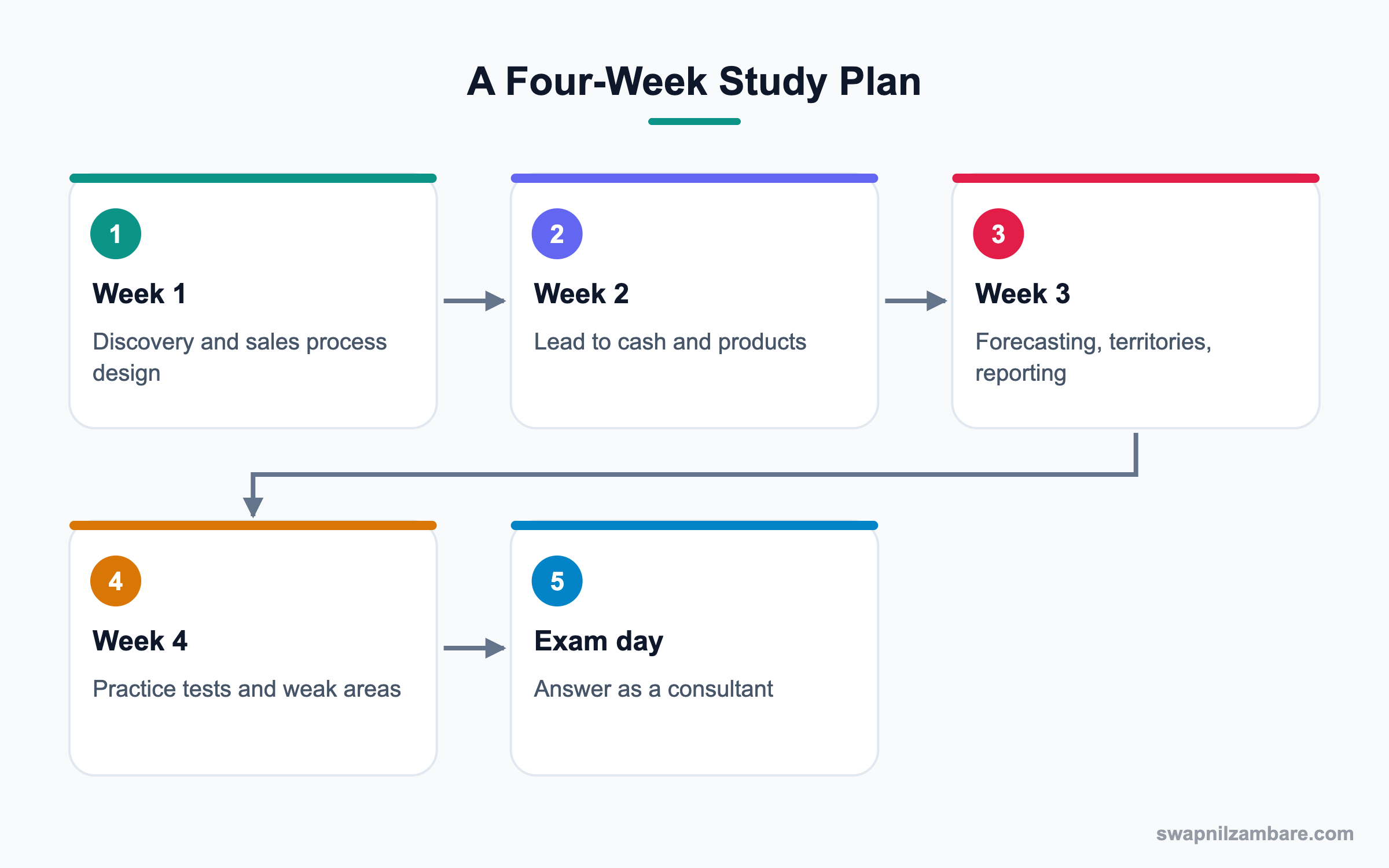
Ravi is a Salesforce admin with three years of experience and one hour a day.
Week 1: Discovery and Process
- Write discovery questions for a sales team you know.
- Map their current lead-to-close process.
- Design the target process with stages and exit criteria.
- List which Salesforce features support each step.
Week 2: Lead to Cash
- Build web-to-lead, assignment rules and conversion in a practice org.
- Create products, two price books and a quote.
- Add a quote approval process.
- Note where CPQ would be a better fit.
Week 3: Forecasting and Reporting
- Map stages to forecast categories and explain the logic.
- Turn on collaborative forecasting and set a quota.
- Build a territory model with two regions.
- Create a pipeline dashboard for a sales manager.
Week 4: Practice and Review
These steps matter most in the last week.
| Day | Task |
|---|---|
| 1 to 2 | Full practice test, then list weak areas |
| 3 to 4 | Redesign weak scenarios on paper |
| 5 | Second practice test |
| 6 | Re-read the exam guide |
| 7 | Light revision, then rest |
Sales Cloud Consultant Certification Exam Day Tips
- Read the last line of the scenario first, because it states the requirement.
- Eliminate answers that solve a different problem.
- Prefer declarative answers unless the scenario needs more.
- Watch for scale words like “global”, “thousands” or “multiple currencies”.
Common Mistakes with the Sales Cloud Consultant Certification
- Answering as an admin who configures instead of a consultant who advises.
- Skipping forecasting, which many candidates find hardest.
- Ignoring data migration and integration questions.
- Memorising features without understanding sales processes.
- Booking the exam without any full practice test.
Best Practices for the Sales Cloud Consultant Certification
- Study with real client scenarios, not feature lists.
- Explain each recommendation out loud with a reason.
- Build the hands-on parts in a practice org.
- Learn forecast categories until they feel obvious.
- Review the official exam guide at the start and end.
Practice Task
Design a sales process for a company you know, with five stages, exit criteria and forecast category mapping. Hint: every stage needs a clear definition of done.
Most Asked Sales Cloud Consultant Certification Questions
These Sales Cloud Consultant Certification questions come from candidates and consulting interviews.
Basic Sales Cloud Consultant Certification Questions
Q1: What does the Sales Cloud Consultant Certification test?
The Sales Cloud Consultant Certification tests designing Sales Cloud solutions for clients, covering discovery, sales processes, forecasting, reporting and data. So it focuses on recommendations rather than settings.
Q2: Do you need the Administrator certification first?
It is strongly recommended, because the exam assumes platform knowledge. So most candidates pass that exam first.
Q3: What is a sales process in Salesforce?
It is the set of stages an opportunity moves through, linked to a record type and page layout. Then each team can have its own stages.
Q4: What are forecast categories?
They group opportunities by confidence, such as Pipeline, Best Case, Commit and Closed. Because stages map to them, a wrong mapping breaks every forecast number.
Q5: What is lead conversion?
It means turning a qualified lead into an account, contact and optionally an opportunity. So the sales team then works the deal, not the lead.
Q6: What are price books used for?
They hold prices for products, so different customers or regions can have different prices. For example, a partner price book can sit beside the standard one.
Q7: Why do territories appear in this exam?
Because territory models decide account access and reporting for large sales teams.
Intermediate Sales Cloud Consultant Certification Questions
Q8: When would you recommend CPQ instead of standard quotes?
When pricing is complex, with bundles, discount rules, subscriptions or approvals beyond basic quoting.
Q9: How do you design stages that managers trust?
Give each stage clear exit criteria and map it carefully to a forecast category.
Q10: How do you improve lead routing?
Clean the data, define rules with the business, then use assignment rules or flows with queues.
Q11: What matters in a data migration plan?
Load order, external IDs, owner assignment, duplicate rules and a validation step after load.
Q12: How do you handle multiple currencies?
Turn on multi-currency carefully, set exchange rates and test reporting with the finance team.
Q13: How do you decide between roles and territories?
Roles cover reporting hierarchy and sharing, while territories handle account coverage for complex sales models.
Q14: What reports do sales managers usually need?
Pipeline by stage, forecast against quota, conversion rates, activity levels and deal slippage.
Advanced Sales Cloud Consultant Certification Questions
Q15: Scenario: a client wants every field required on opportunities. What do you advise?
Ask what decisions each field supports, then make only essential fields required at the right stage with validation rules.
Q16: Scenario: forecasts never match reality. What do you investigate?
Check stage definitions, forecast category mapping, data hygiene and whether managers adjust numbers without evidence.
Q17: How do you phase a large Sales Cloud rollout?
Start with core lead and opportunity management, then add forecasting, territories and advanced features in later phases.
Q18: Scenario: reps refuse to update Salesforce. What do you recommend?
Simplify pages, automate data capture, run management reviews from Salesforce and show reps what they gain.
Q19: How do you handle a client who asks for a custom object that duplicates Opportunity?
Explore the real requirement first, since standard objects bring forecasting and reporting that custom objects lack.
Q20: How does Agentforce fit a sales implementation?
AI agents can handle early outreach and summaries, while reps focus on qualified conversations. Design guardrails first.
Q21: What integration questions appear?
Common ones cover ERP order data, marketing platforms and email integration, plus who owns each field.
Q22: How do you measure a successful implementation?
Adoption, data quality, forecast accuracy and sales cycle time, compared with the baseline before go-live.
Q23: How long should you study for the Sales Cloud Consultant Certification?
Four to eight weeks suits most candidates with admin experience. However, real project work shortens it, because scenarios feel familiar.
Q24: Is the Sales Cloud Consultant Certification harder than the Administrator exam?
Most people find it harder, since answers depend on judgement. So practise explaining why one design beats another.
Q25: Can an in-house admin take this exam?
Yes. The skills help in any sales project, even without consulting clients. Then you design better processes for your own team.
Q26: What should you do after passing?
Lead one real sales process redesign and record the outcome. As a result, your credential has proof behind it.
Official Resources
- Salesforce Credentials: Sales Cloud Consultant
- Trailhead: Sales Cloud Basics
- Salesforce Help: Collaborative Forecasts
Quick Recap
- The Sales Cloud Consultant Certification tests design, not configuration.
- Scenarios ask what you would recommend to a client.
- Forecasting and stage design are heavily tested.
- Study with real sales processes and practice tests.
- Confirm the exam outline in the official guide.
What’s Next?
Next, we finish the admin series with the Service Cloud Consultant Certification.