The Business Analyst Certification tests whether you can find the real business need and turn it into clear requirements. It suits admins who already build well but want to lead discovery and design. So this guide covers the outline, a study plan and the questions candidates ask most.
This post builds on Business Analysis for Admins and the admin career roadmap. We will plan four weeks of study with real practice, not only reading.
What is the Business Analyst Certification?
The Salesforce Business Analyst Certification is a credential for people who gather, document and manage requirements on Salesforce projects. It covers customer discovery, collaboration with stakeholders, business process mapping, requirements, user stories and user acceptance testing. Exam format, question count and passing score can change, so check the official exam guide before you book.
Think of a builder and an architect. The builder lays bricks well. The architect asks who will live there and draws the plan. This certification is for the architect side of the work.
Why the Business Analyst Certification Matters
Most failed projects fail at requirements, not at build. A team may deliver exactly what was asked and still miss the real need.
So the Business Analyst Certification proves you can prevent that. Also, business analyst roles often pay more than junior admin roles, and the skills transfer to consultant work.
How the Business Analyst Certification Exam Is Structured
The exam uses scenario-based multiple-choice questions. Rather than testing clicks, it asks what a good analyst would do next. The main areas are customer discovery, collaboration with stakeholders, business process mapping, requirements, user stories and user acceptance testing.
Customer Discovery
This covers understanding the business, its goals, its processes and the Salesforce context.
Collaboration with Stakeholders
This covers running workshops, handling conflict, managing expectations and communicating clearly.
Business Process Mapping
This covers as-is and to-be maps, notation basics, and finding gaps and pain points.
Requirements
This covers gathering, documenting, prioritising and tracing requirements through delivery.
User Stories
This covers writing stories with acceptance criteria, splitting them and keeping them testable.
User Acceptance Testing
This covers planning UAT, writing test scripts, handling defects and getting sign-off.
Business Analyst Certification Topic Areas
Use this table to plan study time, then confirm the weights in the official exam guide.
| Area | What it tests | Practice idea |
|---|---|---|
| Customer discovery | Understanding the business | Interview a colleague about their work |
| Stakeholder collaboration | Workshops and communication | Run a 30-minute requirements session |
| Process mapping | As-is and to-be flows | Map a process you use weekly |
| Requirements | Documenting and prioritising | Write ten requirements with MoSCoW |
| User stories | Stories and acceptance criteria | Write five stories with Given, When, Then |
| User acceptance testing | Test plans and sign-off | Write a UAT script for one story |
Admin Mindset vs Business Analyst Mindset
Many admins lose marks by answering as a builder. This table shows the shift.
| Situation | Admin answer | Business analyst answer |
|---|---|---|
| New request | Create the field | Ask what decision it supports |
| Conflict | Build both options | Facilitate a decision with the owner |
| Unclear scope | Start building | Clarify and write acceptance criteria |
| Go-live | Deploy and move on | Plan UAT and training |
| Success | It works | The outcome improved |
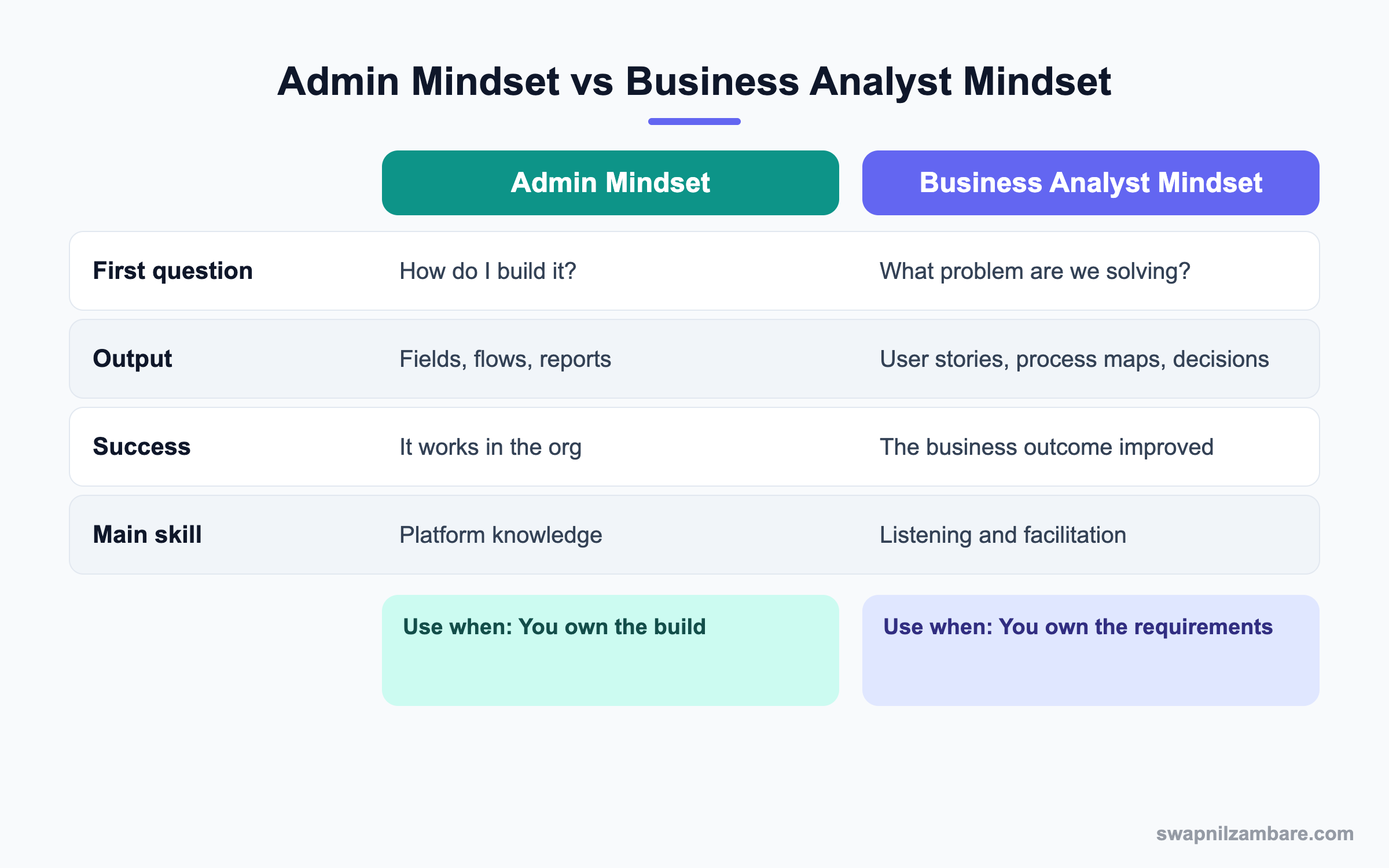
In short, the exam rewards clarifying before building. So answer as the person who owns the requirement, not the build.
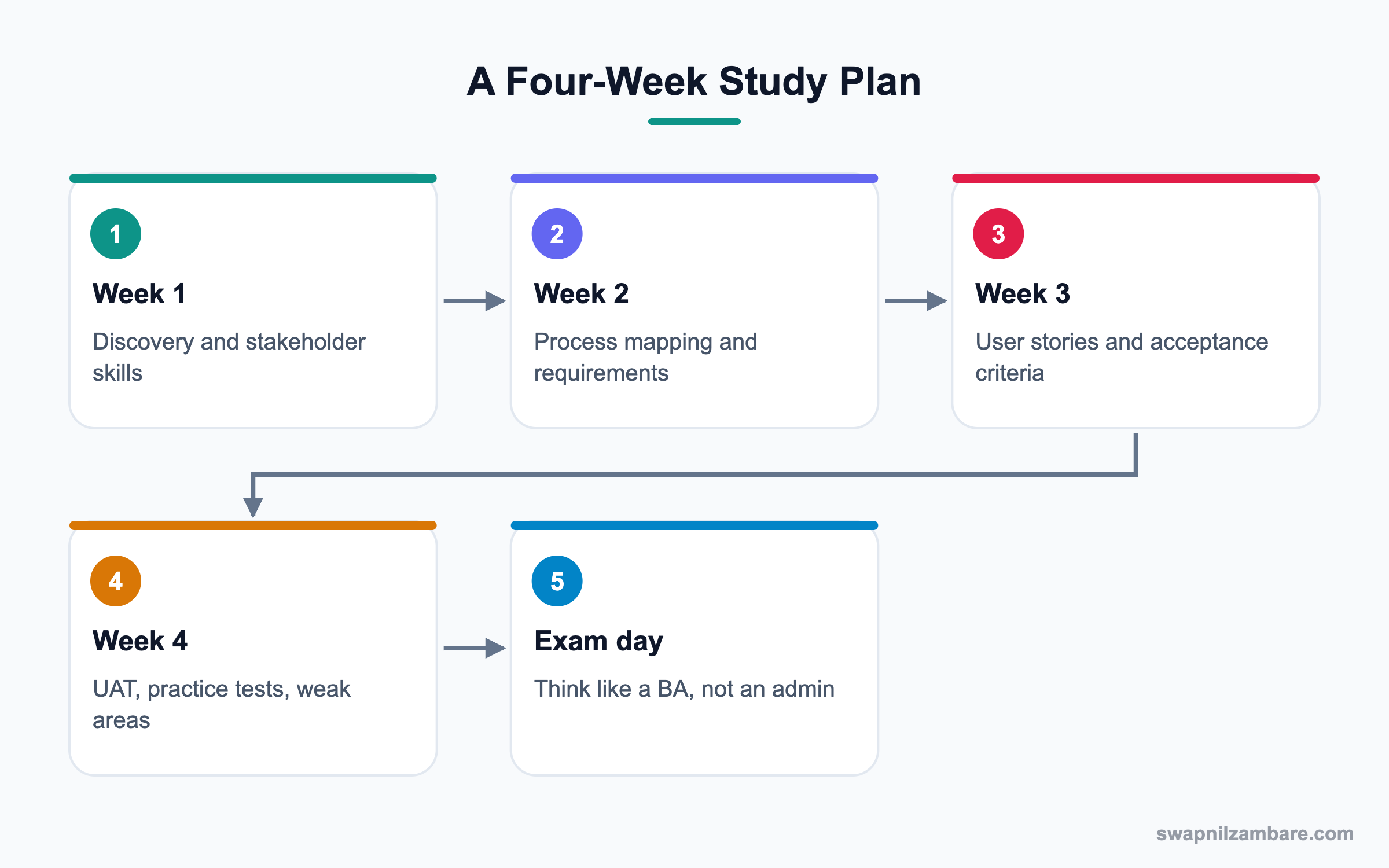
A Real Four-Week Study Plan
Asha is an admin with two years of experience and one hour a day to study.
Week 1: Discovery and Stakeholders
- Read the official exam guide and list every topic.
- Interview a colleague about a process they dislike.
- Write down their goals, pain points and success measures.
- Practise summarising the conversation in five bullets.
Week 2: Process Mapping and Requirements
- Draw an as-is map for that process.
- Mark pain points and the people involved.
- Draw a to-be map with Salesforce steps.
- Write ten requirements and prioritise them with MoSCoW.
Week 3: User Stories and UAT
- Turn the top five requirements into user stories.
- Add acceptance criteria in Given, When, Then form.
- Write a UAT script for two stories.
- Ask a colleague to run the script and record defects.
Week 4: Practice and Review
These steps matter most in the final week.
| Day | Task |
|---|---|
| 1 to 2 | Full practice test, then list weak areas |
| 3 to 4 | Redo weak topics with a real example |
| 5 | Second practice test |
| 6 | Re-read the exam guide and your notes |
| 7 | Light revision, then rest |
Business Analyst Certification Exam Day Tips
- Read the scenario before the options, because context decides the answer.
- Prefer answers that clarify, document or involve stakeholders.
- Be careful with answers that jump straight to building.
- Watch for words like “first”, “best” and “next”.
Common Mistakes with the Business Analyst Certification
- Answering every question as an admin who builds first.
- Skipping practice because the topics sound easy.
- Writing user stories without acceptance criteria.
- Ignoring UAT, which appears in many questions.
- Memorising definitions instead of practising scenarios.
Best Practices for the Business Analyst Certification
- Practise on real processes at work or in a community project.
- Write stories and criteria by hand, not only read examples.
- Learn one mapping notation well and use it often.
- Join a study group and discuss scenarios out loud.
- Re-read the exam guide in the last week.
Practice Task
Pick one process you know and write an as-is map, three requirements and two user stories with acceptance criteria. Hint: each story should fit in one sprint.
Most Asked Business Analyst Certification Questions
These Business Analyst Certification questions come from candidates and from interviews for BA roles.
Basic Business Analyst Certification Questions
Q1: What does the Business Analyst Certification test?
The Business Analyst Certification tests discovery, stakeholder collaboration, process mapping, requirements, user stories and user acceptance testing on Salesforce projects. So it checks how you think, not how you build.
Q2: Do you need to be an admin first?
It is not required, but platform knowledge helps. So many candidates pass the Administrator exam first.
Q3: Is the exam technical?
Not very. It focuses on process and requirements, although you need to know what Salesforce can do.
Q4: What is a user story?
It is a short need written as “As a role, I want something, so that benefit”. So it keeps the user and the value in view while the team builds.
Q5: What are acceptance criteria?
They are the conditions that prove a story is done, often written as Given, When, Then. Then testers and developers share one definition of finished.
Q6: What is UAT?
It is user acceptance testing, where business users test the solution against their real needs before go-live. As a result, surprises appear before launch, not after.
Q7: What is an as-is process map?
It is a picture of how work happens today, including problems and handoffs. Then the to-be map shows how it should work after the change.
Intermediate Business Analyst Certification Questions
Q8: How do you prioritise requirements?
Use a method like MoSCoW with the business owner, based on value and risk.
Q9: What is traceability?
Linking a requirement to its story, build and test, so nothing is lost between discovery and delivery.
Q10: How do you handle a stakeholder who wants everything now?
Show the impact of each option, agree priorities and record what moves to a later release.
Q11: How do you split a large user story?
Split by workflow step, data type, user role or rule, so each part delivers value and is testable.
Q12: What makes a good UAT script?
Clear steps, real test data, an expected result and a place to record pass or fail.
Q13: How do you document decisions?
Keep a decision log with date, decision, reason and owner, linked to the related stories.
Q14: What is the difference between a requirement and a solution?
A requirement says what is needed and why. A solution says how it will be built, which comes later.
Advanced Business Analyst Certification Questions
Q15: Scenario: users reject a feature during UAT. What do you do first?
Find out which requirement was misunderstood, not which button is wrong. Then update the story and retest.
Q16: Scenario: two departments define a term differently. How do you resolve it?
Facilitate one session, agree a single definition and record it in a shared glossary or data dictionary.
Q17: How do you keep stories small but valuable?
Each story should deliver something a user can do. So avoid technical-only stories that no user can test.
Q18: How does a BA work with an admin and a developer?
The BA owns the problem and requirements, while the admin and developer own the build. All three agree on acceptance criteria.
Q19: How do you measure BA success?
Fewer reworked stories, faster sign-off and improved business outcomes after release.
Q20: How do you run a good discovery workshop?
Set a clear goal, invite the people who do the work, use open questions and end with a written summary.
Q21: Why is UAT heavily tested in the exam?
Because it is where requirements are proven. So the exam checks that you plan it early, not at the last minute.
Q22: What should you do after passing?
Add it to your profile, then apply the skills on a real project. Experience plus the credential is what employers want.
Q23: Is the Business Analyst Certification useful without a BA job title?
Yes. Many admins use these skills every week when they gather requirements. So the credential helps even if your title stays the same.
Q24: How is the Business Analyst Certification different from the Administrator exam?
The Administrator exam tests org features and settings. However, this exam tests how you discover needs and write requirements.
Q25: How long should you study?
Four to six weeks suits most candidates with daily practice. Still, real project experience shortens it a lot.
Q26: Can you pass by reading only?
It is risky, because questions are scenario-based. So write real stories and run one small workshop before booking.
Official Resources
- Trailhead: Business Analyst Trail
- Salesforce Credentials: Business Analyst
- Trailhead: User Story Creation
Quick Recap
- The Business Analyst Certification tests requirements, not clicks.
- Discovery, mapping, stories and UAT are the core areas.
- Answer scenarios as an analyst, not as a builder.
- Practise on real processes and write stories by hand.
- Confirm the exam format in the official guide.
What’s Next?
Next, we cover AI skills with the Agentforce Specialist Certification.