An Agentforce Service Agent is an AI agent that answers customers on your website or app and can take actions in Salesforce. It can explain fees, check a course start date or create a case. When a question is too hard, it hands the chat to a human agent with the full history.
This post builds on Agentforce for Admins, Agent Builder and Enhanced Chat. We will set one up for the Bright Path Tutors parent help page.
What is an Agentforce Service Agent?
An Agentforce Service Agent is a ready-made agent type for customer service. You build it in Agent Builder from a template. It uses topics to understand what the customer wants, actions to do the work and instructions to follow your rules.
Think of a trained front-desk assistant with a rulebook. They answer common questions, look things up and call a senior colleague when needed. The AI agent works the same way, but on chat.
Why an Agentforce Service Agent Matters
Support teams get the same questions every day. Parents ask about fees, timings and refunds again and again. However, humans are expensive and offline at night.
So an Agentforce Service Agent handles routine questions instantly and around the clock. Then human agents spend time on complex cases. Also, every conversation is logged in Salesforce.
How an Agentforce Service Agent Works
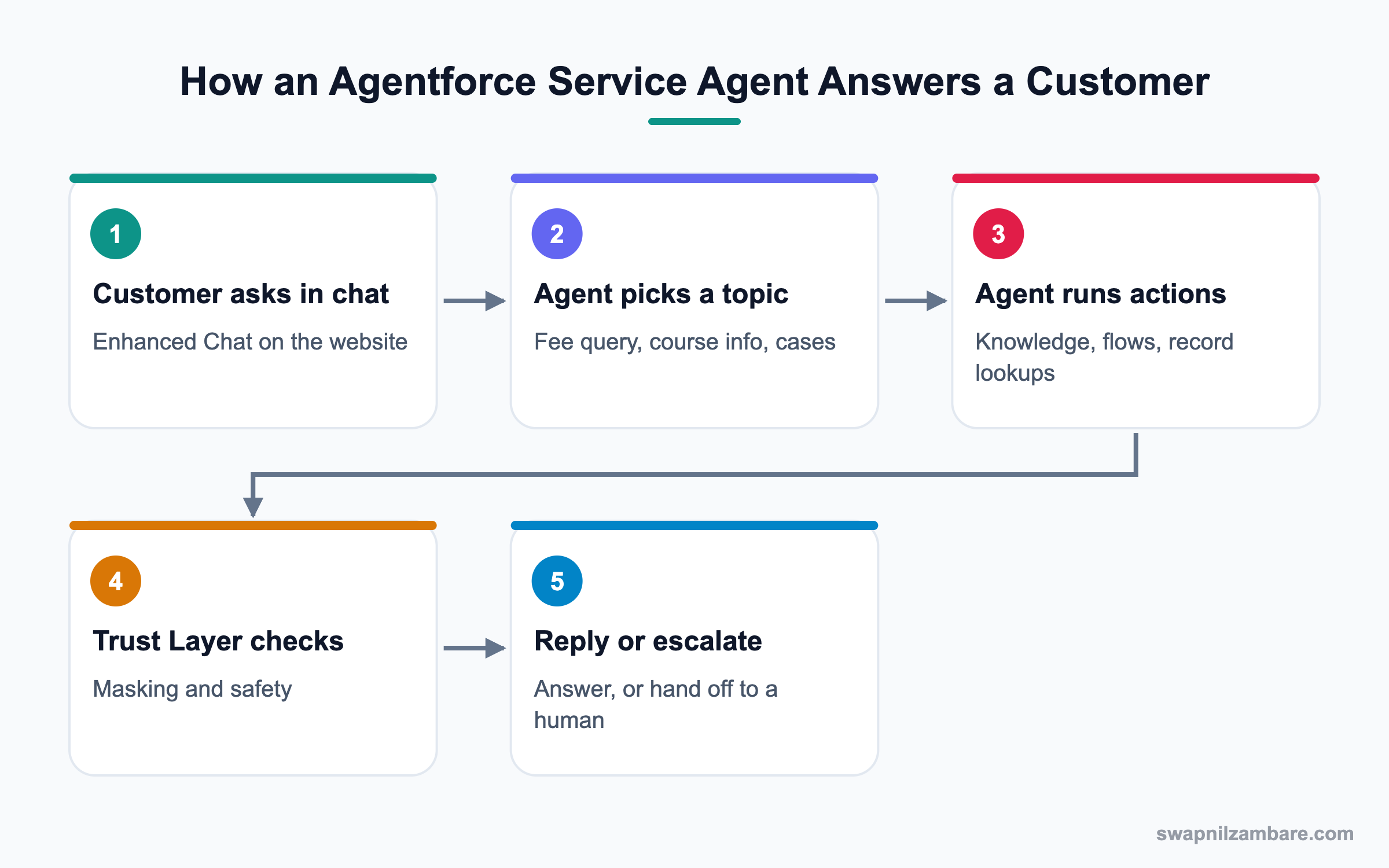
A customer types a question in chat. The agent’s reasoning engine picks the best topic. Then it runs actions, like searching Knowledge or running a flow. Before replying, the Einstein Trust Layer applies data protections.
Topics
A topic is a job the agent can do, such as Fee Questions. Each topic has a description and instructions.
Actions
Actions are the tools inside a topic. They can be standard actions, flows, Apex or prompt templates.
Instructions
Instructions are plain-language rules, like “Never promise a refund. Create a case instead.”
Knowledge Grounding
The agent answers from your Knowledge articles or a data library, so replies match approved content.
The Agent User
The agent runs as a special agent user. Its permissions decide what records it can read and change.
Channels and Escalation
You connect the agent to Enhanced Chat or other channels. An escalation route sends the chat to an Omni-Channel queue when needed.
Agentforce Service Agent Building Blocks
This table summarises each block.
| Block | Purpose | Bright Path example |
|---|---|---|
| Topic | A job to do | Fee Questions |
| Action | A tool | Get Enrolment Fee flow |
| Instruction | A rule | Ask for enrolment number first |
| Knowledge | Approved answers | Refund policy article |
| Agent user | Access control | Read Enrolment and Course |
| Channel | Where customers talk | Website chat |
| Escalation | Hand off to humans | Fees queue |
AI Service Agent vs Human Agent
The two work best together. This table compares them.
| Feature | Agentforce Service Agent | Human agent |
|---|---|---|
| Availability | 24 hours | Shift hours |
| Strength | Common questions | Complex cases |
| Speed | Instant | Queue-based |
| Cost per chat | Lower | Higher |
| Needs | Clean data and Knowledge | Training and tools |
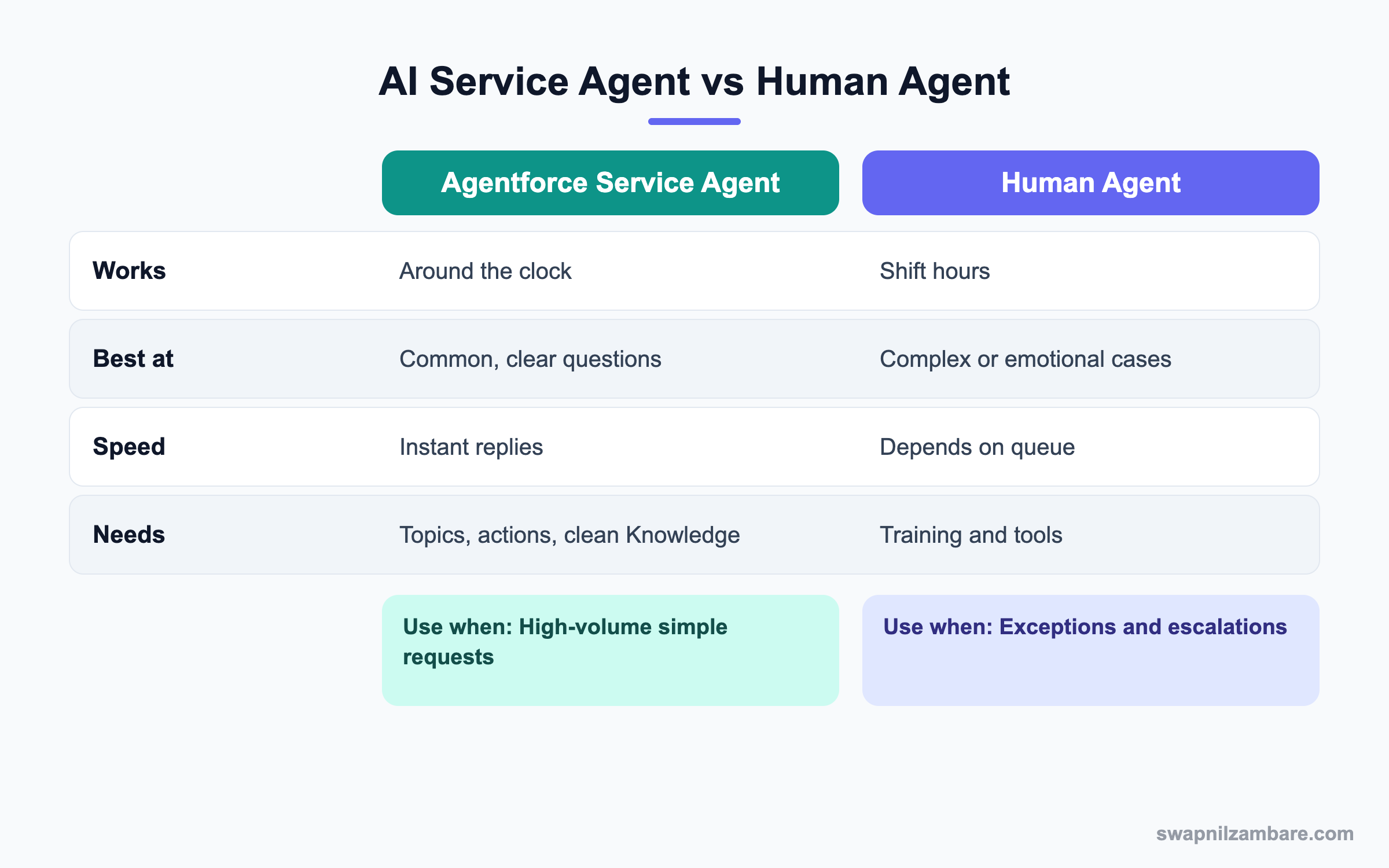
In short, let the AI agent handle simple, frequent requests. Route anything sensitive or unclear to people.
A Real Agentforce Service Agent Example
Bright Path Tutors wants an AI agent on its parent help page. It should answer course and fee questions, create cases and hand off refund requests to humans.
Step 1: Prepare
- Turn on Einstein and Agentforce in Setup, as your license allows.
- Publish clear Knowledge articles for fees, timings and refunds.
- Set up Enhanced Chat for the website.
- Create a Fees queue in Omni-Channel for escalations.
Step 2: Create the Agent
- Open Setup and go to Agents, then click New Agent.
- Choose the Agentforce Service Agent template.
- Name it Bright Path Helper and pick or create the agent user.
- Keep the standard topics you need and add custom ones.
Step 3: Add a Custom Topic and Action
These are the settings for the fee topic.
| Setting | Value |
|---|---|
| Topic | Fee Questions |
| Description | Questions about course fees and due dates |
| Action | Get Enrolment Fee (autolaunched flow) |
| Input | Enrolment number |
| Instruction | Always confirm the student name before sharing fees |
| Instruction | For refunds, create a case and escalate |
Step 4: Connect and Test
- In the agent’s Connections, add the Enhanced Chat channel.
- Set the escalation route to the Fees queue.
- Test in the Agent Builder preview with ten real questions.
- Run a batch of tests in the Testing Center, then activate.
Admins can review sessions later. This query lists recent chat sessions.
SELECT Name, Status, StartTime, EndTime
FROM MessagingSession
WHERE CreatedDate = LAST_N_DAYS:7
ORDER BY StartTime DESC
Common Mistakes with an Agentforce Service Agent
- Launching with poor or outdated Knowledge articles.
- Giving the agent user too much access.
- Writing vague topic descriptions, so the agent picks the wrong topic.
- Forgetting an escalation path.
- Skipping batch testing before activation.
Best Practices for an Agentforce Service Agent
- Start with three to five clear topics.
- Give the agent user least-privilege access.
- Write instructions as short, testable rules.
- Always offer a human handoff for sensitive requests.
- Review conversations weekly and improve topics and Knowledge.
Practice Task
Write three topics for a service agent in your org, each with a one-line description and two instructions. Hint: a good description says what the topic covers and what it does not.
Most Asked Agentforce Service Agent Interview Questions
These Agentforce Service Agent questions are now common in Service Cloud and AI admin interviews.
Basic Agentforce Service Agent Interview Questions
Q1: What is an Agentforce Service Agent?
It is an AI agent for customer service that answers questions and takes actions in Salesforce. It works on channels like web chat.
Q2: Where do you build it?
You build it in Agent Builder, starting from the Agentforce Service Agent template.
Q3: What is a topic?
A topic is a job the agent can handle, with a description, instructions and actions.
Q4: What is an action?
An action is a tool the agent uses, like a flow, Apex method, prompt template or standard action.
Q5: What are instructions?
They are plain-language rules that guide the agent’s behaviour within a topic.
Q6: How does the agent hand off to a human?
It hands off through an escalation route, usually an Omni-Channel queue connected to the messaging channel.
Q7: What is the agent user?
A Salesforce user the agent runs as. Its permissions limit what data the agent can see and change.
Intermediate Agentforce Service Agent Interview Questions
Q8: How does the agent choose a topic?
The reasoning engine compares the customer’s message with topic descriptions and picks the best match.
Q9: How do you ground answers in your content?
Use Knowledge articles or a data library with the answer questions action. So replies follow approved content.
Q10: What is the Einstein Trust Layer?
It is a set of protections for generative AI, like data masking, zero data retention with providers and toxicity checks.
Q11: How do you test an agent?
Use the Agent Builder preview for single tests and the Testing Center for batches of test cases.
Q12: Which channel is common for service agents?
The common choice is Enhanced Chat, also called Messaging for In-App and Web. Other channels are possible depending on setup.
Q13: Why keep topics few and clear?
Because overlapping topics confuse the reasoning engine. So clear scopes give better answers.
Q14: Can an agent create a case?
Yes. A standard or flow action can create a case with details from the chat.
Advanced Agentforce Service Agent Interview Questions
Q15: Scenario: the agent gives wrong fee answers. What do you check?
Check the Knowledge article, the flow action output and topic instructions. Then add test cases and retest.
Q16: How do you secure customer data with an AI agent?
Use a least-privilege agent user, verify the customer before sharing data and rely on the Trust Layer protections.
Q17: How do you measure success?
Track containment rate, escalation rate, customer satisfaction and wrong-answer reports.
Q18: Scenario: customers keep asking for a human. What does it mean?
The agent may lack topics or give poor answers. Review transcripts and add missing topics or Knowledge.
Q19: What licensing should you check?
Agentforce and Data Cloud entitlements, along with conversation or credit usage. Costs can grow with volume.
Q20: How do you roll out safely?
Start on one page or for a share of chats, monitor closely and expand as quality improves.
Q21: How do flows help agents?
Flows give agents reliable, tested steps, like looking up a fee. So the AI does not guess business logic.
Q22: Why verify the customer first?
Because the agent may share private data. So it should confirm identity before showing records.
Q23: What should never be fully automated?
For example, refund approvals, complaints about safety and legal issues. Route them to people.
Q24: How often should you update an agent?
Review weekly at launch, then monthly. Update topics when products or policies change.
Q25: What is containment rate for an Agentforce Service Agent?
It is the share of conversations the agent resolves without a human. However, a high rate only matters if customers are also satisfied.
Q26: Can one Agentforce Service Agent serve several brands?
It is usually cleaner to build one agent per brand or channel. So each has its own topics, tone and Knowledge.
Q27: What data does an Agentforce Service Agent need from Data Cloud?
It may use Data Cloud for grounding with data libraries and for some features. Check the setup guide for your release, because requirements change.
Q28: How do you write a good topic description?
Say what the topic covers and what it does not, in one or two sentences. For example, “Course fees and due dates, not refunds.”
Official Resources
- Salesforce Help: Agentforce Service Agent
- Trailhead: Agentforce Service Agent Basics
- Salesforce Help: Einstein Trust Layer
Quick Recap
- An Agentforce Service Agent answers customers and acts in Salesforce.
- Topics, actions and instructions shape its behaviour.
- Knowledge grounding keeps answers accurate.
- A least-privilege agent user and the Trust Layer protect data.
- Always provide a human escalation path and test before launch.
What’s Next?
Next, we add AI to the sales team with Agentforce Sales Agents.