Before you can understand platforms like Salesforce, AWS, or Google Cloud, you need to know the idea they are all built on. So, what is cloud computing? This beginner’s guide explains it in plain language. You do not need any technical background.
The Traditional Way: Life Before the Cloud
In the past, a company that wanted to run software had to do all of this itself:
- Buy physical servers.
- Keep them in a data center or server room.
- Hire IT staff to maintain, cool, secure, and upgrade them.
- Plan capacity years ahead and buy extra hardware “just in case.”
This was expensive and slow to scale. It was also wasteful, because most of that hardware sat idle most of the time.
What is Cloud Computing?
Cloud computing means getting computing services over the internet instead of running them on your own machines. These services include servers, storage, databases, networking, and software. A provider hosts and maintains everything for you.
In simple words, you rent access to hardware instead of owning it. You usually pay only for what you use. It works like your electricity bill: you pay for the power you consume, but you do not own a power plant.
You already use the cloud every day. When you open Gmail, watch Netflix, or log in to Salesforce from a browser, you are using cloud computing. The servers could be anywhere in the world, and you never need to know where.
Key Characteristics of Cloud Computing
- On-demand self-service: you can set up resources yourself, instantly, without calling anyone.
- Broad network access: you can use it from any device with an internet connection.
- Resource pooling: the provider serves many customers from shared hardware and assigns it as needed.
- Rapid elasticity: resources grow or shrink automatically based on demand.
- Measured service: you pay based on actual usage, such as storage, users, or compute time.
The Three Main Cloud Service Models
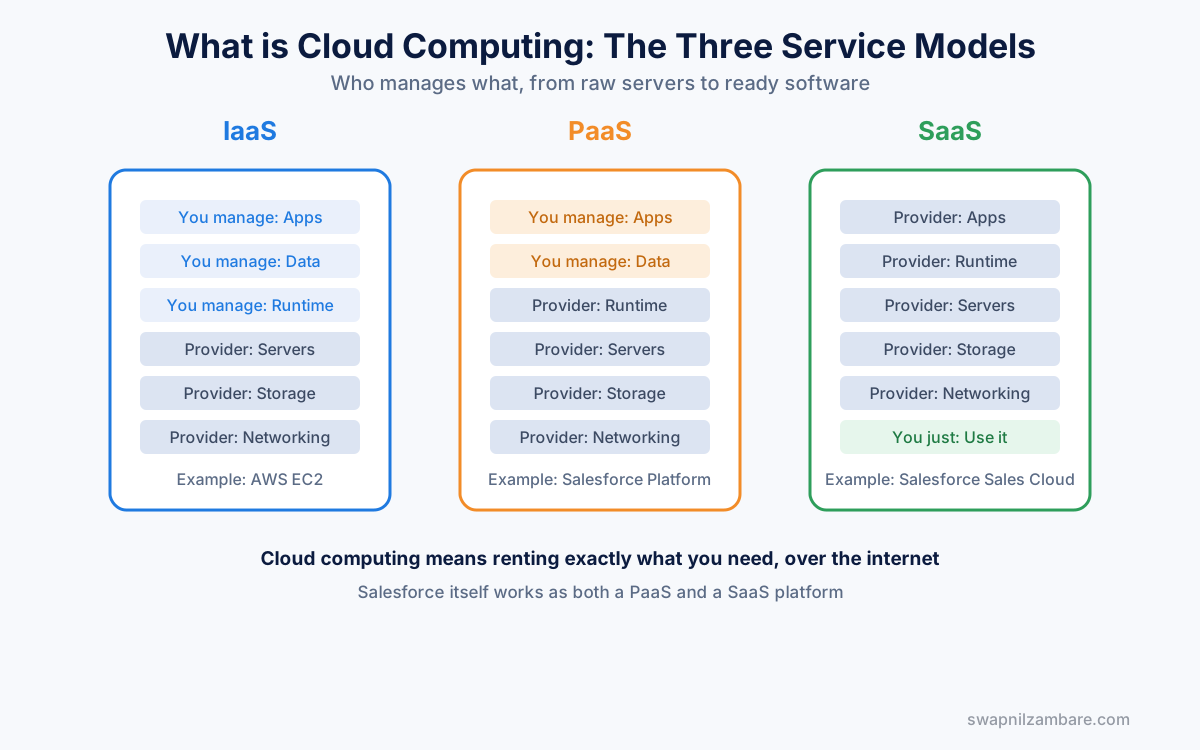
Cloud services come in three main types. The difference is how much of the system you manage yourself.
| Model | Full Name | What You Manage | What the Provider Manages | Example |
|---|---|---|---|---|
| IaaS | Infrastructure as a Service | OS, apps, data | Physical servers, networking, virtualization | AWS EC2, Microsoft Azure VMs |
| PaaS | Platform as a Service | Your apps and data | Infrastructure and runtime environment | Salesforce Platform, Heroku, Google App Engine |
| SaaS | Software as a Service | Just your data and usage | Everything: infrastructure, platform, and the app itself | Salesforce Sales Cloud, Gmail, Slack |
Think of it like getting dinner:
- IaaS is buying raw ingredients and cooking them yourself in a kitchen someone else built.
- PaaS is a meal kit. The ingredients are measured for you, and you just cook.
- SaaS is ordering a ready meal. You simply eat it.
Types of Cloud Deployment
- Public cloud: shared by many customers and managed by a third party, for example AWS or Salesforce.
- Private cloud: used by only one organization, for stricter control or compliance needs.
- Hybrid cloud: a mix of public and private. Companies use it when some work needs extra control and the rest does not.
Why Cloud Computing Matters for Your Career
Almost every modern software role runs on the cloud. This includes Salesforce, AWS, Azure, and DevOps jobs. Even when a platform hides the complexity, you are still working inside cloud computing every day.
Knowing these basics helps you understand why platforms behave the way they do. For example, Salesforce has automatic upgrades, needs no installation, charges per user, and scales on demand. All of this comes from the cloud model. So instead of memorizing steps, you will understand the reasons behind them.
Quick Recap
- Cloud computing means renting computing services over the internet instead of owning hardware.
- You pay only for what you use, and the provider handles maintenance.
- The three service models are IaaS, PaaS, and SaaS.
- Clouds can be public, private, or hybrid.
What’s Next?
Now you know what cloud computing is. In the next post, we look at What is Salesforce? A Simple Guide for Beginners, and see how Salesforce fits into this picture as both a PaaS and a SaaS platform.